

Wildfire skies: The future is hazy
From fire-hazed skies to flash floods, the planetary climate is changing all around us.

_(SVS5664_-_2026_07172026_1920x1080).png)
"Climate change will manifest as a series of disasters viewed through phones with footage that gets closer and closer to where you live until you're the one filming it."
—Twitter user @PerthshireMags, 2025
Those of us born before the digital era may remember the Magic 8-Ball.
The Magic 8-Ball is a fortunetelling toy for kids. It's a sphere that has a 20-sided die suspended within, with a different message on each side. You ask a yes-or-no question and shake it up, and the message that floats to visibility is supposedly your answer.
Sometimes the Magic 8-Ball answers definitively, and sometimes it's noncommittal, giving a vague message like "Reply hazy, try again later".
However, sometimes a hazy future is an answer in and of itself. We're living in one of those times.
Haze and heat
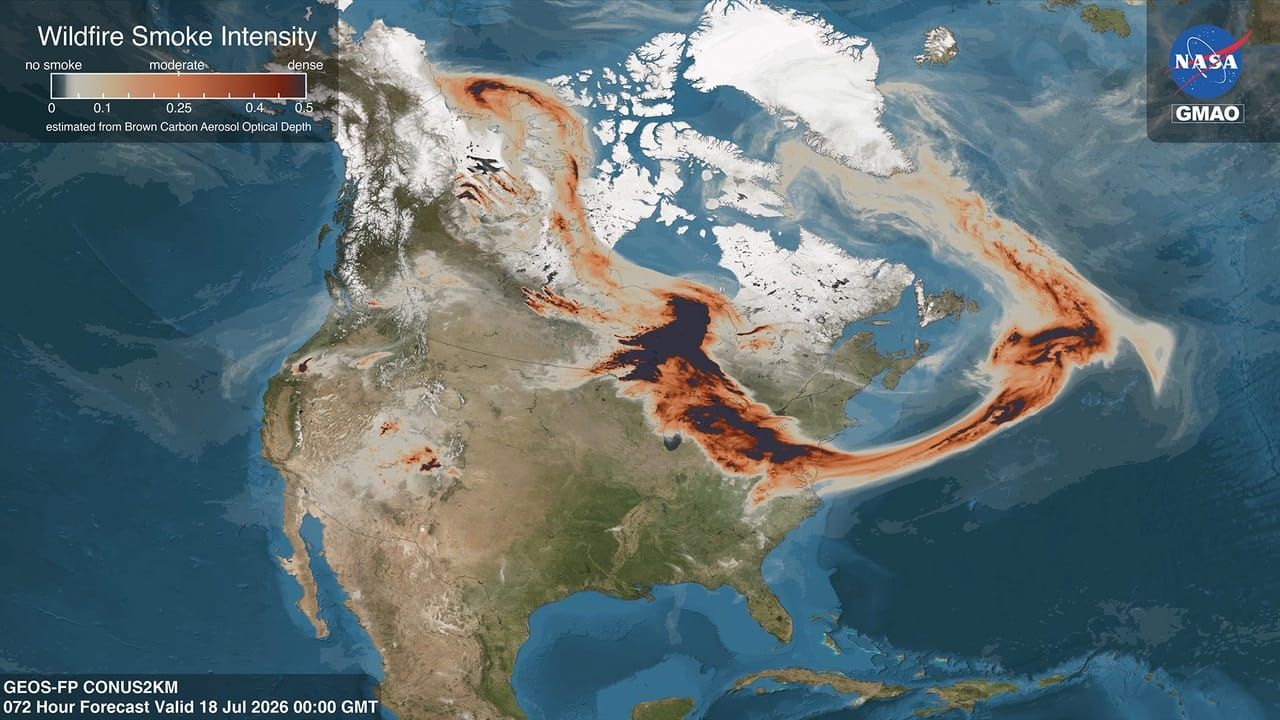
Earlier this month, millions of people living in the Northeast stepped out of their front doors to see the sky clouded with an eerie yellowish-gray haze. Once again, the cause was massive wildfires burning in remote regions of Canada, which sent up plumes of smoke that drifted for hundreds of miles. The smoke shrouded Toronto and Niagara Falls in murky orange, and blanketed cities from Boston and New York to Chicago and Detroit.
What makes it worse is that the smoke arrived at the same time that the Northeast was sweltering under a brutal heat wave. It was a dangerous double whammy for kids with asthma, the poor who lack access to air conditioning, and everyone else who suffers from the burdens of poor health and environmental racism.
The last time this happened was in 2023, when similar fires raging in Nova Scotia sent up thick dark clouds of smoke. At the time, New York City briefly had the worst air pollution in the world. 2023 was the worst smoke event in NYC history... and the second worst was 2026. What does it say that the two worst disasters of this kind on record happened within three years of each other?
These smoky summers are an ominous sign of a warming climate. Canada's boreal forests are becoming warmer and drier. That makes them more susceptible to huge fires like this one—or the one two years ago, when the world-famous resort town of Jasper burned in the worst fire in a hundred years. Some evidence suggests that the Jasper wildfire was so powerful, it spawned fire tornadoes.
First fire, then flood
But it's not only fire that climate change is bringing to our doorsteps. It's water, too.
The three days of heat and smoke that enveloped NYC were washed away by thunderstorms. But the storms brought more than relief: they dumped four inches of rain in just a few hours, overwhelming storm drains and sewers. Sudden flash floods swamped major highways and created rivers in subway stations and cataracts pouring through the ceilings of shopping malls. While no one died this time, people in basement apartments have drowned in similar flash floods in the past.
This, too, is the telltale fingerprint of climate change. More water evaporates from warmer oceans, and warmer air holds more moisture, giving rise to bigger storms that dump rain in greater volumes. NYC is suffering these flash floods more often than it used to. The kinds of events that once would have been considered 100-year storms are now hitting the city every few years.
The urban planners and engineers who built the city's storm drains didn't construct them to cope with this much rain this quickly—because, at the time, storms this big and powerful were so far outside the average, they were considered too unlikely to be worth worrying about. Now climate change is upsetting the table of those old assumptions.
This is weather whiplash playing out before our eyes. Global warming isn't altering the climate along a single dimension, making it hotter without any other side effects. Instead, it makes every kind of extreme weather more likely.
New York City isn't the only place suffering these disasters; far from it. Similar climate-change-driven catastrophes have been sweeping over every part of the nation, from the 2018 Camp Fire in California to 2024's Hurricane Helene in the American South to the deadly Texas floods of 2025.
For those who aren't wearing ideological blinders, these record-breaking fires and floods are like the Earth screaming at us. They're undeniable evidence that climate change isn't a distant future prospect, something we can leave for our descendants to worry about. It's a crisis of the present, and millions of people who contributed to causing it are suffering the consequences.
Cold comfort or clarion call
I've previously written about cutting off the tail of climate change: green energy is overtaking dirty fossil fuel so rapidly that the most extreme scenarios are off the table. But that doesn't mean the remaining scenarios that we're facing aren't also bad, just that they're not the worst ones possible. Obviously, that's cold comfort to people who suffer the brunt of them.
In the coming years and decades, there are going to be many more catastrophic fires and floods. That level of climate change is already locked in; it has too much momentum to stop now. We have to assume these disasters are the new normal, and design our cities, our buildings and our lifestyles to adapt to them.
But it should also be a clarion call to redouble our efforts toward the green transition. Every solar panel we install, every dirty coal plant we shut down, every pollution-belching car we take off the road is a contribution toward keeping this problem from getting any worse. It pays double dividends, both to us living in the here and now and to our descendants.
We got rid of smoking sections in restaurants and on planes because we recognize that it's wrong to be subjected to other people's air pollution against your will. Now we should apply that same logic on a planetary scale. No one should have to cough and choke on smoky air because of the selfishness and short-sightedness of fossil-fuel polluters.