

Cutting off the tail of climate change
We've avoided the worst-case scenario.

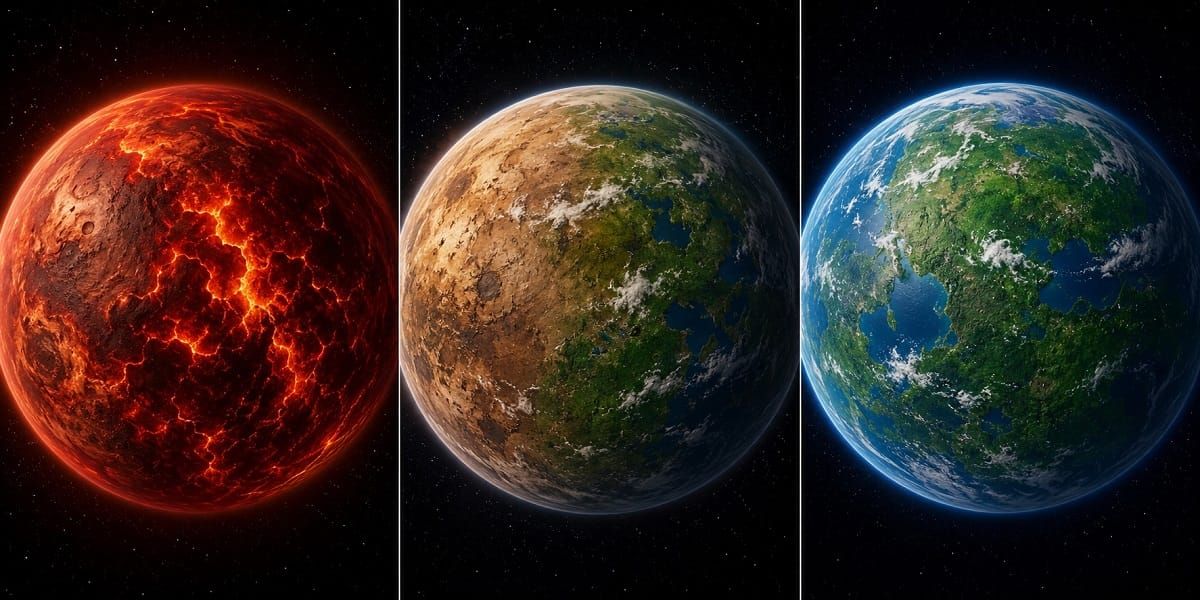
Here's the best news you'll read this year: RCP8.5 is dead.
If you don't know what that means or why it's such good news, that's understandable. But that bland, technical acronym concealed an apocalyptic scenario for humanity. The fact that it's no longer a future we need to fear is something the whole world should be celebrating.
Representative Concentration Pathways
RCP8.5 was created by the IPCC—the Intergovernmental Panel on Climate Change, the U.N. scientific body that studies and advises member nations on the causes and consequences of climate change.
In the IPCC's Fifth Assessment Report, scientists modeled a range of scenarios for what the year 2100 might be like, under different sets of assumptions about what amount of climate-warming greenhouse gases humanity would release into the atmosphere. These scenarios were dubbed the Representative Concentration Pathways, or RCPs for short.
The four original scenarios were RCP2.6, RCP4.5, RCP6, and RCP8.5. Those numbers don't correspond to atmospheric greenhouse-gas concentrations, but to changes in radiative forcing: essentially, a measure of how much we've changed the planet's energy balance.
The Earth receives energy from the Sun, of which it absorbs some and reflects or reemits the rest into space. Positive radiative forcing is caused by factors that tip the balance toward absorbing more and reflecting less, making the planet hotter. Obviously, the chief contributors to this are greenhouse gases like carbon dioxide and methane.
There's also negative radiative forcing, which comes from factors that cool the planet: for example, atmospheric sulfate aerosols that block sunlight. These aerosols are released by volcanic eruptions, but some people have proposed spraying them on purpose to counteract climate change.
The RCP numbers are given in watts per square meter, but they can also be expressed as degrees of warming. RCP8.5 represents planetary warming of roughly 4-5°C (7-9°F) relative to the preindustrial climate.
Of all the IPCC's projections, this is the worst-case scenario. It's what we would expect if fossil fuels, especially coal, remained the dominant energy source throughout the 21st century, and humanity's greenhouse gas emissions continued to rise with no attempt at mitigation.
What would that future look like?
Worst-case scenario
The RCP8.5 scenario represents 4°C or more of warming. As a reference point, this is roughly the same magnitude as the temperature difference between today and the last glacial maximum, when northern Europe and North America were buried under mile-thick ice sheets. Try to picture a future that's as much hotter than the present as the present is hotter than that.
Fortunately (or unfortunately), you don't need to use your imagination. Climate scientists have sketched a picture.
In a world with 4°C of warming, 4.7 billion people would be exposed to potentially lethal levels of heat over the course of the year. Summer temperatures in equatorial regions like the Middle East and North Africa could reach 60°C (140°F) on the hottest days. Southern Spain would become a desert. Cities like Karachi and Kolkata would become uninhabitable. As journalist David Wallace-Wells put it in a famous article: "At four degrees, the deadly European heat wave of 2003, which killed as many as 2,000 people a day, will be a normal summer."
Greenland and the Antarctic ice sheets would experience massive melting. Global sea levels could rise by as much as nineteen meters, inundating all the world's coastal cities. Around one billion people worldwide live within ten kilometers of the shore. Hundreds of millions of them would be forced to abandon their property and flee inland, becoming homeless climate refugees.
A 4°C world would suffer ecosystem collapses and catastrophic losses of biodiversity. As many as a third of vertebrate species would be at risk of extinction. Warming oceans would become so acidic that all coral reefs would die off. Drought and fire would destroy the Amazon rainforest, turning it into grassland.
Hotter weather would put plants under severe heat stress, causing widespread crop failures and famine. Some of the most productive farmland in the world would succumb to permanent drought. The forced displacement of tens of millions would supercharge anti-immigrant bigotry and spark societal collapses and wars. Between all these factors, the world's economic output could decline by 22%.
4°C is a nightmare scenario. That's why it should be a vast relief to hear that this isn't the path we're on.
RCP8.5 assumed that humanity would feed its fossil-fuel addiction unabated, continuing to increase consumption while making little or no effort to decarbonize. Obviously, that hasn't been the case.
Over the past decade, renewable energy deployments have been skyrocketing, while prices for solar, wind and battery power have been plummeting. The green revolution is solidly underway. As a result, climate scientists now believe RCP8.5 is off the table as a plausible future:
In a paper published in Geoscientific Model Development, Detlef van Vuuren and more than 40 co-authors eliminated RCP 8.5 from the scenarios that will feed into the Intergovernmental Panel on Climate Change's (IPCC) Seventh Assessment Report, which is due in 2029. Based on falling clean-energy costs, climate policy, and recent emissions trends, the highest-emissions pathway had become, in their words, "implausible."
Narrowing the range of outcomes
That's the good news. Now here's the bad news.
While we've successfully avoided the worst-case scenario for climate change, we've also missed the best case. Thanks to anti-science ideologues, petrostate intransigence, and lobbyists backed by fossil-fuel dollars, the world dragged its feet too long to catch up now:
The new scenarios have no pathway as optimistic as the lowest emissions scenario from the last round of major climate projections. That scenario—SSP1-1.9—envisaged strong climate action and rapid cuts to emissions, leading to global warming peaking at around 1.5°C.
Because global emissions haven't yet begun to fall, the most optimistic new pathway would lead to warming peaking at about 1.9°C.
Obviously, this is bad for the world. While 2°C of warming isn't as apocalyptic as 4° would be, it's still going to create widespread disruption to civilization: coastal flooding, inland drought, more frequent and dangerous heat waves, shifting weather patterns disrupting agriculture, resource shortages and migrations.
At present, there's no plausible future scenario that avoids this. But everything we can do to speed the green transition will make the future less bad than it would otherwise have been. We've steered away from the worst case, but that's no reason to declare victory. Now we need to see if we can cut off the next worst scenario that's still possible.