

Who comforts the secular?
Hospitals still carry embedded religious assumptions, even as more people than ever are nonbelievers.
Hospitals today are more technologically advanced than ever. In the southern United States, where I live, you can have a remote doctor check-in during your ER visit, undergo an AI-assisted scan, and have robot-assisted surgery.
You’re also likely to be asked if you want to speak with a chaplain.
Hospitals are technologically modern but religiously ancient, having evolved from earlier religious and charitable healing traditions, including the healing temples of Asclepius in ancient Greece and later Christian institutions.
Even in the 21st century, many hospitals offer religious services. According to ResearchGate, 75 percent of general hospitals and 73 percent of specialty hospitals employed chaplains in 2016.
Many smaller hospitals have volunteer chaplains, and even secular hospitals often have non-denominational chapels or meditative spaces.
But the Pew Research Center found that in 2023-24, 29 percent of people in the United States identify as unaffiliated with any religion.
Anyone in a hospital should have access to the type of comfort and support they need and want, regardless of their religious beliefs.
When religion is pushed on patients
As an atheist who spends a lot of time in hospitals, I’ve had religion forced on me twice, even after indicating no religious preference.
On the first occasion, a chaplain visited me in my room during a neurological event.
I explained that I’m not religious.
She apologized, asked if I needed anything, adjusted my thermostat, and left.
This was obviously a mistake by the hospital and I accepted her apology.
Last year, however, an anesthesiologist put a nerve block in my shoulder before a surgery. Then he laid hands on me, prayed, and walked away.
The key difference here is respect, represented by consent.
Hospitals understand something important that secular culture sometimes forgets: sick people do not merely need treatment. They need reassurance, ritual, orientation, and comfort.
Religion has historically filled that role.
But as the number of nonreligious Americans grows, hospitals are entering an awkward transitional period. The technology has modernized faster than the emotional architecture surrounding it.
One option many people don’t immediately think of is a secular chaplain. The idea of non-religious chaplains is relatively new, and they aren’t available everywhere, but some people are drawn to the idea of talking with someone who shares their moral beliefs and can offer support and care as a professional. If this appeals to you, the Humanist Society maintains a directory of humanist chaplains.
For some people, this kind of connection is exactly what they want and need. These chaplains are becoming more common, and more unaffiliated patients will have this access.
It’s good that these nonreligious chaplains are available, but they are only one element of care and comfort for secular patients.
The truth is, what comforts nonreligious people is the same thing that comforts religious people: whatever helps them feel less alone, less frightened, and more human in moments of vulnerability.
This could be a personal connection in the form of a secular chaplain, a counselor, a support network, or a close friend or family member.
Secular people have caring rituals too
Nonreligious people often build their own forms of ritual, even if they don’t use that word for it. Some rely on routines, data tracking, music, mindfulness, therapy, or online support communities. Others create small systems of control and comfort around medical experiences: the same playlist before every MRI, the same lucky sweatshirt for chemotherapy, the same text message sent before surgery.
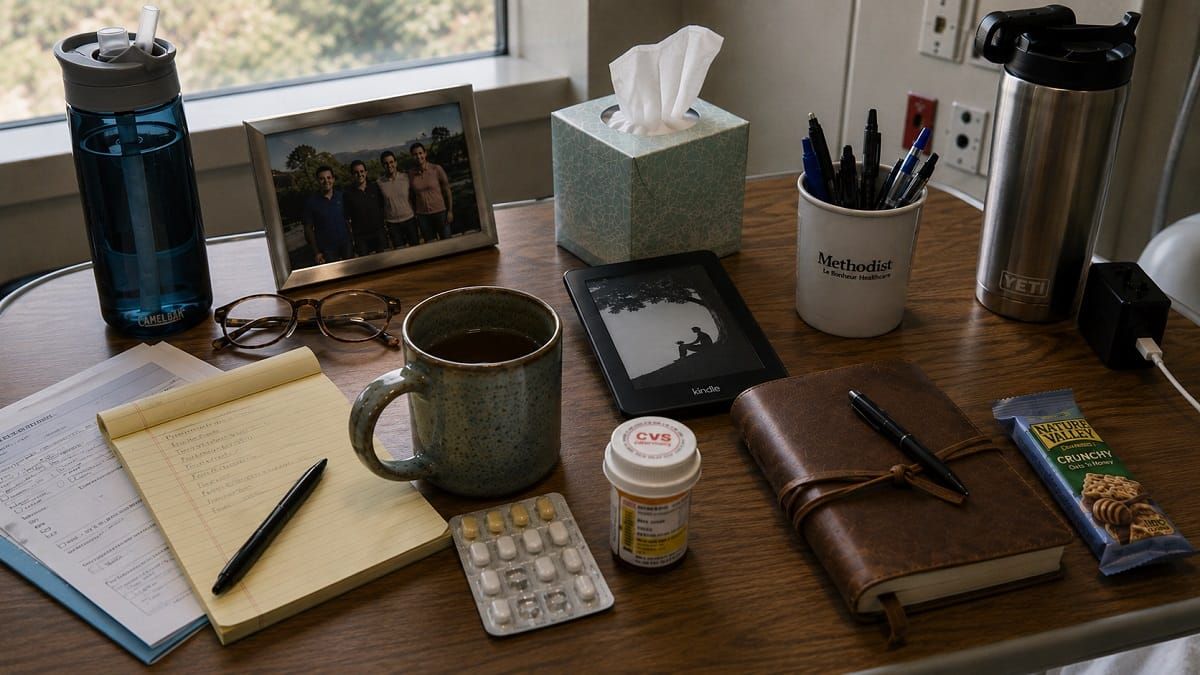
Before medical procedures, I don’t pray. I check my health tracking apps, charge my earbuds, and decide what music I want with me. I text people I trust. I build small systems that help me feel oriented and calm. These rituals are secular, but they are still rituals.
What makes these rituals work is that they’re mine, and they bring me comfort whether I’m having a minor procedure, an outpatient surgery, or a more major surgical procedure.
I also have rituals I observe during hospital stays. I keep the same basic framework, but add daily visits from my husband, ongoing chat threads with my best friend, my fuzzy blue blanket from home, favorite soft drinks and snacks if allowed, and entertainment to relieve the boredom, including music, reading, and television.
There’s one more thing I do when I’m in a medical setting, whether I’m getting an injection, having a procedure, or recovering from an illness.
I try to form a connection with everyone who takes care of me. I learn names. I ask how long they’ve been in health care. I ask about pets, because that’s not too personal and people love to talk about their pets.
I do this partly because I’m genuinely interested in people. I love hearing about their pets and seeing photos on their phones.
But it also helps me emotionally. Focusing on someone else for a few minutes gives me distance from my own fear, pain, or boredom.
I sometimes joke, “I want to be really nice to people who stick needles in me,” but I joke a lot and make it clear that humor is a big part of my communication style.
As American society becomes less religious, hospitals and healthcare systems will likely continue adapting. Some may expand access to secular chaplains or counselors trained in existential care without religious framing. Others may rethink how they provide emotional support altogether. The challenge is not removing comfort from hospitals. It is recognizing that comfort is no longer one-size-fits-all.
Hospitals have learned how to modernize medicine. Now they need to learn how to modernize comfort.