

How close are we to space tourism?
We might be vacationing beyond Earth by 2050.

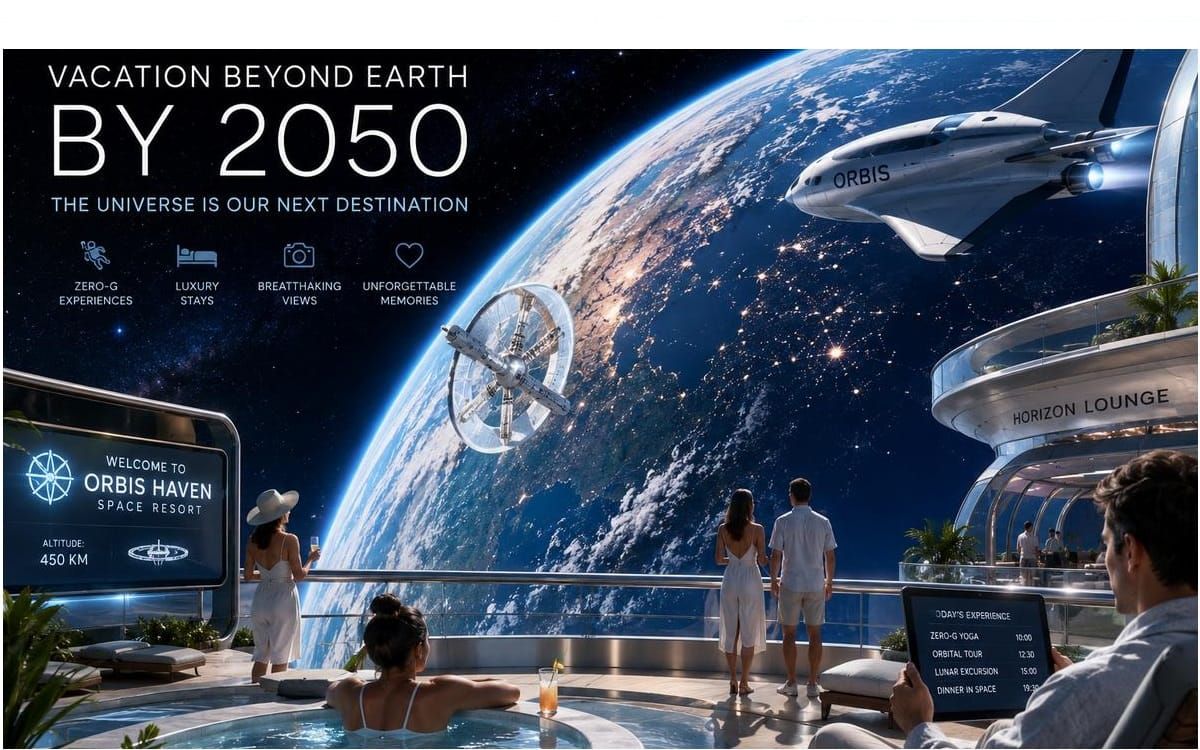
Those of us who are interested in space exploration are justifiably curious and excited about what the future will bring. The successful Artemis II mission and the upcoming Artemis III are keeping hopes and expectations at a simmer.
The next twenty-five years will be a crucial period, as technological innovation makes space travel easier, safer and more affordable. Before long, space travel will no longer be the sole domain of wealthy governments and aerospace conglomerates. It will become a bucket-list experience for private thrill-seekers, adventurers and lovers of the cosmos. In fact, space tourism for the masses may be coming sooner than you expect.
From rarity to routine
For the ultra-rich who are willing to spend millions of dollars, private space travel is already possible. Celebrities from Stephen Hawking to William Shatner have participated in space tourism experiences ranging from zero-G flight to suborbital travel. The real question is how long it will be before this experience might plausibly be within the reach of ordinary people.
Reusable rockets, such as SpaceX's Starship, have the potential to cut launch prices dramatically as soon as the 2030s. This will potentially open up tourism to the well-off who are willing to pay for an outworldly experience. SpaceX has promised at least five private missions per year starting in 2027.
Other companies offering suborbital and orbital flights, with an eye to both commercial launches and tourist applications, are Jeff Bezos’ Blue Origin and Richard Branson’s Virgin Galactic.
If this technology follows the curve of other innovations, it will become cheaper over time as other companies enter the market and competition drives prices down. By the 2040s, there may be multiple businesses offering space travel experiences. Mass production of reusable rockets could reduce ticket prices further. In the long run, it's reasonable to expect that space tourism will follow the same trajectory as air travel: first a risky experiment, then a luxury for the wealthy, then a routine and reliable experience.
Space stations evolve into space hotels
So far, living in space for any length of time is an even rarer and more exclusive experience than merely visiting. But private entities are competing to change that as well.
American aerospace company Vast Space is planning to launch Haven-1, the world’s first commercial space station, atop a SpaceX Falcon 9 in the first quarter of 2027. The station will have a capacity of four people, and will host private astronauts and commercial research missions. It features a scientific lab for research in microgravity and a dome observation window. Vast is also already developing Haven-2. Another company with the goal of building a commercial space station is Axiom Space.
Even more ambitiously, the Voyager Station (not to be confused with Voyager’s Starlab Space Station) is a blueprint for the world’s first space hotel. The plan is for a rotating ring, providing artificial gravity while spinning around the Earth, large enough to accommodate up to 400 guests and 100 crew members. Planned amenities include restaurants, bars, a gym, an activity module, and a cinema. The accommodation will consist of luxury villas for purchase or rent, and smaller suites for three-day or month-long stays.
READ: Artemis II brings us one step closer to a Moon base, future missions to Mars
By 2050, space hotels like these could offer long stays in orbit with spectacular views of Earth. Companies already striving to enter this market include Above: Space Development Corporation (formerly Orbital Assembly), Axiom Space, Voyager Technologies, and SpaceX. China is also chasing the space tourism market, with Chinese companies such as Deep Blue Aerospace and CAS Space announcing they plan to sell tickets as soon as 2027 or 2028.
The Moon is an attractive destination, too. SpaceX and Japanese billionaire Yusaku Maezawa partnered on the DearMoon project, which aimed to fly eight to ten private passengers around the Moon, marking the start of commercial lunar travel. While this project was later canceled, it surely won't be the last attempt. Investors and entrepreneurs will keep an eye on these developments; the space tourism industry is expected to reach a valuation of $10 to 15 billion by 2030.
As humanity expands beyond low Earth orbit, the space economy will grow along with it. Tourism might one day extend to trips in lunar orbit, hotels in pressurized domes on the lunar surface, lunar surface excursions, or space "cruise ships" that visit asteroid habitats and mining stations.
The space vacation experience
The spartan environments and tightly planned schedules of modern space travel might suffice for astronauts, but paying tourists will expect a luxury experience.
A true space vacation will require a good hotel where guests can enjoy the most amazing view in the cosmos while sipping a space-themed cocktail such as a Nebula Martini, a Moonwalk, a Cosmonaut, or a Galaxy mocktail for those who prefer non-alcoholic drinks. This scenario will soon become reality for the ones who can afford it, with prices dropping in subsequent years to reach more customers as the facilities improve and can host more guests.
Despite the prospect of space travel benefiting science and health research, there are unresolved questions of safety and environmental sustainability. Projections anticipate high carbon emissions, as much as a hundred times greater per passenger than long-haul flights, as noted by Annette Toivonen in her paper New Space Tourism Sustainability as an Evolving Concept.
What can you do with ten minutes in space?
I followed the launch and successful return to Earth of Blue Origin flight NS-38 earlier this year. It lasted approximately ten minutes, which was shorter than my time in the shower.
What can you do with ten minutes in space? Pretty much nothing. Look at the Earth from above, take a selfie with your fellow passengers to post on social media as soon as you land, and boast that you went on a space holiday that cost a small fortune. I don’t think it was worth it.
However, this is still a preliminary phase. Jeff Bezos wants to push forward with reliable, suborbital space tourism with weekly flights by the end of this year. Bezos needs to keep Blue Origin moving because he has competition. There is Richard Branson’s Virgin Galactic in the United Kingdom and others entertaining the space tourism market as well.
I would love to experience proper space travel, a three-day or a week-long vacation in a space resort. That will be possible in the future, without a doubt. However, I don’t think it will become affordable in my lifetime. If space travel advances fast enough, there's a chance that I might be able to experience it at least once. If not, most likely my nephew will. Until then, as the astronomers in the ancient world would say while looking up to the sky: Ad astra!