

Do we actually want human-centered healthcare?
We should leave the human aspects of healthcare to humans, and let AI handle the rest.
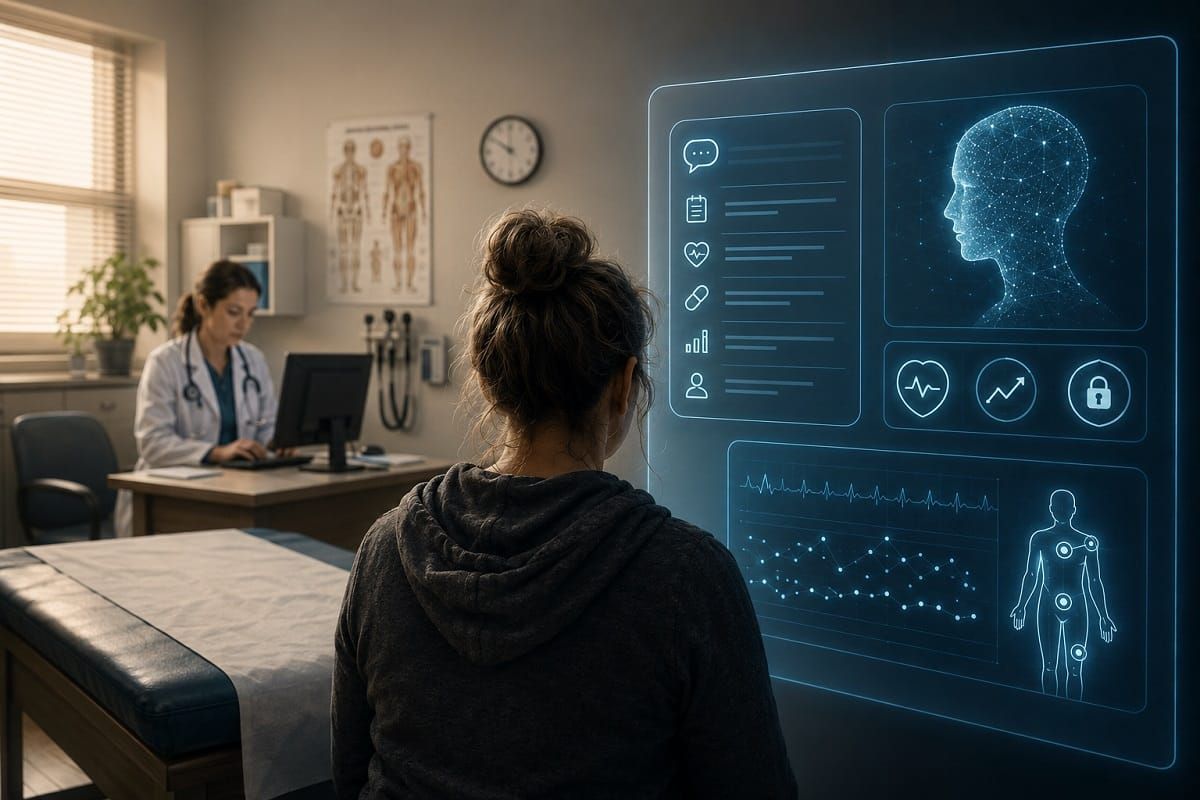
"Human-centered healthcare" sounds like an uncontroversial goal. Who could possibly object to that?
I understand the appeal. Medicine should be compassionate. Patients should feel heard. No one wants healthcare to become cold or mechanical.
But every time I hear that phrase, I find myself asking a different question: Which humans?
The human part isn't always the best part
I'm disabled. Over the past eight years I've accumulated a collection of specialists, surgeons, physical therapists, nurses, physician assistants, emergency room doctors, and imaging technicians. Some have been extraordinary. They changed my life. Others left me feeling invisible.
The hardest part of healthcare has rarely been the MRI machine, the blood draw, or even the surgery itself. It's often the conversation.
Patients are expected to summarize years of complex medical history in a fifteen-minute appointment. We repeat the same information over and over because records don't always follow us. We learn which details to emphasize and which to save for later because we know time is running out. Many of us quietly wonder whether we're sounding believable enough.
A few weeks ago, I went to the emergency room by ambulance after I became suddenly lightheaded in my doctor’s office and stayed that way for about thirty minutes. Once I arrived at the ER, I had about two minutes to explain eight years of medical history.
It turned out my vagus nerve had overreacted and caused my blood pressure to crash. Once they got my blood pressure back up, I was fine.
But the experience still felt dehumanizing.
Performing suffering
Healthcare doesn't simply ask us to describe our symptoms. It asks us to perform them.
People with chronic illnesses know this performance well. How much pain are you in? Is it sharp or dull? Constant or intermittent? Better than last week? Worse than yesterday? Have you tried physical therapy? Are you still taking that medication? How has it affected your daily activities?
These are reasonable questions. But after months or years of appointments, answering them becomes its own kind of labor.
Patients with invisible disabilities often face another challenge: proving they really are sick.
If you're too emotional, you risk being dismissed as anxious. If you're too calm, doctors decide your pain must not be that bad.
If you know too much about your condition, you're accused of diagnosing yourself on the internet. If you know too little, you aren't providing enough useful information.
Somewhere between those extremes is an invisible standard that patients are somehow expected to discover.
I’m fortunate to now see one provider for most of my pain management. She listens, remembers what I tell her, and genuinely seems to care about my well-being. As a result, I don't have to convince her that I'm in pain. We can skip the performance. In my experience, doctors like that are rare.
Autism makes this even stranger
On top of this, autistic patients may experience an additional layer of difficulty.
Many of us answer questions literally. If a doctor asks, "How have you been?" my brain immediately wants clarification. Compared to yesterday? Compared to before my spinal injury? Compared to my average week? Compared to the average person?
I also spend energy translating my natural communication style into something that feels more conversational. I rehearse appointments in advance. I try to remember which information belongs together. I wonder whether I'm making enough eye contact while simultaneously trying to remember what I wanted to say.
By the time the appointment is over, I sometimes need a nap—not because of the examination, but because of the conversation.
Enter AI
This is one reason I'm fascinated by the possibility of artificial intelligence becoming part of healthcare.
It's not because I want AI to replace doctors. I don't. I want doctors spending more time doing the things humans are uniquely good at: explaining difficult decisions, exercising judgment, recognizing nuance, comforting frightened patients, celebrating good news, and helping people through impossible diagnoses.
But many other parts of healthcare aren't especially human. They're administrative.
Imagine an AI system that remembers your history so you can tell your story once, instead of twenty times.
Imagine symptom tracking that notices patterns you never would have recognized.
Imagine your wearable devices monitoring changes in your mobility, sleep, heart rate, or pain over months, instead of relying on your memory during a rushed appointment.
Imagine a physician beginning the visit already familiar with your history instead of reading your chart while asking questions you've answered dozens of times before.
That doesn't sound less compassionate to me. It sounds less exhausting.
More AI could mean more humanity
Of course, AI introduces real concerns of its own. Medical algorithms can inherit bias. Health data deserves strong privacy protections. No computer should become the unquestioned authority over someone's care. Technology has an unfortunate habit of promising convenience while creating new frustrations.
Those risks deserve serious discussion. But so does another uncomfortable reality.
When people say they want healthcare to remain human-centered, they're often imagining the best interactions they've had with thoughtful, caring physicians and nurses.
Many disabled people are remembering something else entirely.
They're remembering being interrupted after thirty seconds. They're remembering having their symptoms minimized. They're remembering having to justify their pain, their mobility aids, or their need for accommodations. They're remembering leaving appointments more emotionally exhausted than physically exhausted.
If artificial intelligence can remove some of that burden—if it can handle the repetitive, bureaucratic, pattern-finding parts of medicine so that clinicians have more time and energy for actual human connection—that seems less like replacing humanity than making room for it.
Maybe the goal isn't healthcare that is more human.
Maybe it's healthcare that makes patients feel more human.