

Halloween: The evolution of a Celtic pagan festival into a secular celebration (Part 2)
Technology will make Halloween's future spookier than ever before.

[Previous: Halloween: The evolution of a Celtic pagan festival into a secular celebration (Part 1)]
The 1692-1693 Salem witch trials in colonial Massachusetts represent a grim real-world manifestation of the supernatural fears that lurked beneath the surface of that society. In a strict Puritan community fractured by political divisions and fearing attacks by Native Americans, young girls began suffering from inexplicable screaming fits, thrashing, and contortions. Local magistrates and clerics diagnosed “bewitchment,” sparking a wave of mass hysteria.
The University of Virginia keeps a Salem witch trials digital archive, noting:
“The accusations spread across twenty-four communities in eastern Massachusetts Bay Province. At least 155 people were arrested and jailed, thirty were convicted, nineteen were executed by hanging, one man was crushed to death with stones, and five more died in prison due to harsh conditions. Compared to the large seventeenth century European witch-hunts, the Salem episode was a small-scale tragedy. But it was the worst witch-hunt in American history.”
The Puritans despised all things pagan and un-Christian, and sought to stamp them out with harsh punishments and executions. Instead, the morbid and tragic history of Salem forever cemented the “witch” into the bedrock of American folklore. Ironically, the Puritans themselves made witches an inextricable part of the modern holiday.
The transition to a secular holiday
By the late 19th century, Irish and Scottish immigrants had brought their autumn customs to America, but the dark and bloody history of real-world witch hunts had become sanitized. Instead, people of the Victorian era consciously shifted Halloween away from witchcraft and vandalism into a sociable festival that incorporated costume parties, parlor games and fortunetelling.
The rebranding of Halloween as a day of light-hearted fun, rather than devil worship, opened the door for commercialization and business opportunities. By the mid-20th century, media companies were moving to capitalize on the Halloween aesthetic. The feared crones of the Salem trials were rebranded into harmless, cackling cartoon mascots—or even beautiful witches such as Samantha Stevens, played by Elizabeth Montgomery, the attractive, goodhearted protagonist of the classic 1960s TV series Bewitched.
Pop culture split the difference, giving us everything from terrifying hags like the resurrected witches who restart their reign of terror after 300 years in the 1993 film Hocus Pocus, starring Sarah Jessica Parker, Bette Midler, and Kathy Najimy, to beloved and empowering icons in Halloweentown, a 1998 family comedy. In the late 1990s and early 2000s, the TV series Charmed starred three sisters played by Shannen Doherty, Holly Marie Combs, and Alyssa Milano, all descendants of a line of good witches destined to fight against the forces of evil. In 2005, a movie version of Bewitched with Nicole Kidman and Will Ferrell brought the witchcraft of the original series to the big screen.
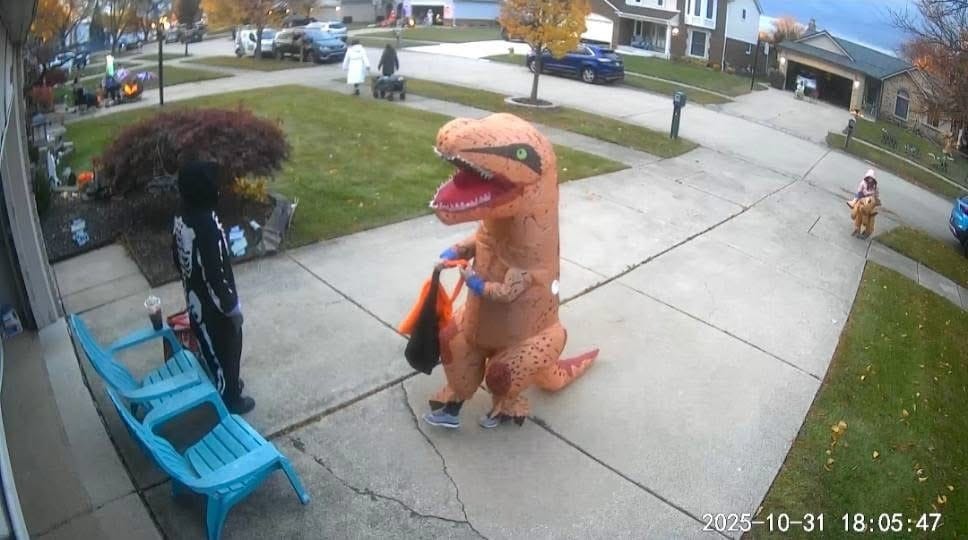
By passing through this pop-culture capitalist filter, Halloween completed its transition to an entirely secular and commercialized holiday. Worlds away from the dour and paranoid religion of the Puritans, it's now a day devoted to candy, costumes, trick-or-treating, elaborate house decorations, and spooky but harmless scares.
The future: Tech-driven Halloween
In the future, technologies such as virtual reality, holograms, and AI will change the way we celebrate Halloween. Internet of Things technology will take over candy dispensers, costumes, and virtually everything else.
Halloween celebrations will decouple from cheap, disposable decorations—in part due to greater concern for the environment and the long-lasting effects of plastic pollution on the planet—and uniform jump-scares. Instead, they'll move towards an era of customization and mixed-reality immersive experiences.
The traditional haunted house relies on human actors and recorded sounds playing on a fixed, predictable loop. In the coming decades, high-tech scares will use computer vision, AI, and biometric sensors to track eye movement, micro-expressions, or sweat levels to gauge the guests’ fear in real time.
Rather than giving the same experience to all guests, elaborate haunted houses and amusement-park thrill rides will reconfigure themselves in real time to spook us with whatever we fear most. If an AI senses that a guest is unbothered by, say, an animatronic zombie, it can deploy an entirely different phobia, such as dynamically altering the soundscape and lighting to evoke claustrophobia, or using 3D projection-mapping to generate spiders that suddenly crawl on someone’s shoulder.
Neighborhood trick-or-treating will blend the physical world with the digital. Children wearing AR smart glasses will see their neighborhoods transformed; they will immerse themselves in scenery such as realistic ghosts floating through the air, virtual monsters climbing rooftops, or interactive AI-powered trick-or-treat porch bots that converse with children before releasing candy. Some people might think that these changes will rob the day of all the fun. However, this new version of trick-or-treating will be the only reality that the children of the future might know.
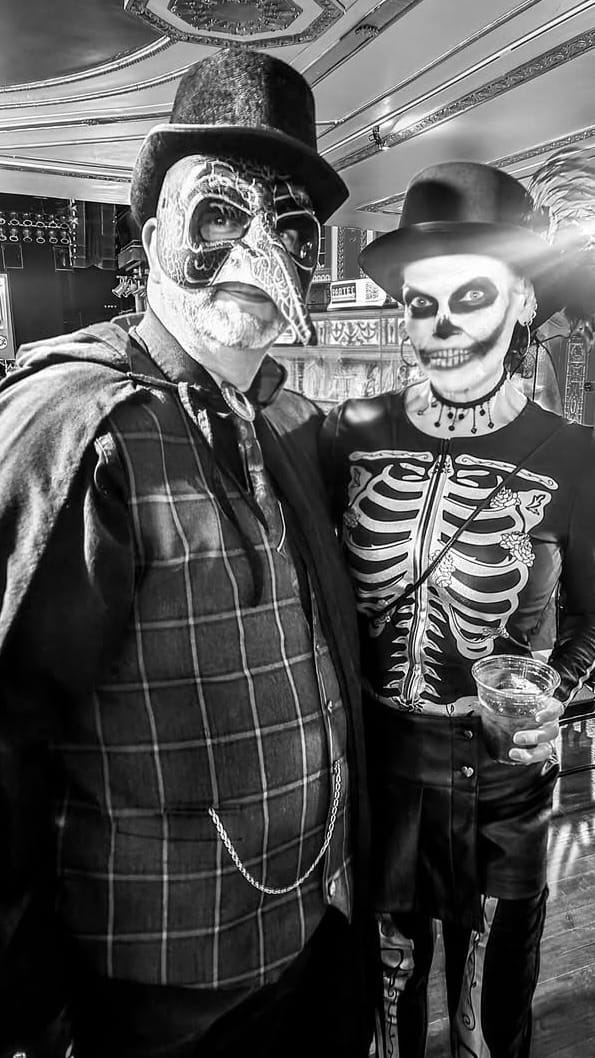
Smart textiles are already changing the world of fashion, and they open up new worlds of possibility for Halloween costumes. There are already gesture-sensitive LED masks that shift their displays on demand, and future costumes will continue this trend, incorporating flexible LED screens and haptic feedback. Instead of buying one costume, an outfit could dynamically shift appearance from a superhero to a vampire to a celebrity. Kids going trick-or-treating together could program their costumes to sync up to create coordinated soundscapes or visual effects.
As the holiday continues to evolve, I wonder what Halloween will look like in 2050 and what the accused witches—and the witch hunters—of Salem would think if they could see it.