

What happens when the caregiver shortage arrives?
Caregiving is essential work, but it's rarely treated or recognized as such.
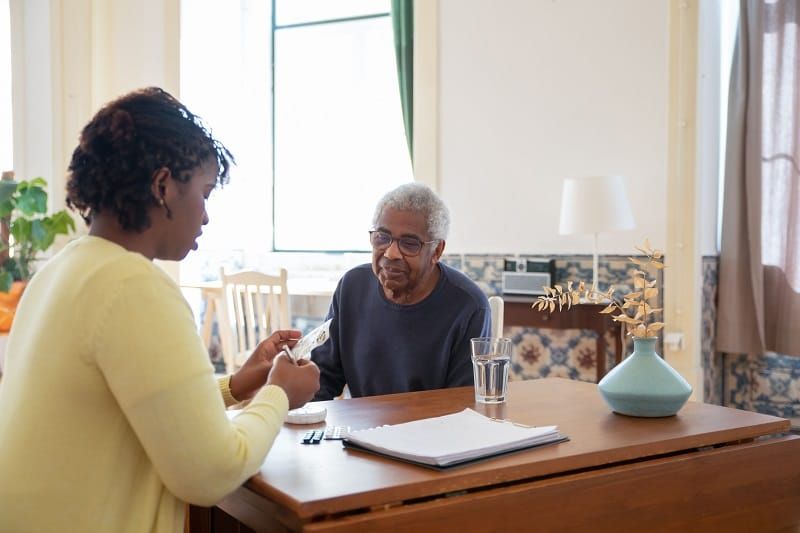
The future of caregiving is usually discussed as if it’s approaching from a distance. We picture a graying population, a shortage of workers, a wave of need coming toward us over the horizon. But for many people, the shortage has already arrived.
It looks like a home-care aide who never shows up, a daughter who cuts her work hours to take her father to appointments, a disabled person home alone because the help they need is unavailable or unaffordable.
The shortage isn’t only a prediction about how many workers there will be. It’s the gap between the care people need and the care they can actually get.
Not just a family matter
America has long treated that gap as a family matter. A relative will notice. A daughter will figure it out. A spouse will take over. Somebody will leave work, move closer, learn how to manage medications or lift a person safely, and absorb the cost in lost income and exhaustion.
The “somebody” is often a woman. The arrangement is so familiar that we barely recognize it as an arrangement at all.
The numbers are startling, but they mostly describe what is already happening. A 2025 report from AARP and the National Alliance for Caregiving counted 63 million Americans providing ongoing care to an adult or child with a complex medical condition or disability—nearly one in four adults, and about 20 million more than a decade ago. AARP estimates that 59 million people provided unpaid care to adults in 2024, amounting to 49.5 billion hours of work. Put a price on those hours and the annual value tops a trillion dollars.
That labor is not an emergency reserve waiting to be tapped. It is already carrying a substantial part of the care system.
Meanwhile, the paid workforce is struggling to keep up. PHI, a research and advocacy organization focused on direct care, projects 9.7 million job openings in direct care between 2024 and 2034. That figure includes new jobs and the need to replace workers who leave the field or the labor force. PHI reports median annual earnings for direct care workers of just under $26,000, in part because low wages and part-time hours keep annual pay down. The Bureau of Labor Statistics projects 760,500 openings a year for home health and personal care aides in its latest outlook, and reports a 2025 median annual wage of $35,800. These figures use different years and definitions, but they point in the same direction: demand is growing, and this work is not being made attractive enough to retain the people who do it.
The most common response to that problem is to ask how we can recruit more caregivers. It is a reasonable question, but it can also hide a more uncomfortable one: Why would someone choose a physically demanding, emotionally intense job with unpredictable hours and low pay, when other jobs offer more money or control over their time?
Care workers are not an inexhaustible resource. They are people whose labor has been treated as naturally available because it has so often been performed by women, immigrants, and people with limited economic choices. We can’t solve the shortage by demanding more devotion from workers while continuing to make care a bad job.
We also can’t assume that families can endlessly fill the gaps. Families are smaller than they once were. Relatives may live across the country, or be working while raising children of their own. Some people have no close family to call. Others have family members who love them but are unable to provide the physical care required. Affection does not give someone the strength to lift another adult, the training to manage a complex medical need, or the financial freedom to stop earning a living.
When the system asks a family to provide unpaid care, it doesn’t make the cost disappear. It transfers the cost to the caregiver: lost wages, damaged health, reduced retirement savings, and less time for a life of their own. It may also transfer the risk to the person receiving care. A family member can be loving and still be exhausted, untrained, or unavailable.
The future menu looks grim if we pretend there are only a few choices: underpaid workers, immigration, automation, institutions, or abandonment. Each option carries a familiar political argument. Immigrants are asked to do essential work, then demonized and treated as a threat. Robots prompt fears of coldness and dehumanization. Institutions are criticized, sometimes rightly, for removing people from their homes and choices. Family caregiving is praised as love, while the sacrifice it requires is left largely private.
The answer cannot be to pick one of those options and declare the problem solved. We need more human care workers, with better pay, predictable hours, training, and a real path to a sustainable career. We need immigration policy that recognizes care work as essential instead of treating the workers who do it as disposable. We need respite, paid leave, and workplace protections for family caregivers. We need public financing that makes support available before a family reaches a breaking point. We need to recognize the tremendous economic impact of family caregivers.
We also need to rethink what care itself has to look like.
What machines can and can't do
Some caregiving tasks really do require another person. A machine cannot supply human touch, notice every change in someone’s condition, or comfort a frightened person in the same way another human can. Personal care isn’t a list of chores that can all be handed off to devices. A robot that can lift someone safely, give them a bath, and respond sensibly to an emergency is not just around the corner.
But many parts of daily life don’t require a human body in the room every time. A device can remind someone to take medicine, make a video call easier, turn on a light, adjust a bed, or help a person communicate. A delivery service can get groceries to someone who can’t shop. Remote monitoring, used thoughtfully, can let a person get help sooner or give a caregiver more confidence when stepping out.
An argument about automation often compares a machine with an ideal caregiver: attentive, skilled, unhurried, available whenever needed. But the actual alternative may be an overworked relative managing one more task, an aide stretched across too many clients, or no one arriving at all.
A machine that reliably brings medication may be less emotionally satisfying than a devoted human caregiver. It may also be considerably better than lying alone without medication because no human came.
That is not an argument for replacing caregivers with robots. It is an argument for asking the right comparison. Technology should reduce dangerous or exhausting work, give people more control over their homes and routines, and make human care more effective. It should not become a pretext for cutting paid hours, surveilling people in their own homes, or telling families that an app is an adequate substitute for help.
The evidence is still developing. A 2026 systematic review of medication reminder technologies for older adults found some health benefits, but said evidence on cost-effectiveness, service use, and the experiences of patients and caregivers remained limited. Technology can help with particular tasks; it hasn’t been shown to solve the whole problem.
That makes design and accountability crucial. People should be able to understand what a device collects, decide who can see that information, and keep using essential functions even if a company changes its app or ends a service. Devices should work with assistive technology, accommodate different bodies and senses, and have a way to get help when they fail. Most of all, the person receiving care should have a say in which tools enter their home and what those tools do.
Care also has a geography. When communities are designed around isolation and driving, every appointment, grocery run, or visit becomes another logistical problem. Housing with accessible units near shops and transit, shared transportation, local health services, and neighborhood networks can make ordinary support easier to provide. Those things don’t replace personal assistance. They can make a person’s daily life less dependent on one relative making every trip and managing every need.
The future of caregiving will be shaped by what we are willing to pay for and what we are willing to share. If we keep treating care as private trouble, it will keep appearing as a crisis inside individual homes: the burned-out daughter, the worker forced to leave, the person whose needs go unmet. If we accept care as part of the infrastructure of a functioning society, we can build a different mix of human support, technology, public services, and accessible communities.
That future will not be frictionless. Human care will still involve disagreements, fatigue, mistakes, and limits. Machines will fail, and some people will hate having them in their homes. Family members will still need time, money, and help. A more reliable care system won’t make every situation easy. It can make it less likely that one person’s illness or disability turns everyone else’s life into an improvisation.
We should stop asking only what we will do when there aren’t enough caregivers. We should ask why our current system requires so many people to provide care in secret, without pay, training, or relief—and what it would take to make care a responsibility we can actually share. The shortage isn’t waiting in the future. The future is deciding whether we keep calling today’s unmet needs a family problem.