

We have more to go on than ‘me’ in setting the course of our post-religion lives
Choosing yourself and your own life is the first step in leaving religion. What's the second?

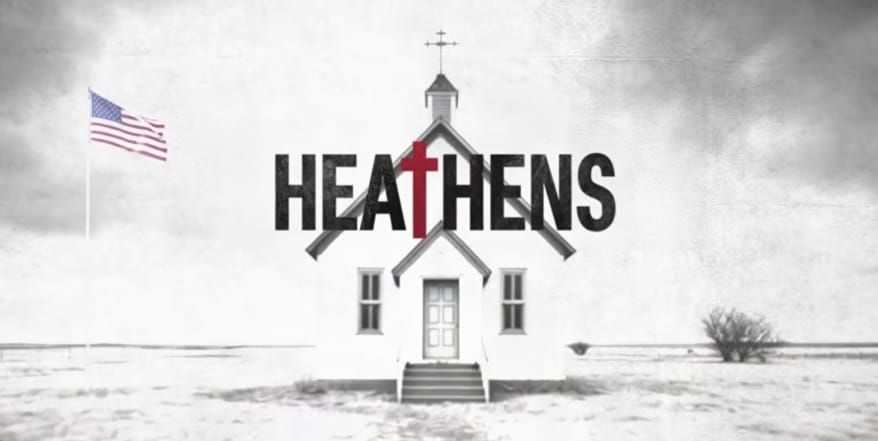
Disclosure: OnlySky's publisher, Shawn Hardin, is a producer of HEATHENS. The author of this column was provided a screener of the film.
An evocative scene unfolds in a recording studio near the end of the new documentary Heathens as the five protagonists contemplate what comes next now that they’ve left religion.
These central characters are taking a break during their recording of an original song capturing the spirit of their religious deconstruction. “I choose me over this fantasy,” they sing in one part of the song—this fantasy of religion. As they talk in between turns at the microphone, one of them begins to cry and admits she is struggling with her deconversion. "I don't have something to go to,” she tells the others. “When I was Christian, all my answers were given to me. I knew what to do. I knew where to find (answers). I don't have that anymore, and I'm really struggling not having that."
You do have something, the others reply. It’s like the moment they are sharing now: being together, making music, forming friendships, “going from a place of isolation to a place of community,” as one of her fellow ex-Christians offers.
But, we might ask, on what shared basis can the work proceed and communities coalesce, other than the common experience of leaving, or never having, religion? Where can we find answers when we no longer have religion to provide them?
These are questions the film leaves hanging in the air, and I suspect that was the intention of directors David Cowan and Shawn Hardin. It is up to us—those in the audience and larger secular sphere—to delve into them and find good answers.
Sources beyond our individual selves
It is here that the “me” in the song’s lyrics clamors for attention. I don’t mean to be unrealistic or ungenerous in my interpretation of its meaning. You can fit only so many syllables into the meter of a song, and the “I choose me” in the beautifully sung refrain might be heard to mean “I will be true to myself.” None of the five people featured in the film come off as selfish or narcissistic.
Yet, as someone who has done extensive research on responses to secularism, I can see the “me” playing into the hands of would-be critics. Many are the times I have come across (false) charges that secular people have not truly left religion but have merely turned to a religion of a different sort, a false religion revolving around worship of the almighty self. Along with that comes a sense that secular people think they can construct their ethics and life meaning from scratch, with only their rational minds and inner compasses to guide them—as if anything from the past or outside oneself is suspect.
On one hand, this is freedom. You decide what your life is about. On the other hand, it is a terrible burden. Not only do you get to construct your life by your own lights but you have to. The work is terribly hard; it is almost impossible to get it right without help.
Nonsense from ill-informed critics would not bother me if not for the fact that the criticisms of secular life are, in some cases and in some ways, partially true. I find that there is a tendency in the secular population to be leery of potentially valuable sources of instruction and meaning for fear they are contaminated by religion and its almost-as-suspect cousin, spirituality.
So keen are we to exhibit our independent thinking and freedom from theism that we often look askance at worthy source material that might seem too proximate to religion—“love thy neighbor” morality, for example, or rituals like sabbaths that are associated with religion but lend themselves to secular adoption, too.
Thankfully, we do not have to build from scratch, and we are not left to our own devices either collectively or individually, as we create secular lives of meaning, purpose, and fulfillment. We have so much more to go on than merely “me.”
Sourcing the natural world
As intuited by the central figures in Heathens, community is large part of the answer to the “what now?” question. My sense, drawn from experience and research, is that informal secular community happens all the time, through such venues as social get-togethers, book clubs, exercise groups, passionate fandoms, community service, and activism. Secular institution-building has not been a stirring success. But secular people who feel isolated do not have to do life without community even though they are doing it without God. We can join something, or start something, whether it rides under the official banner of “secular” or not.
Answers outside our individual selves are also there to be found in science, art, philosophy, literature, music, more thoughtful forms of film, TV, and journalism, and so on. I will go so far as to say they can even be found in the Bible and other religious texts, if one is willing to read beneath the supernatural elements to find the time-tested life wisdom they often convey.
Speaking of literature, I contend we can benefit greatly from reading the “book” of nature, a source from which large swaths of the developed world have become estranged. If we can regain this vital form of literacy, we will see that the natural world has huge and largely unrealized potential as a source for ethics, inspiration, and insight on the meaning of life.
Untold millions of biological lifeforms other than our own have been busy for eons evolving ways to make a living, to make life good, in ways most beautiful and ingenious. We impoverish our understanding of life if we do not avail ourselves of this rich source and give it the attention it deserves.
It just so happens that the natural world needs that attention now, most dearly, as it sags under the weight of humanity and our extractive capitalist economies. And that leads to my final point about the vast world outside of “me.”
A larger purpose
It is not just a question of where we turn for answers, but of what we dedicate ourselves to—beyond theism, beyond our individual wants and needs—as we enter the vast and still-unmapped terrain of secular life. Our existences take on a greater depth and richness if we commit to causes larger than ourselves, and to purposes greater than getting what we want as quickly and efficiently as possible.
In my read of the human predicament this century, there is no greater cause than the protection of biological life and the Earth on which it utterly depends. Between climate deterioration, rampant species extinctions, and tech-lord visions of a post-human, post-biological future, life itself is at risk of being snuffed out or degraded beyond recognition. To resist these threats in their various forms, and to fight for life, fills one with the greatest purpose imaginable.
But secular people can find purpose many ways: by standing up for the poor and oppressed, for example, giving time to community service, teaching kids to read and doing volunteer work of other sorts, working for worthy political causes and candidates, and pursuing art and other creative projects. Religious people testify that they do their good works to serve God (or avoid God’s wrath). Secular people do them because they are the right thing to do and because they bring rich satisfactions along the way.
Our inner voices and internal compasses, our innate capacities for goodness, will always have a role to play as we form our ethics and strive to lead good, fulfilling lives. But the newly unconverted woman who sheds tears at the end of Heathens is not sentenced to going it alone as she does life without religion. Nor, thank goodness, are the rest of us.