

Disabled people live in the future
Technology that merely represents convenience to some can be lifesaving to others.
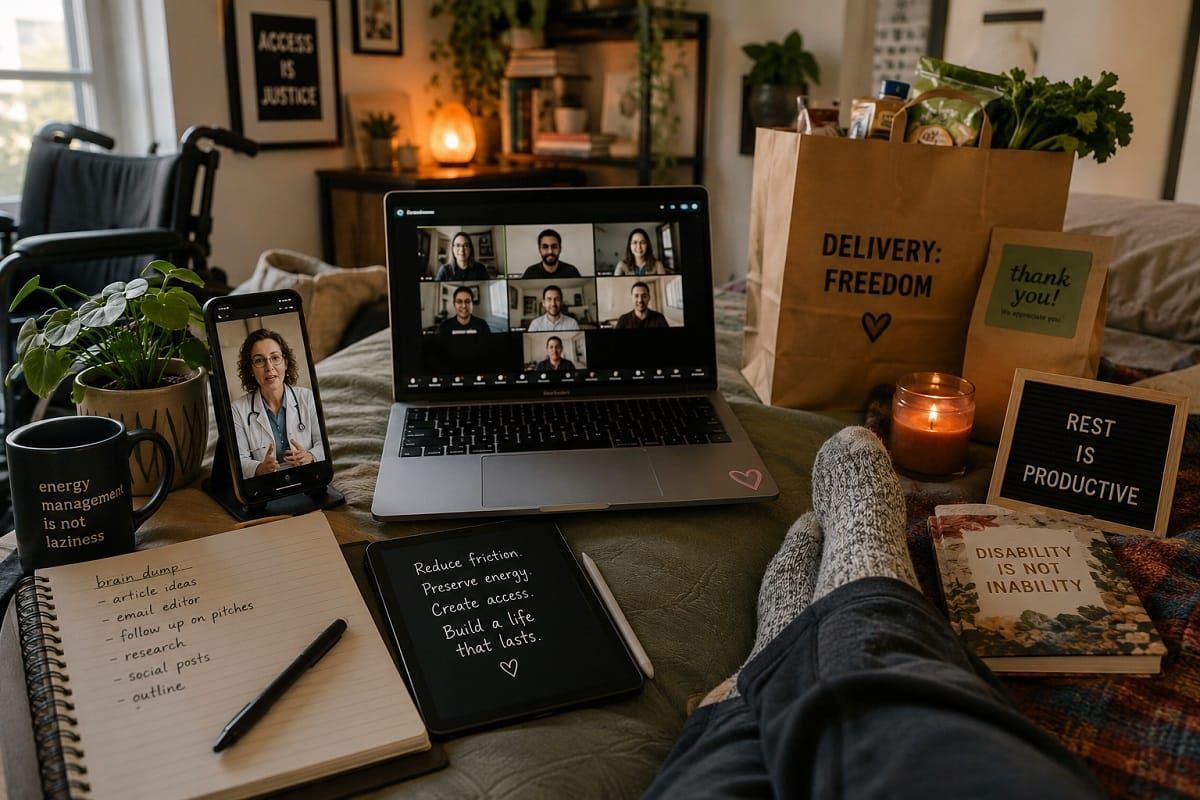
On a given day, I might log into a remote meeting, receive a grocery delivery, meet with my doctor by telehealth, brainstorm ideas using AI, text my best friend, and coordinate with my editor by email.
This may sound like just standard operating procedure since Covid, but I have been doing it for nearly a decade as a disabled person who can’t easily get out into the physical world.
Society talks about these changes in work and communication as innovations. Disabled people often experienced them first as survival strategies.
The future arrived quietly
Since the Americans with Disabilities Act passed in 1990, disabled Americans have repeatedly asked for flexibility and accessibility, often hearing the same response: it simply wasn’t possible.
Then these excuses were exposed as just that, excuses, when Covid hit.
Companies suddenly discovered that work somehow continued even when employees weren’t sitting under fluorescent lights in matching cubicles.
Flexible schedules became the norm in many companies.
Conferences that had once been in-person affairs became virtual events accessible from anywhere.
More medical providers offered telemedicine services.
For years, just living my life required me to plan extensively for access, mobility calculations, pain management, and recovery time.
Many things just weren’t possible for me.
Then nondisabled people started experiencing constraints.
And my world opened up.
Disabled people weren’t suddenly included in the future. The future finally caught up to disabled reality.
Engineering daily life
When most able-bodied people think about accessibility, they picture accessible parking spaces, wheelchair ramps, braille, or sign language interpreters.
While those are valuable accommodations, much of disability is actually about engineering daily life: reducing friction, managing energy, minimizing unnecessary movement, structuring environments, creating workarounds, and preserving enough “spoons” to function through the day.
Disabled people learn the accessibility routes, the online purchasing options, the delivery systems, digital organization, asynchronous communication, virtual gatherings, and countless ways to reduce friction in everyday life.
People who live with a disability become experts in sustainability because unsustainable systems have immediate consequences.
Convenience for some, access for others
Society often frames convenience tech as laziness. It’s not uncommon to see people on social media saying things like “The moral choice is shopping local” or “If you don’t like the way DoorDash works, get off the couch and go get it yourself.”
This attitude assumes that the person on the couch can get up, drive, get into the restaurant safely, and have the energy to do all of that and then eat.
This attitude surfaces whenever people talk about grocery delivery, online shopping, voice assistants, AI help, working away from a desk, or telemedicine. Some people see using these tools as a sign of weakness or softness, treating those who avoid them as somehow more disciplined, moral, or self-reliant.
For someone with chronic pain, limited mobility, severe fatigue, or immune system concerns, avoiding a trip to the store may mean avoiding days of increased pain and recovery afterward. A telemedicine appointment may conserve enough energy to cook dinner later that night. Working from home may allow someone to remain employed who would otherwise be physically unable to manage a daily commute and office environment.
Disabled people often perform complex calculations that nondisabled people never have to think about. Is this outing worth the recovery time? Can I manage the stairs today? If I spend my energy on this appointment, what will I no longer be able to do tomorrow?
Accessibility is not only about ramps and parking spaces. It is also about reducing unnecessary barriers to participation.
I see one of my doctors exclusively through Zoom because getting in and out of his office is simply too difficult for me physically. Without telemedicine, I would likely need to find another provider entirely.
Disabled people are not looking for shortcuts.
We are looking for equity.
AI as accessibility
Another very useful tool for some disabled adults is artificial intelligence. As NeuroNav’s Self-Determination Blog explains, AI can “help with work, communication, and accessibility.”
Artificial intelligence is often discussed in apocalyptic or corporate terms. People worry, reasonably, about companies using AI to replace workers, flood the internet with misinformation, or prioritize productivity over humanity.
But that conversation often overlooks another reality entirely: many disabled and neurodivergent people are already using AI as accessibility support.
Critics sometimes describe AI as cheating. But cheating who out of what?
If an autistic person uses AI to organize scattered thoughts into a coherent structure, what exactly has been stolen? If someone with chronic fatigue uses it to reduce cognitive load during a pain flare, who has been harmed? If a person with ADHD uses AI to overcome executive dysfunction and begin a task that otherwise would have remained inaccessible, what unfair advantage have they gained?
Disabled people have long used adaptive technologies to bridge gaps between ability and participation. Screen readers, speech-to-text software, mobility devices, predictive text, voice assistants, and captioning systems all reduce friction between a person and the world around them. AI is increasingly becoming part of that ecosystem.
For many people, AI is not replacing human thought. It is helping create access to it.
Certainly there are legitimate ethical concerns surrounding artificial intelligence, particularly involving labor, privacy, misinformation, and environmental cost. But accessibility technology has often been treated with suspicion when it makes difficult tasks easier or less painful.
Sometimes what nondisabled people call convenience is actually accommodation.
Flexibility is the future
Accessibility is a huge concept within disability communities because it extends far beyond ramps, parking spaces, or physical accommodations.
The National Center on Accessible Education Materials states that “accessibility is shaped by what we need to do, our interactions with the environment, and our personal preferences.”
In practice, accessibility often means flexibility.
It means recognizing that people participate in the world differently. Some people need remote access. Some need asynchronous communication. Some need reduced sensory input, adaptive technology, recovery time, or the ability to structure work around fluctuating health and energy.
Disabled people often become experts in flexibility because rigid systems fail us first.
That matters because modern life increasingly rewards adaptability over constant physical presence. Hybrid work remains widespread even as some companies push return-to-office policies. Asynchronous communication has become deeply embedded in both professional and personal life. More people now expect to accomplish tasks, maintain relationships, receive healthcare, and participate in communities without always being physically present in the same space.
At the same time, many people are questioning productivity systems built around exhaustion, performative busyness, and the assumption that human value is measured primarily through visible output.
Disabled people have long understood that unsustainable systems eventually break people.
We simply learned it earlier because our bodies enforced the lesson first.
Already there
Disabled people are often treated as burdens from an outdated past, people asking for accommodations simply to participate in a world not designed for us.
But many disabled people have already spent years developing the adaptive skills modern life increasingly demands: flexible communication, distributed work, digital participation, energy-based productivity, remote collaboration, and technology-assisted living.
Far from being disconnected from modern society, many of us are already navigating the systems that broader culture is only beginning to normalize.
The future did not leave disabled people behind.
In many ways, disabled people arrived there first.