

The morality play of chronic pain
Will AI help treat pain more effectively, or will it just learn to replicate human biases?
In 2022 I slipped on a loose rug and fell. I’m disabled, so I needed help getting off the floor. This time, my right ankle noped out. It didn’t hurt, at that point. It just wouldn’t hold any weight.
My husband wanted to call an ambulance. I said, “It’s a Friday night. The ER will be a madhouse. I’ll just ice it and it will probably be better in the morning,” and had him inflate the air mattress so I could sleep on the floor.
In the morning it was swollen and very painful so I let him call the ambulance. My ankle was broken in three places. I couldn’t bear weight on it for four months.
And that line about the ER on a Friday night? Mostly hogwash. ER beds do hurt my back and I do try to avoid them.
But the reason I didn’t want to go to the ER wasn’t just because my ankle didn’t hurt at that point. It was because I didn’t think I’d be taken seriously.
Many chronic pain patients learn, over time, that pain is not just accepted and treated, but also judged.
Modern medicine has become extraordinarily sophisticated. We can replace joints, map genomes, and increasingly use artificial intelligence to assist diagnosis. Yet when it comes to pain, we still rely on surprisingly old moral instincts.
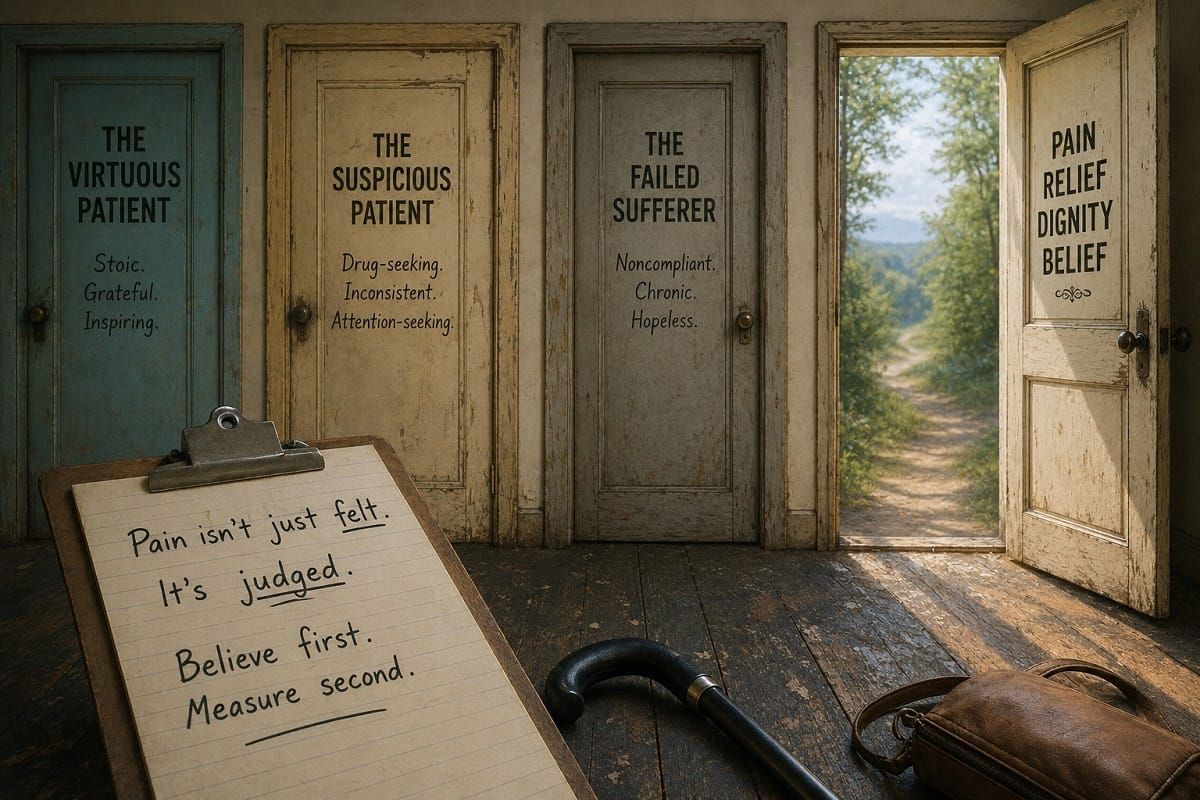
Pain patients are often sorted into three unofficial categories: the virtuous sufferer, the suspicious sufferer, and the failed sufferer.
Category #1: The virtuous patient
Virtuous sufferers are easy patients. People use words like “stoic” and “grateful for help,” but what they mean is that these patients may be in pain but they’re not whiny about it.
Virtuous sufferers try yoga and tai chi. They mostly suffer quietly and at home.
They don’t ask for pain medication at all, or if they do, they ask for a small quantity of something mild.
These pain patients never express anger or bitterness at their situation. They may minimize what’s happening in their bodies because they don’t want to be a bother. In some cases, they may even delay seeking care because their pain doesn’t look dramatic enough to justify concern.
I was once asked to describe my nerve pain.
I said, “My left leg feels like it’s engulfed in flames all the time.”
My physician assistant looked horrified. “That sounds terrible!”
“It is terrible.”
Virtuous pain patients are rewarded culturally. People find them inspiring. Partly this is a holdover from Protestant ideas romanticizing suffering. Partly it’s because of a stigma against using pain medication. And partly it’s because people who don’t make a fuss are easier to like.
Unfortunately, the patients who make the least trouble are not always the patients who need the least help.
Category #2: The suspicious patient
Some pain patients start out virtuous and become suspicious, and others are judged as suspicious from the beginning.
The easiest way to be labeled suspicious is to ask for pain medication. Even asking for something like a nerve pain medication or a muscle relaxer can throw up red flags. Asking for anything stronger can convince some providers that a patient isn’t really in pain, as ludicrous as that sounds.
Another factor in pain suspicion is a patient who carries their pain well and “doesn’t look sick.” If you present in the ER with a broken ankle, you’ll probably be taken seriously. If you present with back pain but you’re not bent double, you may encounter doubt.
Most pain patients will tell you that pain fluctuates. Some days it may be so bad breathing hurts, and other days it may be pretty mild. Unfortunately, having a good day can seem sketchy to others, instead of being a good thing.
Another red flag for some providers is a knowledgeable patient. Many chronic pain patients research their conditions and know what works and doesn’t work for their bodies. In a perfect world, doctors would appreciate patients who can contribute to their own care. Some do. Others find this problematic only when pain patients do it.
Many pain patients also have complicated histories, which may include failed surgeries and complex pain profiles. This is especially common for patients who’ve experienced chronic pain for years, but is also viewed with skepticism by certain professionals.
You might think if pain patients aren’t supposed to ask for pain medication, that treating their own pain with cannabis would be welcomed by doctors who worry about prescribing opioids. Unfortunately, medical cannabis use is a disqualification at some pain clinics, even in states with legal recreational cannabis.
Someone suffering from chronic pain and not receiving the help they need for any of the above reasons might naturally exhibit some negative emotions, or simply appear distressed because of the pain. This, too, can raise questions about the validity of the pain and the need for pain medication.
The opioid epidemic is real and tragic, but when a pain patient is viewed as suspicious, the medical relationship can become adversarial in an attempt by the provider to avoid giving pain medication to the wrong person
Category #3: The failed sufferer
To some providers, certain pain patients look extremely suspicious. The typical failed sufferer isn’t suspected of faking pain. Their offense is different. They simply never got better.
Back pain patients are common “failed sufferers,” often even after major surgery.
According to the Journal of Physical Therapy Science, as many as 80,000 back surgeries each year fail. Many of these failed operations are lumbar spinal fusions, which are largely considered a last resort for lower back pain.
Many patients who are viewed as suspicious have stopped working due to their pain. This ties back to the work ethic mentioned above. People who can’t work because of pain are often seen as malingering in a way that, say, cancer patients are not.
The longer pain lasts, the more visible its consequences. Another red flag in some providers’ eyes is that patients who have been suffering for years often can’t walk unassisted and use a cane, walker, or wheelchair. This reflects not only a suspicion of pain patients, but a stigma against disabled people in general.
The suspicion often deepens when chronic pain patients gain weight, particularly if obesity is involved. Reduced mobility, years of pain, disrupted sleep, and medication side effects can all contribute to weight gain. Yet many people interpret the weight itself as evidence of personal failure rather than another consequence of illness.
The most serious “sin” committed by chronic pain sufferers is that after years of pain and failed treatment, they can often no longer perform optimism. They may be seen as noncompliant because they are no longer submitting to procedures or attending physical therapy. Some people view this as refusal to participate in trying to recover. The patients understand it as conserving energy when treatment has failed to produce results. Society treats this as a character failure instead of an outcome.
When suffering becomes data
These categories—the virtuous sufferer, the suspicious sufferer, and the failed sufferer—feel deeply human. They seem to be the product of individual prejudices and cultural assumptions.
Unfortunately, these categories may be entering a new phase.
Medicine is becoming increasingly data-driven. Artificial intelligence systems, wearable devices, biometric monitoring, and predictive analytics are beginning to reshape healthcare. Many advocates hope these technologies will finally help pain patients be believed.
But, sometimes, technology doesn’t eliminate bias. Sometimes it simply automates it.
Until recently, studying pain was difficult and cost-prohibitive, but that’s changing as tech advances. For instance, researchers are now studying movement patterns and gait analysis. Combined with step counts, this could track not only how much someone is walking, but how well.
Many patients use wearables and biofeedback apps that can track sleep disruption, heart-rate variability, and stress markers. This data can be shared with providers.
For pain patients, this sounds appealing. If a wearable device can demonstrate that someone sleeps only three hours a night, walks with an altered gait, and experiences significant physiological stress, perhaps they won’t have to convince anyone that they’re suffering.
This is the dream.
The problem comes with the questions of who controls the data and what is done with it. While many providers will value this data and use it to guide treatment, there’s a darker side to it.
Used in a certain way, good days become evidence that can be used in ways that don’t benefit the patient, even when that may not be the provider’s intention or even their choice.
Imagine this. A patient walks 5,000 steps on a Tuesday, when they usually struggle to walk 1,000 steps. The patient thinks, Tuesday was a good day.
Their wearable sends Tuesday’s data to their insurer, where it is evaluated by an AI which concludes that the patient isn’t that impaired.
Pain patients are rightly worried about artificial intelligence in medicine, in part because algorithms learn existing biases.
Insurers and some providers already make assumptions about things like treatment compliance, medication use and disability. They already judge clients for things like obesity and disability-related unemployment.
The risk is that future systems will inherit those assumptions. A system trained on decades of decisions may learn human prejudices just as easily as human knowledge. The algorithm may learn to sort pain patients into virtuous, suspicious and failed, the same way that humans always have.
A patient who appears to be complying with treatment and trying to get better, is actively exercising, and uses little or no pain medication will trigger a positive response from the algorithm. All of these behaviors will still be rewarded.
Suspicious patients will still be flagged when they have inconsistent symptoms, request pain medication, or need treatment beyond the minimum.
Patients will still “fail” the algorithm when they present, after years of disability and multiple failed interventions, with reduced activity, unemployment, obesity, and a requirement for pain medication.
These judgments from the algorithm are problematic now, but there’s a worse future waiting. At the moment, wearables and biofeedback apps are a convenient tool for chronic pain patients to track their own progress. AI is a tool some providers use as a scribe to help manage patient notes. Insurance companies have started using artificial intelligence in their decision-making.
In the future, insurance companies will “incentivize” or even require wearable devices that share data with the insurer. Providers will use AI more and more in making treatment decisions. Insurers will rely more on the algorithm than on human decisions.
Pain patients are extremely unlikely to benefit from these changes.
The past is the future... maybe
Pain patients have always had to prove they are suffering.
The question isn’t whether technology will enable us to measure pain more accurately.
The question is whether we will use that technology to treat pain more effectively, with more compassion, or simply to judge and categorize sufferers more efficiently.
The greatest challenge isn’t detecting pain. It’s resisting the temptation to turn it into a moral score.