

English is becoming humanity's shared language
It's now the language of choice for communication between people who speak different native tongues.

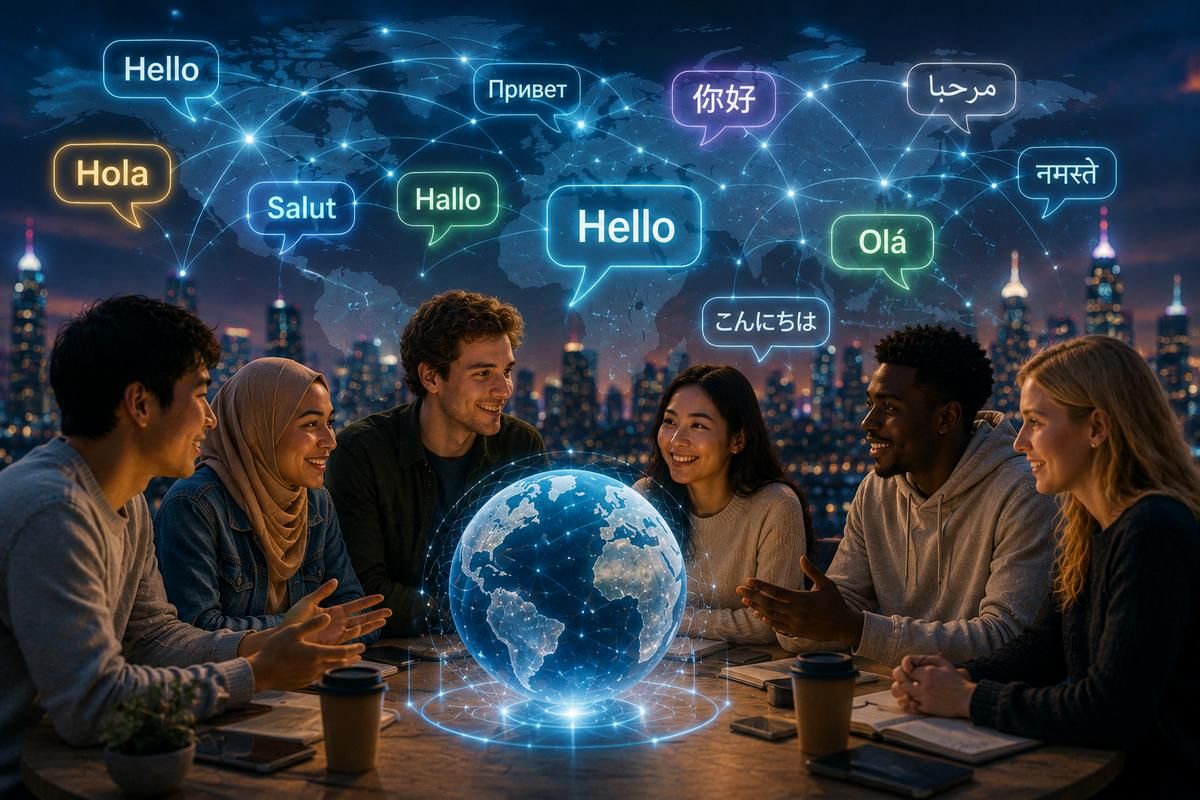
Last month, I traveled from London to Helsinki by coach bus. The journey lasted nearly sixty hours and crossed several European countries, with a few hours spent in Warsaw along the way. During those two and a half days, I heard French, Dutch, German, Polish, Estonian, and Finnish, among other languages. Every border brought a new linguistic landscape. Yet whenever people from different countries needed to communicate with each other, they instinctively switched to English.
The pairs of drivers who changed throughout the journey addressed travelers in English. At every service station, café, and restaurant, staff greeted international customers in English before trying anything else. Nobody stopped to discuss which language to use. The choice was automatic. English had become the bridge connecting the different nationalities traveling together.
The experience made me wonder whether we are witnessing something much larger than the rise of English as an international language. Perhaps we are watching the first stages of humanity developing a truly global tongue.
English as a lingua franca
This does not mean national languages are disappearing. French remains French. Finnish remains Finnish. Japanese, Spanish, Danish, and thousands of other languages continue to carry their stories, identities, and cultures. Instead, something different is happening: humanity is increasingly becoming bilingual on a global scale.
Linguists have been studying this phenomenon for decades under the concept of English as a Lingua Franca (ELF). The term refers to English used as a common language between people who do not share the same native tongue. According to British linguist Barbara Seidlhofer, one of the pioneers of ELF research, English has evolved beyond being the property of its native speakers. Instead, it has become a flexible international tool shaped primarily by the millions of people who use it every day as a second or third language.
This is reflected in the numbers. Linguist David Crystal, author of English as a Global Language, estimates that around two billion people have at least some knowledge of English, making it the most widely learned language in history. Native speakers are now outnumbered by non-native speakers by roughly three to one. In other words, most conversations conducted in English today take place between people for whom English is not their first language.
Technology has dramatically accelerated this transformation. Social media platforms like YouTube connect people across the world, attracting audiences from dozens of countries, and English content reaches billions of watchers.
Latin was once the language of science, but today, scientific papers are overwhelmingly written in English, allowing researchers in different nations to collaborate without translation. Aviation has long relied on English as its official operational language. International business, startups, software development, tourism, and higher education increasingly depend on English as their default means of communication.
Artificial intelligence is adding another layer to this phenomenon. Modern translation programs can translate conversations almost instantly, reducing language barriers like never before. Ironically, rather than replacing the need for a common language, these tools often reinforce it. English remains the default language for many AI models, programming frameworks, and global online discussions, while translation makes it easier for non-native speakers to participate.
Global English is not the same as American English
Interestingly, this emerging global language may no longer be identical to the English spoken in London, Sydney, or New York. Researchers studying English as a Lingua Franca have found that many international speakers naturally simplify certain grammatical structures, avoid culturally specific idioms, and favor vocabulary that is widely understood. Jennifer Jenkins, another leading scholar in ELF research, argues that successful international communication depends less on sounding like a native speaker than on being intelligible to people from many linguistic backgrounds. In this sense, global English is evolving according to its own rules through everyday use by millions of people worldwide.
This language evolution reflects a broader historical pattern. Languages have always changed through contact. Modern English itself absorbed vocabulary from Latin, Norman French, Old Norse, Greek, and other languages. Swahili emerged through centuries of interaction between African communities and Arab traders. Throughout history, commerce, migration, and technological change have repeatedly created new linguistic bridges.
Today’s globalization is simply happening on an unprecedented scale. Will everyone speak the same language by the end of the century? Most likely not.
UNESCO estimates that over 7,000 languages are still spoken worldwide, but nearly half are at risk of disappearing during the coming generations unless they continue to be transmitted to children. At the same time, multilingualism is increasing, particularly among younger generations who grew up using English online while maintaining their native language at home.
Rather than replacing local languages, a global tongue is more likely to exist alongside them. Multilingualism may become the defining characteristic of the 21st century.
Looking back at that coach journey across Europe, I realized I had witnessed more than an international bus ride. I had seen a small glimpse of the future, dozens of people from different nations, carrying different cultures, and speaking different languages, communicating effortlessly through a shared one.
Perhaps the world’s first truly global language is not something that will appear one day. Perhaps it is already emerging, one conversation at a time.