

Rucho is the real threat to American democracy
The courts have blessed anti-democratic gerrymandering.

Many people feel that American constitutional democracy is threatened today. They are right, but the threat does not come from President Donald Trump, who has been revealed by the stalemate in the Iranian war to be much weaker than anyone thought.
No, the actual threat to constitutional democracy comes from a 2019 U.S. Supreme Court decision, Rucho v. Common Cause, which held that the issue of partisan gerrymandering is a nonjusticiable political question. As a result of that decision, partisan gerrymanders cannot be challenged in federal court, no matter how extreme they are.
Rucho has unleashed a frenzy of untimely redistricting by both political parties. These efforts represent pure partisan efforts to seize control of the U.S. House of Representatives in the 2026 midterm election. The resulting congressional maps contain weirdly shaped districts having nothing to do with the traditional concerns of districting, such as compactness, contiguity and community cohesion.
Both parties are trying to take the decision of which party should control the House out of the hands of the people by manipulating the number of party affiliated voters in each district.
Barring unlikely congressional action, only a future majority on the Supreme Court could reverse Rucho and restore sanity to the districting process.
How districting works (or doesn't)
The way partisan districting generally works is that either the party in power, or both parties together, create as many “safe” congressional or state legislative districts as possible. This is in the interest of political incumbents and is not hard to do.
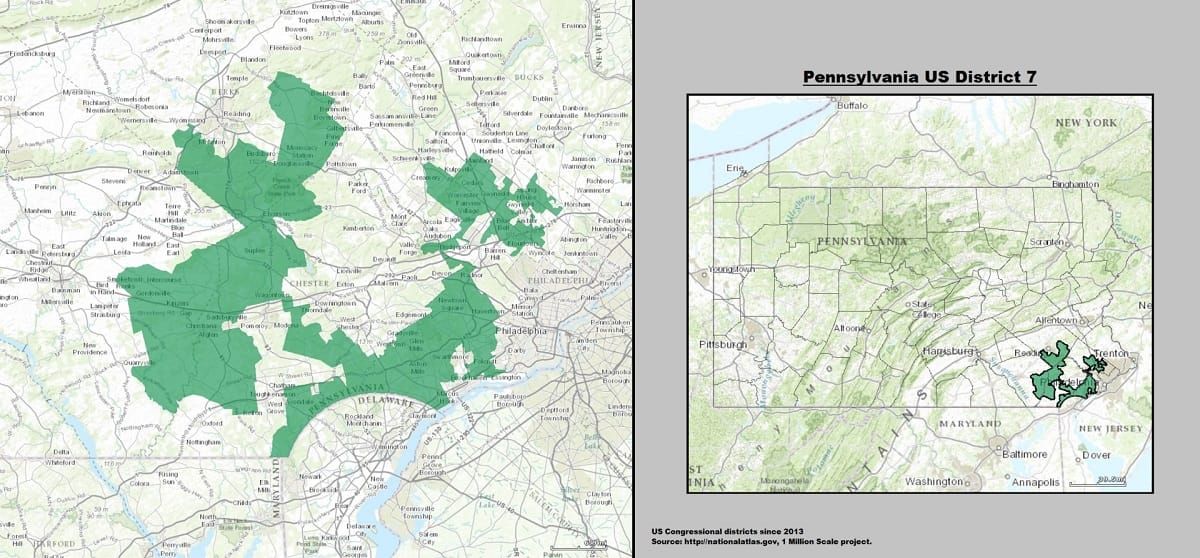
In a more extreme version, one party controls the process and makes the seats of the other party “super safe” by eliminating any swing districts and stuffing as many of the other party into a small number of districts as possible. A perfect example of this was the Pennsylvania 2011 congressional map designed by the Republican party to deliver 13 Republicans and 5 Democratic congressional representatives regardless of what outcome the majority of the people of Pennsylvania wanted.
The map worked perfectly until a special election in 2018 barely flipped one red district blue—by 267 votes.
The only way you can design a map that one-sided is by weird shapes, which is part of the reason that the Pennsylvania Supreme Court ultimately found the map unconstitutional under the Pennsylvania Constitution. One district was often described as looking like Goofy kicking Donald Duck.
Rucho was the culmination of decades of voting rights litigation that attempted to outlaw partisan gerrymandering altogether as an unconstitutional interference with the right to vote. These efforts proved misguided, as no one was able to say what an “objectively fair” congressional map should look like. Should it reflect party statewide voting, or maximize the number of contested seats, or something else? Plus, the framers left congressional districting in the hands of state legislatures and so presumably anticipated at least some level of political influence in drawing congressional maps.
Although various majorities of Supreme Court Justices have assumed that extreme partisan gerrymandering is unconstitutional, no constitutional standard emerged by which judges could evaluate particular congressional maps.
The court throws up its hands
In Rucho, Chief Justice John Roberts’ majority opinion essentially threw up the Court’s hands and retreated from the issue altogether.
Rucho did not have an immediately dramatic impact. From 2019 to 2026, districting remained more or less business as usual, with districting limited to the years immediately following the publication of the national census. But then, in early 2026, fearful of losing the midterm elections and the House, President Donald Trump called on Republican-dominated states to redistrict immediately to maximize the number of Republican seats. Several Republican states responded and Democrats engaged in the same process in a few states.
This latest, even more extreme version of partisan gerrymandering, seeks to practically eliminate, and sometimes actually eliminate, the other party’s congressional representation altogether by drawing lines that include enough of the party faithful to win every seat, or almost every seat. If successful, these latest efforts will keep Republican control of the House even if the Democrats get most of the votes for the House nationally, or even in a majority of the states.
Rucho prevents any federal challenges to partisan gerrymandering, no matter how extreme or grotesque the resulting maps become.
Rucho is also the reason that Republicans can eliminate minority majority voting districts without running afoul of the Voting Rights Act. Media reports suggested that the Supreme Court’s most recent Voting Rights Act decision, Louisiana v. Callais, would lead to the elimination of black majority districts. But this was not the real story. The real reason that Republicans are now free to act is that under Rucho they may claim—probably sincerely—that their goal in eliminating black-majority districts is partisan success rather than racial discrimination.
Rucho does not prevent state courts from striking down extreme partisan gerrymanders under state constitutions, as the Pennsylvania Supreme Court did, but so far only the Virginia Supreme Court has done so and only on the ground that the Democratic-favoring map was enacted too late in the political process to pass constitutional muster.
Will the court realize its mistake?
There is reason for hope that our constitutional democracy might yet be saved from all these anti-democratic efforts by both parties. In the first place, as Karl Rove pointed out, partisan gerrymandering this extreme can backfire by diluting party margins in safe districts to such a degree that safe seats can become contested in a year in which the other party runs up larger than normal margins. That could happen this year.
In the longer run, the U.S. Supreme Court might simply recognize that Rucho has been a disastrous mistake. Political question decisions are easier to overturn than decisions on the merits. All the Court held in Rucho was that there was no standard by which to judge the constitutionality of partisan gerrymandering. But the Court did not retreat from the idea that extreme partisan gerrymandering is probably unconstitutional.
Thus, all that is needed to overturn Rucho is the feeling that it led to bad results and the appearance of an alternative standard.
The feeling that Rucho led to bad results is undoubtedly beginning to dawn on the Justices. I’m sure they did not expect this unprecedented, wholesale mid-decade redistricting. The results have been more extreme than anyone expected in 2019.
As for a workable standard, one has been hiding in plain view all along. It was articulated by then-Justice Max Baer in the Pennsylvania case. Baer wrote in his partial concurrence in that case, “I would hold that extreme partisan gerrymandering occurs when, in the creation of a districting plan, partisan considerations predominate over all other valid districting criteria relevant to the voting community and result in the dilution of a particular group's vote.”
Under Baer’s standard, most partisan gerrymandering would be upheld. That is why voting rights advocates did not promote it in previous gerrymander litigation. But it would disallow all of the most recent gerrymandering efforts, which have plainly been motivated by purely partisan considerations.
When Roberts wrote the Rucho majority opinion, he probably assumed that common sense would prevail and politicians in both parties would be reasonable in their gerrymandering. In the second Trump term, we now know that common sense and traditional norms are no longer barriers to irresponsible conduct. A court today just cannot say to our politicians, “do whatever you want.” The result of that will be to greatly weaken constitutional democracy.
Rucho must go. The hope is that the Justices themselves will see this.