

Disabled people are creating the future in their bedrooms
A life lived in a small space doesn't have to be deprived or meaningless.
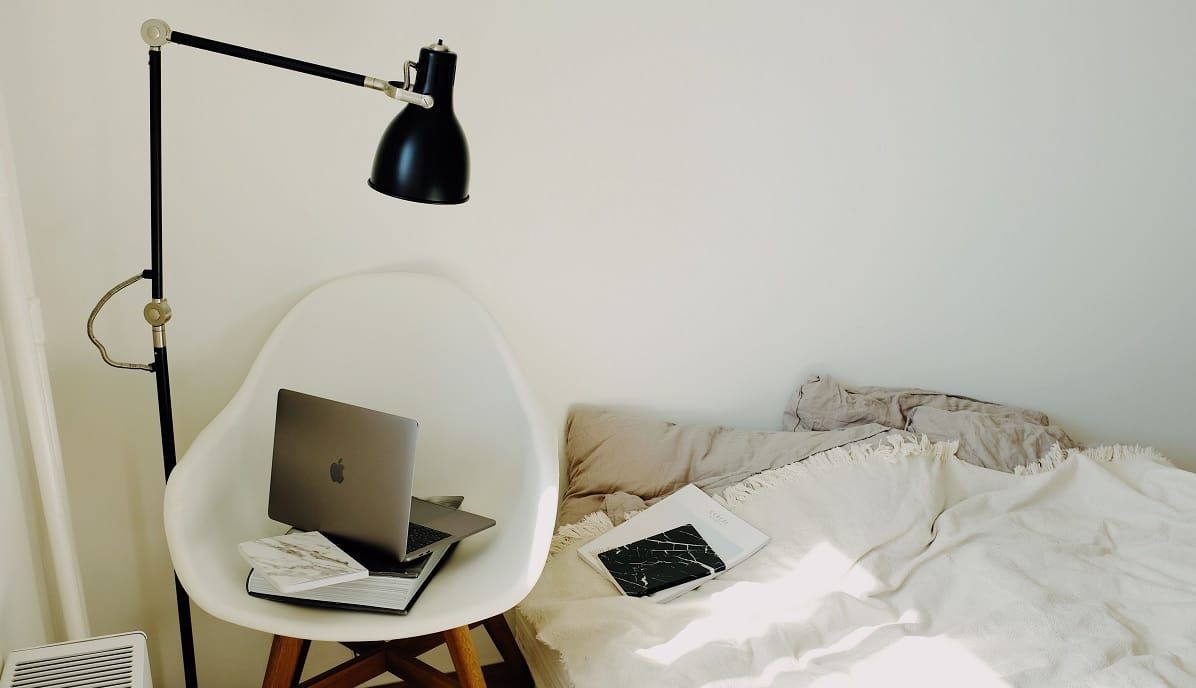
There is a particular kind of ingenuity that develops when ordinary life becomes physically difficult. You stop asking, “What is the normal way to do this?” and start asking more useful questions.
Can I do it from bed?
Can I divide it into smaller pieces?
Can technology remove three steps?
Can I arrange my environment so I do not have to ask for help every single time?
My favorite question is, “What parts of this process don’t need to be done?” Do my file folders need printed labels, or can I just slap on a sticky note?
Disabled people ask questions like these constantly. We redesign routines, rearrange objects, improvise tools, and construct entire lives around bodies that cannot reliably perform on demand.
From the outside, this may look like retreat. A bed desk can look like surrender. Grocery delivery can look like laziness. A carefully guarded schedule can look antisocial. A room filled with chargers, pill organizers, earbuds, rolling carts, grabbers, cushions, and adaptive devices can look excessive.
But many disabled people are not withdrawing from life. We are rebuilding it around the bodies and capacities we actually have. Some of the systems we are creating may offer a preview of how more people will live in the future.
When the standard instructions don't apply
Most of modern life is designed around an imaginary person.
This person wakes at a predictable time, stands without difficulty, moves through a house built for an able body, commutes to work, concentrates for hours, runs errands, prepares food, socializes, completes household chores, and goes to bed tired but functional.
Their energy is treated as renewable. Their body is expected to cooperate. Their environment requires little modification.
Millions of real people do not resemble this person. Disabled, chronically ill, neurodivergent, and older people often have to create alternative workflows because the official workflow does not work.
I do all of my work from bed because sitting for long stretches causes me days of pain afterward. I use a tablet on a floating arm over the bed, with a remote connection to my laptop across the room. With a small keyboard and mouse, I can operate my computer while lying on my side. I recently attached a second tablet to the wall so I can work while facing the other direction and avoid becoming quite so stiff.
My room has become a bedroom, office, art studio, music listening room, media center, and game room.
Climate events, caregiving, illness, economic pressure, and an aging population may lead more people to create similarly multifunctional lives at home.
Disabled people already work during the hours when we feel best and use shortcuts for tasks that nondisabled people can perform without planning. We write notes before appointments because pain, stress, brain fog, or neurodivergence may make it difficult to retrieve information under pressure. We arrange medication by time, symptom, and likelihood of remembering it.
We also keep duplicates of important objects where we need them. I use a walker and take a stair lift upstairs to shower. I keep another walker at the top because transporting the first one would defeat the purpose of the stair lift.
We do not necessarily invent new technologies. Often, we invent new relationships between existing ones.
A tablet, wall mount, wireless keyboard, earbuds, and rolling cart can become a workplace. A delivery app can become transportation. A shared document can become a meeting room. An AI assistant can become a brainstorming partner, organizer, memory aid, or executive-function scaffold.
The mathematics of energy
Disabled people often become reluctant accountants.
We calculate the cost of showers, appointments, phone calls, cooking, travel, and conversation. An activity does not cost only the energy required to perform it. It may also require preparation, transportation, pain management, recovery, and the cancellation of something else.
A doctor’s appointment may occupy twenty minutes on a calendar and consume an entire day.
I recently started using my wheelchair, even on a good day, to see one provider because her office moved to the back of an enormous building. Walking there and back used my energy reserves for the day.
Even enjoyable activities have a price. I love concerts, but after attending one, I will usually be exhausted and sore the next day. When I travel, my recovery time increases by roughly four hours for every hour on the road. So I calculate the cost of a concert six hours away, including the hotel stay, and decide whether I am a big enough fan to make the recovery worthwhile.
Disabled people combine tasks, alternate demanding activities with easier ones, and conserve strength for something important. We abandon the fantasy that every day should contain the same amount of productivity.
These systems can be mistaken for symptoms of a diminished life. But energy accounting is not inherently a disabled practice. It is simply more visible among people who cannot pretend their capacity is infinite.
Everyone has limited energy. Disabled people are forced to acknowledge the limit.
That knowledge may become increasingly useful in a culture facing burnout, chronic illness, caregiving shortages, climate disruption, and longer life spans.
Asynchronous lives are still lives
Many disabled people live partly outside conventional time. We sleep when symptoms allow it, work in short bursts, respond to messages hours later, and socialize without occupying the same room—or even the same day—as the people we care about.
Two of my closest friends live in other states. We communicate mainly through text, with occasional calls. I might send several long, chatty messages to my best friend at 2 a.m. because my back hurts and I cannot sleep. She answers when she gets up at 5:30. The relationship continues, just not on a traditional schedule.
Society often treats real-time presence as more authentic. A meeting seems more serious than an email. A phone call seems more personal than a text. Appearing in person is interpreted as proof that we care.
This excludes people whose bodies, minds, immune systems, or environments do not permit reliable presence.
But asynchronous life is not necessarily thinner. Writing gives people time to process. Recorded communication allows repetition. Flexible response times accommodate fluctuating health. Remote gatherings allow participation without travel, sensory overload, inaccessible buildings, or the physical effort of remaining upright.
Disabled people have been building asynchronous communities for years because they allow us to remain part of the world. During the COVID-19 pandemic, remote work, virtual conferences, telehealth, and contactless services—all things that disabled people had been asking for for years—became normal when nondisabled people needed them.
The bedroom as command center
For someone who spends much of life in bed, the bedroom cannot be only a place to sleep. It may also be an office, library, theater, classroom, medical station, and social space.
Comfort itself has to be engineered. Adjustable beds can reduce pain. Bed risers change the height. Trapeze bars provide leverage for repositioning and getting up. Pillows support particular joints. Blankets, chargers, medication, notebooks, and scissors must remain within reach.
To the person using them, each of these objects may represent one avoided injury, one preserved unit of energy, or one task that can be completed independently. Sometimes independence is as simple as placing the scissors where you can reach them.
Technology as access layer
Disability technology is often imagined as specialized medical equipment: wheelchairs, hearing aids, prosthetics, and communication devices. But disabled people also use ordinary consumer technology in unconventional ways.
Noise-canceling earbuds create a portable sensory boundary. Smart bulbs eliminate the need to cross a room. Tablets can be mounted where books would be too heavy to hold. Online banking and streaming services remove trips out of the house. Delivery services bring food, medication, supplies, and sometimes an entire social world.
Artificial intelligence is becoming part of this informal access layer. It can organize disordered thoughts, summarize dense material, generate a starting structure, draft routine communication, or break a project into manageable steps.
None of these tools makes an inaccessible society fair. But they create small openings, and small openings matter when nearly every ordinary task contains friction.
Disabled people are good at discovering these unintended uses because we approach technology with a different question. Not “What is this supposed to do?” but “What could this help me do?”
Micro-lives and the myth of smallness
Disabled people often build what I think of as micro-lives—not lesser lives, but meaningful ecosystems constructed within narrow physical limits.
Disability can shrink the geographic radius of a life. A person may spend most of the day in one room. A trip to the mailbox may be impossible. A major outing may happen only a few times a year. This is the life I have lived for nearly eight years.
From the outside, it can appear tragically small. But physical range and human depth are not the same thing. A person can study history from bed, maintain friendships across continents, write a book, make art, take classes, advocate for change, fall in love with music, and become intensely interested in an obscure subject no one else in the household wants to discuss.
I have written books, appeared on podcasts, grown closer to the people I love, and started graduate school in a program I have dreamed about for years. A life can occupy a small physical area and still reach far beyond the room.
This is not necessarily the life I would have chosen. Adaptation should not be romanticized. Disabled people deserve healthcare, accessibility, financial security, transportation, assistance, community, and opportunities beyond the bedroom. But a life does not become meaningless just because it has been reduced in scale. Sometimes, scale reveals intensity.
The future is already in the room
Disabled people are often judged according to how closely we approximate nondisabled life. Can we work a conventional schedule? Leave the house? Attend in person? Perform independence in a form other people recognize?
When we cannot, our lives are interpreted as failed versions of normality.
But a person who builds a workable life around severe limitations has not failed to live normally. They have solved a problem the standard design ignored.
These skills will become more relevant as populations age, chronic illness increases, climate events disrupt public life, and technology changes how people work and communicate.
Innovation is usually pictured as something sleek, happening in laboratories and glass buildings. But innovation also happens when someone tapes a charging cable to a nightstand so it stops falling to the floor, or when someone discovers that a rolling cart designed for crafts can hold everything needed for a workday.
My room may look, at first, like evidence of everything disability has taken. But the wall-mounted tablets, reachable supplies, tiny keyboard, rolling carts, and carefully positioned tools are also evidence that I kept designing a life.
Disabled people are not merely waiting for the future to become more accessible.
In bedrooms, living rooms, kitchens, and small corners of the internet, we are already building versions of it.