

Congress' only humanist sounds the alarm on Christian nationalism
Rep. Jared Huffman’s book ‘No Prophets’ warns that democracy is threatened by MAGA Christianity.

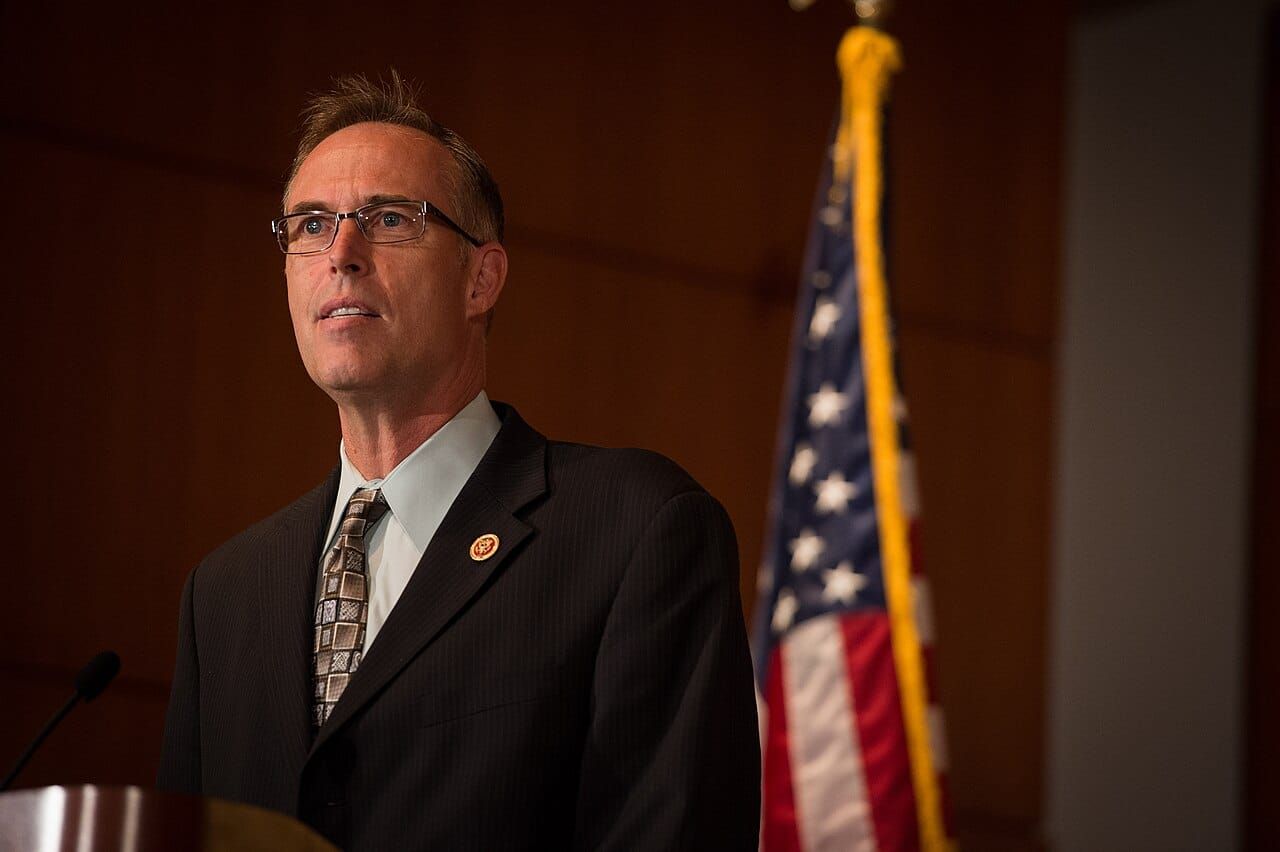
In 2017, U.S. Representative Jared Huffman, a once-devout Mormon, outed himself as a nonreligious humanist—the only current member of Congress to do so. Now he's doubling down with a new book, No Prophets: The Fight to Save Democracy from Christian Nationalists.
The book convincingly warns that this anti-democratic, power-hungry faction is well on its way to turning America into an authoritarian theocracy.
Why aren't there more nonbelievers in Congress?
Perhaps surprisingly, considering the abiding value of secular governance that informed the Founding Fathers’ democratic vision, Huffman is only the second lawmaker in congressional history to reject the concept of God. The first was Rep. Pete Stark, also a California Democrat, who in 2007 described himself as “a Unitarian who does not believe in a supreme being.” Huffman appears slightly more nuanced, self-describing on his website as “a humanist, a loose philosophy based on the idea that humans should work to improve society and live ethically, guided by reason, not necessarily by anything supernatural.”
However, in his book Huffman seems more godless, stating that he is “the only member of Congress dumb enough to publicly admit I don’t believe in God.” But there’s an inherent contradiction in his disparate statements. Which is it? Is he guided “not necessarily by anything supernatural” or “I don’t believe in God”? “Necessarily” in the first phrase is a qualifier; “don’t” in the second is not. In his book, he also says he feels declaring absolute certainty that God exists, or doesn’t, seems “arrogant.” Which would make him an agnostic.
So, humanist it is.
Nonetheless, other members of Congress—many of whom are nonbelievers, as in the general population—won’t even go that far, opting instead to stay silent about their views, Huffman told Jake Tapper on CNN’s The Lead news program this month.
So, Huffman is likely not alone. A 2023 Pew Research Center analysis noted that whereas three in 10 Americans claim no religious affiliation, only two of 534 incoming members of Congress said the same, when statistically there should have been more than 60, PBS News reported. The reason for their reticence: fear of social or political blowback from voters, colleagues and loved ones who remain believers. A 2024 Cornell University study indicated that one in three Americans, about 80 million citizens, “hides their religious disbelief, fearing repercussions from loved ones and communities,” Palo Alto Online reported in October.
OnlySky founder Shawn Hardin’s new documentary film, “Heathens,” which had its world premier at the United Nations Association Film Festival on October 24, introduces five people from fundamentalist Christian families who lost faith but struggled to adjust socially, hiding their deepening apostasy while transitioning from a life of religious devotion to publicly acknowledged disbelief.
In 2018, Huffman and Rep. Jamie Raskin (D-Maryland), and former representative, now Sen. Jerry Rep. McNerney (D-California), founded the Congressional Freethought Caucus, which currently has 37 members (more, interestingly, than the right-wing Freedom Caucus). The purpose of the caucus, Rep. Raskin writes in his foreword to Huffman’s book, is “to defend the Jeffersonian ‘wall of separation’ between church and state, and to promote the passage of public policy based on reason, evidence and scientific knowledge, to oppose discrimination against people based on their religious beliefs or nonbelief, and to provide a forum for dialogue among members of Congress on matters of ethics, morality, and their personal spiritual and religious journeys.”
The caucus is not a cabal of atheists, as some critics have falsely claimed—in fact, its members are a theological mixed bag—but a bastion against encroachment into U.S. governance by far-right Christian nationalists. The nationalist opposition is well-financed, well-organized, and has for years been aggressively pursuing its undemocratic, theocratic agenda against pluralistic, time-honored American constitutional laws, values and norms.
MAGA cranks up the religion dial
In his foreword to No Prophets, Raskin contends that Christian nationalism should be situated “alongside other forces of unreason—like political corruption, racism, and antisemitism, misogyny, conspiracy theory, pseudoscience and disinformation—that threaten to destroy secular democracy and its achievements.”
He writes that Huffman’s book reveals “the underappreciated role of Christian nationalism in the Jan. 6, 2021, insurrection, to the way Christian Zionism is distorting foreign policy and empowering the far right in Israel.”
Huffman was first elected to Congress in 2013, not long before a New York real estate mogul blasted onto the political stage in 2015, seeking the GOP presidential nomination.
“Then came Trump,” Huffman recalls, “the billionaire narcissist who improbably won the support and adoration of millions of conservative Christians and proceeding to open the theocratic floodgates by elevating fringe religious zealots into powerful positions.”
In the book’s introduction, Huffman remembers how “the religion dial was cranked to eleven” among MAGA “Stop the Steal” organizers and protesters in the weeks leading up to the U.S. Capitol insurrection, spurred on by U.S. President Donald Trump and his Christian nationalist lieutenants.
“These weren’t political protests in any normal sense; they were megachurch revivals,” he writes. “Firebrand pastors delivered apocalyptic sermons. Speakers invoked violent Bible stories, labeled Biden as a ‘demon and Antichrist,’ and cast their mission to keep Trump in power as a holy war.”
Speakers at an outdoor conclave Trump addressed the morning of the Capitol attack, Huffman wrote, “prophets” of MAGA “took turns beseeching God to bring ruin and destruction on their ‘Antichrist’ enemies: liberals, abortion rights supporters, Muslims, nonbelievers.”
“At one point, ‘secular humanism’ was added to the divine hit list by a speaker who repudiated ‘weak, limp-wristed, cowardly Christianity’ and urged Americans to embrace ‘the Lord as a man of war,’” he recalled.
Christians embrace an un-Christian president
The Christian Right’s continuing embrace of Trump is starkly ironic in that he is manifestly one of the nation’s most un-Christian presidents—if not the most. He is a convicted civil and criminal fraudster, was found legally liable in 2023 for sexually abusing E. Jean Carroll, compulsively lies about everything, chronically treats people with contempt, cheats on his wives, has called Americans killed in battle “losers” and “suckers,” and, tellingly, did absolutely nothing for several hours to stop the rioters who in his name rampaged in and around the Capitol and beat law enforcement officials bloody on the infamous insurrection day.
No, Donald Trump is no paragon of Christian love or moral rectitude. Not that his millions of fact-averse acolytes seem to care.
In the January 6 “Jericho March,” Huffman writes, “thousands of MAGA faithful marched around the Capitol, Supreme Court, and Department of Justice, blowing traditional ram’s horn trumpets called shofars in a reenactment of the biblical siege of Jericho.”
In the Bible, after Joshua and the Israelites subdued Jericho, the God of the Old Testament, in Joshua 6:21, commanded him to slaughter every survivor—“both man and woman, young and old, ox and sheep, and ass, with the edge of the sword.”
The morning of the insurrection, Trump infamously incited protesters: “We fight. We fight like hell, and if you don’t fight like hell, you won’t have a country anymore. So let’s walk down Pennsylvania Avenue.”
He said he would walk with them. But he didn’t.
Off charged the hyped-up minions, and “minutes later, all hell broke loose,” Huffman wrote. “Trump’s shock troops slammed into the west wall of the Capitol. From a block over (where Huffman sat in his office) and five stories up, the noise was deafening.”
The Capitol riot was a manifestation of the existential threat to U.S. democracy posed by Christian nationalism, which is also the central warning of journalist Michelle Goldberg’s 2007 book, Kingdom Coming: The Rise of Christian Nationalism. Two other books on the worrisome phenomenon spotlighted by Huffman are Katherine Stewart’s The Power Worshippers, and Andrew Whitehead and Sam Perry’s Taking Back America for God.
Huffman contends that Christian nationalism is “the ‘connective tissue’ that bonds Trump’s disparate elements together.” He adds, “And the MAGA Christian nationalism Trump stoked wasn’t an innocent combination of gauzy patriotism and nice Christian values. It seethed with violence and hatred.”
Rep. Huffman's journey to humanism
Indeed, Huffman says it was alarming expressions of violence and hatred in his own Mormon sect that eventually drove him to humanism and unbelief.
He recounts a harrowing story about a former high school basketball teammate, Richard Brand, who descended into darkness. Following college, Brand, after being fired from his Mormon offshoot Reorganized Church of Jesus Christ of Latter-Day Saints (RLDS) temple for embezzlement, embraced the teachings of Jeffrey Lundgren, the charismatic leader of an RLDS fringe cult. In prophetic Christianity, Huffman explains, “people claim exclusive access to God’s voice… and when others believe them without question, the consequences can be deadly.”
Ultimately, Brand “ended up helping murder an innocent family—Dennis and Cheryl Avery and their three young daughters—in a ‘blood sacrifice’ to please God,” Huffman wrote.
The family’s “sin”? According to Huffman, they declined to move permanently to a remote farmhouse with other cult members to build a new Zion, as Lundgren demanded. Lundgren claimed God told him the Averys must be killed for their insubordination, Huffman writes, and Brand “believed Lundgren spoke for God and that disobedience meant damnation. So, he went along.”
Lundgren was convicted of the killings in 1990 and executed six years later, while Brand and an accomplice served 21 years in prison for their roles in the homicide. Other accomplices received varying long sentences. Brand was later paroled.
Huffman recounts other Mormon schoolmates who went to dark, crazy, harmful—if not homicidal—theological places fully believing they were doing God’s bidding.
Huffman’s “moral breaking point” came in the summer of 2017, he says, with “the ascendance of self-styled “prophets” in Trump’s orbit, paired with the Christian nationalist takeover that was reshaping so many federal agencies and policies.”
Pushing back against this movement are American “nones”—citizens who claim theological allegiance to “nothing in particular”—including atheists (17%), agnostics (20%) and people who are otherwise religiously unaffiliated (63%). Combined, “nones” comprise about 28% of the U.S. population, up from 16% in 2007, and they are the nation’s fastest growing religion-adjacent demographic.
“Nones” also are the largest religion-related cohort in the U.S., larger than Catholics (24% of the population) and Protestant Christians (23%).
Yet, the impressive growth of the “nones” like Rep. Huffman, plus a slew of best-selling books on atheism and secularism (e.g., the late Christopher Hitchens’ acerbic best-seller God is not Great), has not necessarily translated into broad acceptance of their views by the rest of the populace.
When will nonbelievers find acceptance?
Although Thomas Jefferson wrote in the 18th century that atheists should be equal, respected citizens of the new American republic, in the 21st century nonbelievers are among the nation’s most distrusted groups.
“The legitimate powers of government extend to such acts only as are injurious to others,” Jefferson wrote in his 1798 book Notes on the State of Virginia. “But it does me no injury for my neighbor to say there are twenty gods, or no god. It neither picks my pocket nor breaks my leg.”
Notwithstanding, in the U.S. today, even hints of atheism are radioactive for political candidates.
A 2012 study published by Scientific American concluded: “Only 45 percent of Americans say they would vote for a qualified atheist presidential candidate, and atheists are rated as the least desirable group for a potential son-in-law or daughter-in-law to belong to.”
A 2026 study published in the journal Secularism and Nonreligion indicates that bias against atheism remains deeply embedded in U.S. society—and even in other Western countries, such as the United Kingdom.
One of Huffman’s most beloved college professors once posed this challenge: “Is the involvement of religious groups in politics a good or a bad thing? Discuss.”
Huffman doesn’t recall how he answered this in 1985, but he knows how he would today: “It depends.”
“If religious groups engage in politics while respecting democratic norms—following the law, peacefully bringing their values into the public square, and accepting that in a democracy you don’t always get what you want—that’s a healthy democracy, whether I agree with their views or not,” he writes. “But if they reject the democratic order and seek to impose their religion on others through the coercive power of government, then it’s not just bad, it’s dangerous and un-American.”
“I’ll stake my grade on that,” he adds, “but this exam is still in progress, and history is doing the grading.”
But what Christian nationalists are trying to do is the opposite of healthy for democracy, Huffman warns.
Huffman’s book recounts the history of the Christian nationalist movement, much of it disingenuous and stealthy, and vehemently warns of the existential danger it poses to American democracy and secular governance.
And it’s not only “nones” that are worried.
Scared of the monster they created
In 1982, a Southerner named John Whitehead launched a Christian liberty law firm, the Rutherford Institute, which helped turbocharge the fledgling Christian nationalism movement. Today, he says the movement he helped create is not Christian. “This is not faith, this is blasphemy baptized in nationalism,” he told journalist Michelle Borstein in an article this September.
“We started out trying to protect the little people,” Whitehead told Borstein, adding that movement leaders are now “sitting in the White House with Trump. They’re now part of the nationalist movement. Religious liberty is a constitutional principle, not a political program.”
In October 2025, after then-Homeland Security Secretary Kristi Noem publicly prayed at an ICE facility in Portland, Oregon, Whitehead wrote that her actions were “not Jesus’ Christianity—it is Christianity draped in the flag and wielding the weapons of war.”
Borstein wrote that law firms associated with Whitehead’s hugely successful Rutherford Institute over many years and “sprinkled with his former protégés, have been on a winning spree at the Supreme Court, overturning long-standing legal limits on religious expression by public officials, expanding religious exemptions and elevating the place of religious exercise to its highest point in modern times.”
But after turning against what he says has evolved into a “dangerously politicized” right-wing movement, Whitehead is now an outcast.
“If the government is acting as a Christian nationalist organization as opposed to one representing the Constitution and all Americans, there is a problem,” Whitehead told Borstein.
There are many other loud naysayers in the faith community, including Christians Against Christian Nationalism, an initiative of BJC (Baptist Joint Committee for Religious Liberty); the American Baptist Churches USA (ABCUSA); various mainline Protestant organizations, such as United Methodist Church (UMC) and the Evangelical Lutheran Church in America (ELCA); and individual Catholic theologians, leaders, and Latino evangelical networks.
"The mind once enlightened cannot again become dark"
Huffman writes, “If I’ve learned anything from my odyssey with religion—from my Christian youth, to the spiritual drifting that ultimately landed in Humanism, to the wonderful complexity of having a Catholic wife, ultra-Orthodox Jewish sister, two agnostic brothers, and dear friends at every point on the spectrum of faith—it is the importance of stretching beyond the narrow comfort zones to find the universal values that are always there to unite us.”
“Let us be worthy of [our democracy] by confronting the myths, defending the facts, and honoring the Enlightenment inheritance that made pluralistic democracy possible,” he writes. “And as we do, let us remember Thomas Paine’s words that echo across the centuries: ‘The mind once enlightened cannot again become dark.’”
Of relevance is a quote by the late great Carl Sagan in his 1995 best seller The Demon-Haunted World, which opens Huffman’s tome with an ominous warning that Americans ignore reason at their own existential peril:
“I have a foreboding of an America in my children’s or grandchildren’s time,” Sagan wrote, “…when the people have lost the ability to set their own agendas or knowledgeably question those in authority; when, clutching our crystals and nervously consulting our horoscopes, our critical faculties in decline, unable to distinguish between what feels good and what’s true, we slide, almost without noticing, back into superstition and darkness.”
Sagan’s and Jared Huffman’s existential warnings should be viewed as essential guideposts as America’s fact-challenged future unfolds.
HEATHENS, a new film from OnlySky's publisher, tells the stories of America's growing secular population. Learn more or find a screening near you.