

Godless time: Time for a secular calendar
Time is measured by scientific standards, so why do we still use a calendar based on religion?
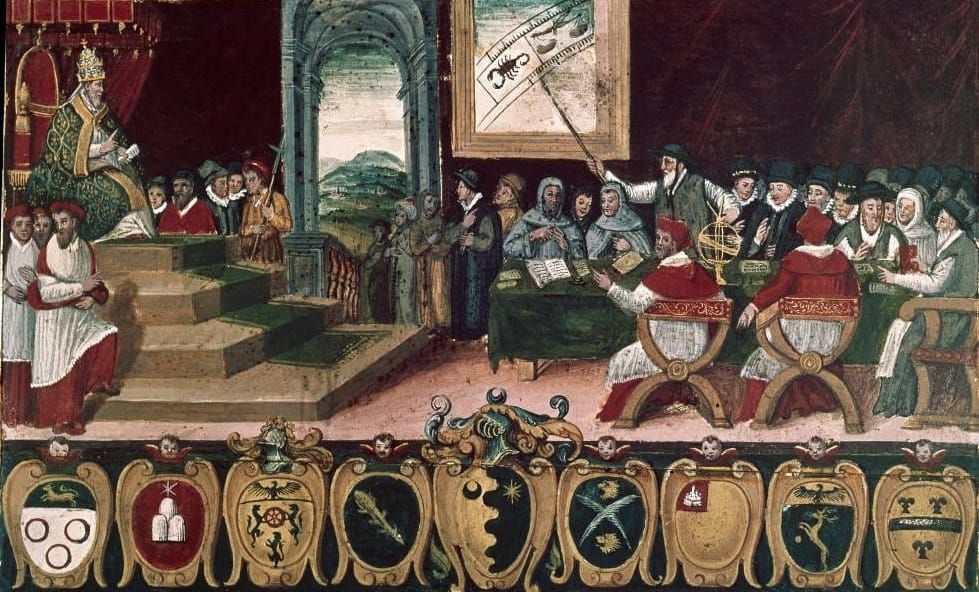
We derive our time unit, the second, from a global network of atomic clocks. This atomic time forms the basis of Coordinated Universal Time (UTC). To line the seconds up to form a time scale, UTC bundles them into larger derived units—minutes, hours, days, months and years—and identifies the days, months and years by the Gregorian calendar. And that’s a problem, because the Gregorian calendar is a Christian calendar conceived by the Catholic Church for ecclesiastical purposes. This leads to the curious situation where in our standard time, the time units are defined by science, but the time scale is defined by religion.
Our calendar, based on religion, is a problematic world standard
The Gregorian calendar was introduced by Pope Gregory XIII in 1582 and has since been adopted by (almost) every country in the world: Catholic European countries and their colonies adopted it immediately in the 16th century, Protestant countries over the course of the next two centuries, some Muslim and Buddhist countries in the 19th, and Eastern Orthodox countries followed in the 20th century. The most recent convert, Saudi Arabia, joined just 10 years ago in 2016. This slow pace of adoption—over 450 years and counting—is indicative of just how problematic this standard is. So, what is wrong with it?
There are technical and conceptual problems. The calendar effectively uses two separate time scales with religious labeling: One for the years of the Christian era, labelled “Anno Domini”, or AD, meaning “the years of our Lord”; and one for the years prior to the Christian era, labelled “Before Christ”, or BC. Both start counting at 1 and are not connected through a common year zero, which complicates the math of calculating time intervals. The start date of the Christian era is specified by the incarnation of Jesus Christ. But this was not only calculated wrong by several years (he was probably born around 4 BC), but it is also indeterminate (no one knows when Jesus was actually born) as well as inaccurate (no one knows if incarnation refers to conception or birth).
Those are some of the technical problems. More problematic, though, are the conceptual problems: The year of the onset of the Christian era is referenced to the immaculate conception and the virgin birth of Jesus Christ and the day (and month) is linked to the resurrection of Christ (the Pope wanted to fix the date of Easter somewhere close to the spring equinox) as well as to the biblical creation (supposed to have occurred at 6 PM on October 22, 4004 BC). This means that the origin of the Gregorian time scale is defined entirely in reference to supernatural happenings in religious stories of a minority religion. That raises some serious questions.
In the natural sciences, scientists need to ask themselves: Does it make sense to measure time by a time scale that is indeterminate, inaccurate and referenced to the supernatural? Can that even be considered a “scientific” time scale? In the humanities the question is: Does it make sense to evaluate the histories of other cultures along a timeline that is defined by the religious beliefs of one particular culture? Is that really unbiased science? For civil society: Does it make sense to run the affairs of a multicultural world by the calendar of one particular minority religion? Is that really inclusive? If the answer to these questions is no, then the next question is: What to replace it with?
Technical improvements by scientists
Astronomers soon started tinkering with the technical issues in an effort to create a more scientific time scale, first with the insertion of a year zero to fix the math of calculating dates, and later substituting positive year numbers for the “Anno Domini” years and negative numbers for the years “Before Christ” to simplify the math. The German astronomer Johannes Kepler kicked this off as early as 1627 by introducing a kind of zero, which he called “Christi”, meaning “Christ’s”, in his astronomical tables. The actual number 0 was first used by the French astronomer Jaques Cassini in 1740 who defined it as “the year in which it is assumed that Jesus Christ was born”. That is a very subtle, but important distinction.
It is clear that these astronomers had no intention to remove religious connotation. Their motivation was scientific accuracy: By defining a date, they were making no claim to knowing the actual birth date and thus decoupled it from the uncertainties associated with the historical date. But they did not decouple it from the religious and supernatural connections: The “year zero” is defined as the year “1 Before Christ”. The subtle shift from “when Jesus was born” to “when Jesus was thought to have been born” does not make it scientific per se. It remains unequivocally a year “when something supernatural is supposed to have happened”. It certainly is not astronomical or in any way physical or evidence-based. It is, in fact, arbitrary. On top of that, it inherits the beginning of the year—together with its religious and supernatural connections—from the Gregorian calendar unchanged.
About a hundred years ago, in 1925, the International Astronomical Union struck a committee to look into this. This committee recommended moving the beginning of the year to the winter solstice as a more logical start date for a new cycle of seasons. But this recommendation was never implemented. So, this astronomical year numbering definitely represents a technical improvement over the Gregorian time scale, but conceptually it is not an adequate replacement. So, the question remains: What to replace it with?
The Anthropocene and the Great Acceleration
An answer to that has recently become clear: The Anthropocene. The Anthropocene is a proposed new unit in the geologic time scale which subdivides geologic time into periods as they appear in the stratigraphy of the rocks, and pairs these with equivalent periods of historical time. Each one of these time periods is defined by the Earth system remaining relatively stable within certain limits.
For the past 12,000 years we have been living in the geological epoch of the Holocene. But since the turn of the millennium, evidence has been mounting that we may have crossed its thresholds recently. This would mean that the Holocene has ended and we have entered a new geological epoch, the Anthropocene. So, what happened?
In the mid-20th century, the human population exploded. Over the hundreds of thousands of years of human evolution, the population grew to 1 billion by 1800. By 1950 it was already 2.5 billion, and in 2022 we surpassed 8 billion. This enormous population growth has been accompanied by an equally enormous growth in energy consumption and pollution. In the first seventy years of the Anthropocene, we have consumed more energy than in the entire 12,000 years of the Holocene. All of this has left a mark on the planet.
The rise in population and energy consumption has led to equivalent rises in carbon dioxide in the air, surface temperature, ocean acidification, and a whole host of other indicators of the functioning of the Earth system. Every one of these indicators exhibits a sharp increase in their growth rates around 1950. This planetary environmental change has been termed the Great Acceleration that marks the onset of the Anthropocene. Just like the asteroid impact 66 million years ago led to a fundamental transformation of living organisms across the planet, so the activities of technologically advanced humans have exerted enormous environmental impact on planetary climate and biodiversity.
Industrial emissions have not only altered the natural composition of the atmosphere, but have contributed entirely new chemicals that do not even occur in nature; and not only to the atmosphere, but also to the oceans and the land (e.g., garbage, plastics, fly ash, concrete, etc). This is reflected in the sediments that are being deposited now.
But today’s sediments are tomorrow’s rocks. So, in 2009, geologists established the Anthropocene Working Group to find out if these changes fit the formal definition of a new geological time period. After 15 years of work their answer was an overwhelming “Yes”. The geological change on Earth is no longer due to purely “natural” forces, but is now driven by human activity. And they used radiometric dating to nail down its exact beginning: 1952. Although in 2024, despite the mountain of evidence, the geological community decided to ignore the advice of their own experts and failed to ratify the Anthropocene for their very specific purpose, the concept of the Anthropocene is alive and well.
The Anthropocene Era and the Anthropocene time scale
We can now use the work the geologists have done to define a new historical age, the Anthropocene Era, which coincides with the geological Anthropocene epoch but has a more precisely defined beginning. Geological methods can pin down the geological onset to within a year. But for standard time we need to define it down to the day (or second, even).
So, we define it in the following way: First of all, adopt astronomical year numbering. This sanitizes all the arcane technical issues. Then, shift the year of the origin to the onset of the Anthropocene, and shift the beginning of the year to the winter solstice.
If we do that, then the resultant time scale is defined entirely by astronomical and geological evidence, without any of the religious and supernatural baggage. This gives the natural sciences a physical time scale. It gives the humanities a cultural bias-free time scale. And in civil use, it would be a meaningful modernization of the calendar that is based on science instead of faith. A culturally unbiased world standard for a multicultural world.
Implementing Anthropocene time is easy
Implementing the Anthropocene Era as standard time involves nothing more complicated than a simple shift of origin: Subtract 1952 years from the current date and add 10 days. That’s it. Most physicists can perform this conversion in their heads; most historians can do it with a calculator. For the rest of us, our smart phones will do it for us.
This is not full-blown calendar reform, which can be difficult to implement because messing with the internal structure of the year can be disruptive. But Anthropocene time leaves the structure of the year entirely intact. It is more like a calendar update that has few, if any, practical consequences at all. It literally just calls the year by a different name: You say “2026”, I say “74”. You say “potaytoe”, I say “potahtoh”. It is akin to a name change. But names convey meaning. and a simple name change can be culturally highly significant and meaningful.
It is just inconceivable that today, in the 21st century, we still reckon time by a church calendar. We still do not measure time by a physically meaningful time scale. But we surely should. And we certainly could. We have now, in the Anthropocene Era, a historic opportunity to remove religion and the supernatural from our time scale and make our dates entirely physical and evidence-based. Whether we actually will... that, dear readers, is up to all of you.
Time, as they say, will tell.