

How digital nomads are reshaping work and life
Workers of the future will live wherever they choose, rather than being tied to a fixed location.

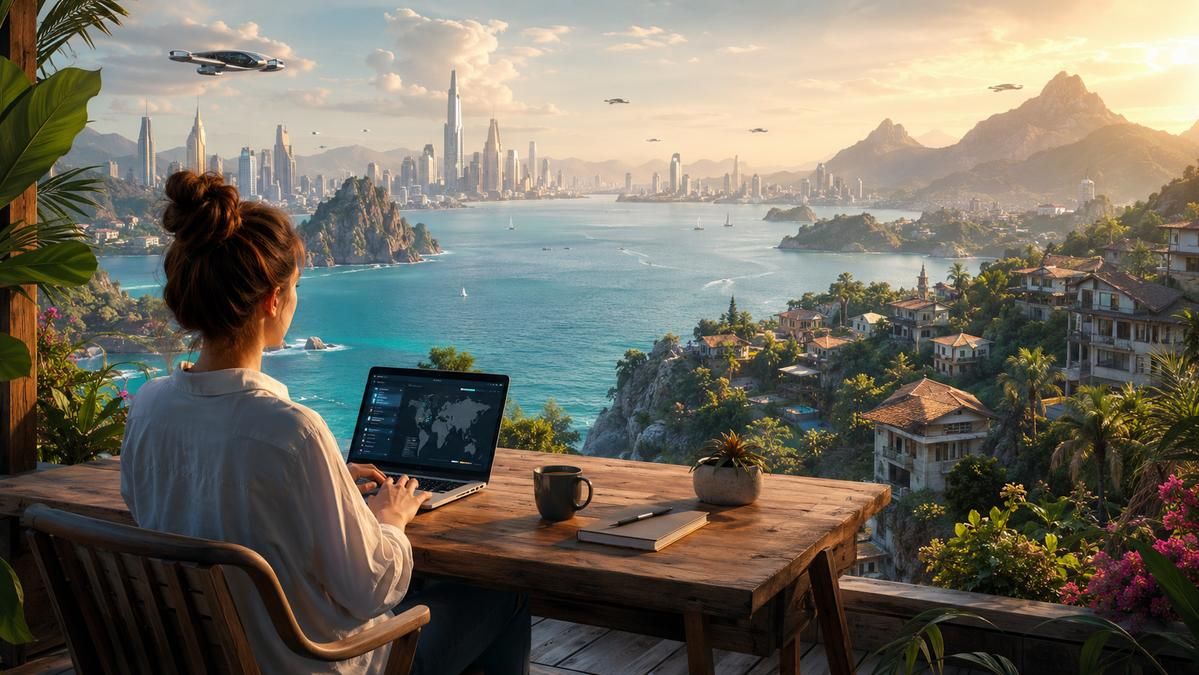
How would you like to live near the beach in a tropical paradise, or in a charming European city rich with history and culture, or in an affordable, up-and-coming destination where you can live like a millionaire—all while keeping a regular job?
All of that is possible; just ask a digital nomad.
From survival necessity to lifestyle perk
During the pandemic era, remote work exploded in popularity as a necessary adaptation. Even after vaccines were rolled out and COVID receded as a global threat, work-from-home programs persisted, becoming a valued perk in tech companies and other jobs where work is mainly done on a computer. Over time, it became an accepted, long-term way of working and living.
However, not all remote workers are digital nomads. A digital nomad is someone who works remotely, but instead of living in a fixed place, is location-independent. A digital nomad travels and works from any place they choose, changing their location every month, season, or year, or whenever the mood strikes them.
This lifestyle is no longer a niche experiment, reserved for freelancers sipping coffee in Bali or twenty-somethings on a gap year. More and more remote workers are discovering that their quality of life improves when work is detached from geography. Why deal with the slog of a daily commute, or live in expensive, crowded cities simply because that's where the corporate offices are, when you can instead choose a location based on your climate preference, affordability, safety, culture, public services, or proximity to nature?
The digital nomad lifestyle has become a serious economic, cultural, and technological movement. A 2025 study by Cornell University that analyzed millions of Airbnb reservations found a long-term increase in extended stays associated with remote workers and "slowmads"—digital nomads who travel slowly and settle for longer in one location, usually from a few months to a year, to avoid the stress of constant travel.
As a digital nomad myself, I have seen firsthand how remote work redefines our understanding of home and identity and creates a lifestyle based on freedom of movement. Millions of digital nomads believe that home can be any place where you feel you belong, not necessarily the place you were born or the place where your office is.
Countries compete to attract digital nomads
Today’s digital nomads represent a new class of globally mobile professionals, especially freelancers and those in the startup world. Digital nomads create their own communities, inspiring demand for dedicated co-living and co-working spaces. Some governments have created visa programs specifically tailored to digital nomads, in hopes of attracting high-paid professionals.
According to research from Global Citizen Solutions, 91% of digital nomad visa programs worldwide were launched after 2020, showing how nations are competing to attract remote workers and location-independent entrepreneurs. Countries offering these visas include Portugal, Spain, Estonia, Croatia, Greece, Malta, Mexico, Thailand, Barbados, Costa Rica, and the United Arab Emirates. These visas offer one- to three-year stays, pathways to residency, tax incentives, and infrastructure specifically designed for remote professionals.
Portugal is among the top destinations for digital nomads because of its established nomad communities and strong connectivity. Estonia—a favorite of mine—is popular among tech startups and is influential thanks to its pioneering e-Residence program, fantastic Internet offers, affordable co-living and co-working spaces, and the magic of living in a historic medieval town. Spain remains attractive due to its residency pathways, excellent infrastructure, and lifestyle advantages for those who prefer the culture and weather.
By 2035, there could be over one billion digital nomads globally. As remote work becomes the norm, cities will require more advanced digital infrastructure and reliable networks. Satellite connectivity will be a must, especially in remote rural areas chosen by adventurous digital nomads who prefer these places over crowded cities. There will be a rebalancing of the global economy as remote work reshapes regional economies.
Large metropolitan cities will still be important cultural centers, but we will also see the rise of distributed living that includes smaller towns and villages, driven by people seeking a lower cost of living, more privacy and easy access to nature. This will result in a more sustainable rural economy, revitalizing regions that were left behind in previous economic revolutions.
Digital nomads reshape the workforce
In the next few decades, the influence of digital nomads will force companies to shift to global-first hiring and immersive virtual collaboration. It’s fair to say that not everyone can or is willing to adapt to a lifestyle on the move. However, there are certain jobs, industries, and careers that are well suited to those who choose a digital nomad lifestyle, as noted by the EU Business School.
By the 2040s, the digital nomad lifestyle will move fully into the mainstream, becoming a normal and accepted element of the workforce. Countries will compete to attract remote workers with tax incentives, cheap ultra-fast internet connectivity, smart cities with autonomous public transportation, and convenient, flexible visa programs and cross-border mobility agreements.
Digital nomads are a boon to local economies because we are not simply tourists who visit for a few days. We can stay for months or years at a time in a chosen place, renting apartments or co-living spaces, using dedicated co-working spaces, supporting local cafés that also function as offices, and supporting local businesses, even launching startups and hiring local talent.
Today, most remote work still imitates office culture, with endless video meetings, phone calls and Slack notifications. Remote work in the next few decades will be powered by advanced artificial intelligence, immersive computing, and ambient collaboration tools. Rather than sitting in front of a screen all day, remote workers may interact through wearable devices, spatial smart glasses, or mixed-reality workspaces. AI assistants could handle scheduling, research, customer service, coding, and even provide negotiation support.
Digital nomads of the future may also become micro-citizens of several countries simultaneously, an idea I personally support as it could simplify international travel dramatically.
At the same time, some challenges remain. Remote work is not equally accessible to everyone. Remote opportunities tend to favor highly skilled workers and wealthy regions that can afford to invest in digital infrastructure.
There are psychological considerations that should be taken into account as well. Frequently moving and never having a chance to put down roots can lead to loneliness, depression, and burnout. This is a reason why most digital nomads shift toward slower lifestyles, spending extended periods in one place instead of constantly traveling. Perhaps the secret is in identifying a few places in the world where you feel you belong and dividing your time among them. This strikes a balance between geographical freedom and local belonging.
Another thing to consider is that the digital nomad lifestyle is poorly suited for families with small children, as reported by the Guardian. Education is a major challenge when families don't stay in one place long enough to enroll their children in formal schooling. Children also suffer from anxiety and depression when they never have a chance to make long-term friends, especially when there are language or cultural barriers on top of that.
For generations, people structured their lives around the places they worked. In the coming decades, work will increasingly organize itself around human life instead. A life motivated by freedom, flexibility, well-being, and global mobility—for millions of digital nomads living this reality, the future has already begun.