

Why did the color violet go viral after 1863?
Allen Tager has spent the new millennium thus far trying to find out why the color violet is so difficult to find through thousands of years of human history—until suddenly it was everywhere.

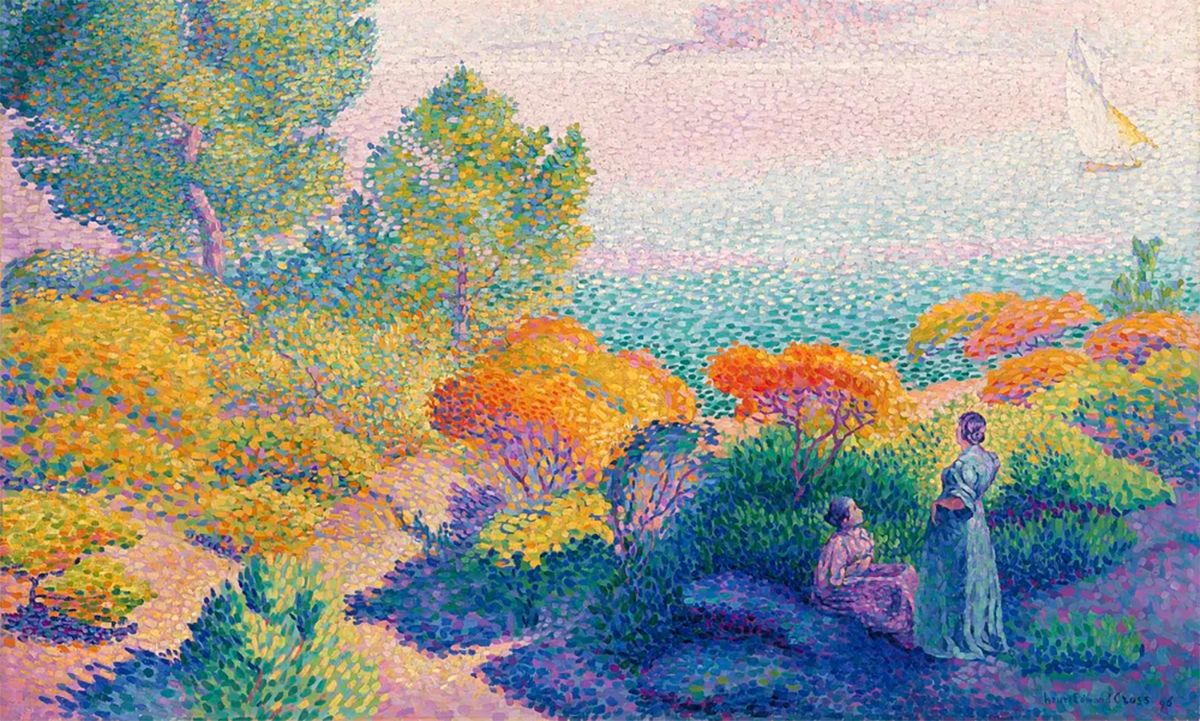
Allen Tager has spent the new millennium thus far trying to find out why the color violet—a combinative color of red and blue—is so maddeningly difficult to find through thousands of years of human history.
But in the late 19th century that color’s fortunes seemed to suddenly enhance.
Tager, a Russian-American artist and cognitive scientist, thinks he may have unraveled the mystery. What happened allowing violet to abruptly emerge in artistic expression?
During the past 20 years, by his own count, he has visited 193 museums in 42 different countries in service to this quest. In a recent Psyche ezine essay, he explained:
“Equipped with 1,500 Munsell colour chips—the world-standard samples for colour science—I examined 139,892 works of art, searching for violet. I concluded that there were indeed only a very few artworks before the 1860s that contained this colour from my childhood. But from the second half of the 19th century, violet became very popular.”
He noted that his fascination with violet stems from his early schooling in the old USSR where school pens inexplicably all had violet ink.
“In contrast, though, outside of school, violet was hard to find, be it in paintings or everyday life,” Tager recalls, “I am a painter, and early in my career I noticed that neither the teachers in my painting classes nor my fellow students used violet pigments. … I realised that, in my childhood, I’d never seen anyone in a violet blazer, shirt, tie or dress, holding a violet umbrella.”
Why was that? he wondered.
In initially researching the question at London’s National Gallery, he found but a single painting with violet created before Impressionism kicked off in 1863 in France. It appeared that the greatest artists of preceding eras had simply ignored that color.
He subsequently collaborated with color scientists Eric Kirchner and Elena Fedorovskaya in collecting high-resolution digital photos of 4,117 paintings from 14 of the world’s largest art museums, and putting them online. Included was artwork from ancient civilizations, and from the Middle East and Asia spanning the 4th to mid-19th centuries.
Can we thank supernovae muons for birthing violet
Tager’s synthesized theory of why violet suddenly emerged in fine art and elsewhere in world cultures sounds simultaneously exotic and pedestrian, and in fact, it may be both.
In a 2018 paper in the academic Journal of Cognition and Culture, he wrote:
“I examine[d] several explanations for the explosion of the use of violet in the art world during the Impressionist era, and conclude that a cognitive-perceptual explanation, based on the heightened sensitivity of the Impressionists to short wavelengths, may account for it. The findings fit with a new understanding about evolutionary changes in planetary light and human adaptation to light.”
Tager contends a two-track trajectory may have led to violet’s seemingly sudden embrace by human culture.
The first and most fundamental track, he speculates, was scientific:
“Over the millennia, the light reaching our planet might have changed, causing our retinas to adapt accordingly. The idea drives the zoologist Andrew Parker’s ‘light switch’ theory, which suggests that, when atmospheric oxygen increased during the Cambrian explosion, this in turn boosted the amount of light reaching our planet, increasing the evolutionary benefits of vision too. As a result, the eyes of the creatures that populated Earth back then rapidly developed. … But what could have caused us humans to embrace the colour violet so recently in our history?”
He cites a theory by American astrobiologist Adrian Melott at the University of Kansas, who “has suggested that cosmic rays produced by supernovae can alter ionization of the atmosphere, resulting in showers of subatomic particles called muons; the muons, in turn, might induce genetic mutations in Earth’s inhabitants, including us.”
Everything really useful at some point goes viral.
Tager’s conclusion, though tantalizing, seems far-fetched.
“I can’t help but wonder whether a muon shower might have enhanced our ability to see violet midway through the 19th century on Earth,” he wrote.
Perhaps, if science can provide some compelling evidence for this musing.
But the other track Tager cites for violet’s sudden popularity starting about 162 years ago seems far more convincing.
‘The law of simultaneous contrast’ inspired impressionists
He refers to the discovery by French chemist Michel Eugene Chevreul of “the law of simultaneous contrast,” which holds that colors appear more intense when viewed side-by-side with their complementary color. Then, in 1864, influential French art critic Charles Blanc wrote about Chevreul’s law in relation to Eugene Delacroix’s paintings—how violet in Delacroix’s art was intensified in juxtaposition to yellow.
Blanc later elaborated on this in his book, The Grammar of Painting and Engraving, which became a kind of artists’ textbook in late-19th-century Frances, Tager notes:
“It would directly inspire painters such as Georges Seurat, Vincent van Gogh, Camille Pissarro and indirectly also Claude Monet, Paul Signac and many others.”
This is plausible because people are inspired and moved by new ideas that can quickly and lastingly revolutionize old practices, as in fine art.
As someone noticing that milkmaids didn’t get smallpox led to an effective inoculation against the dreaded disease globally, it’s not outlandish to think that someone noticing how certain colors side-by-side enhance each other might transform art and turbo-charge the Impressionist movement.
Everything really useful at some point goes viral, even if at first we don’t have a clue why.