

The single day of Carl Sagan
The embers of a great scientist continue to kindle light down here on Earth.

When I was eight years old, my dad gave me an astronomy book: Terence Dickinson's Exploring the Night Sky. It was a beautiful book, packed with gorgeous illustrations and amazing facts—but one of these amazing facts scared the hell out of me.
One section talked about the future of the Sun and Earth. To my absolute horror, I read that the Sun was going to die, and it would likely take the planet down with it. Now, I knew that living things could die—I had lost a grandparent to cancer several years earlier—but, as far as I knew, Earth and the Sun had been around forever and would remain so. Dickinson had stated that it wouldn't happen for another five billion years, but what did that number mean to an admittedly math-challenged eight-year-old?
I think that this was the first time I truly grappled with the concept of mortality. For a long while, whenever I was outside, I would occasionally glance up at the Sun, as if to reassure myself that it still looked as it should. It may seem silly now, but to this little kid, knowing that our star still shone and the ground was still solid meant everything.
Like mayflies
In his 1980 book Cosmos, the astronomer Carl Sagan wrote,
"Compared to a star, we are like mayflies, fleeting ephemeral creatures who live out their whole lives in the course of a single day."
It turns out that stars are like mayflies too, compared to the universe itself. It's a sobering thought, but also an oddly enlightening one—a star spends its single day as a beacon in the dark, warming worlds and potentially nourishing life. A human can do the same with their day, whether it is through educating the next generation, performing acts of kindness, or simply recognizing that—deep down—every other human being is just like them.
Carl Sagan spent his own single day shining as brightly as a blue supergiant star. Unfortunately, however, these behemoths burn fast and die young—and Sagan was no exception. A year after I discovered the Sun would die, his own light went out.
What a light it was, though.
Our very best
There are those who believe that knowing the science behind something somehow ruins its beauty. They would prefer to preserve the mysteries of the flowers and the stars. Sagan could not have disagreed more. When he looked at a flower, he didn't see a scientific name or a dry paragraph on photosynthesis. He instead saw, as he put it in Cosmos, part of a "planet-wide mutual mouth-to-stoma resuscitation, the entire elegant cycle powered by a star 150 million kilometers away."
Sagan viewed human beings in the same way. He famously called us "star stuff"—the end result of ancient stars going supernova, forging the atoms of our own bodies in the chaos. Humans were simultaneously unimportant (in the sense that we do not occupy center stage in the cosmos) and very important. Sagan held that we were "a way for the cosmos to know itself" through our ability to wonder, question, and investigate.
He did, of course, wonder whether there was intelligent life elsewhere in the universe. A major proponent of SETI, in 1985 he published his only work of fiction, Contact, in which humanity must come to grips with the ramifications of discovering an advanced extraterrestrial civilization.
He also took a leading role in crafting the messages sent aboard the Pioneer and Voyager spacecraft in the 1970s. If there is life elsewhere, Sagan saw to it that they'll see us at our very best.
Our very worst
What worried him was when we were at our very worst.
Sagan made it part of his life's mission to combat what he dubbed "that reptilian voice within us": the tribalism, the fear, the ignorance and superstition that ran rampant throughout daily life. A civilization as dependent on science as ours simply could not afford to be ignorant of how that science actually worked. Sagan was deeply troubled by this demon-haunted world, but he offered a solution in the form of the "baloney detection kit", which, among other ideas, advocated the following:
1) Independent confirmation of facts
2) Not getting attached to any one hypothesis
3) the use of Occam's Razor: if two hypotheses are both capable of explaining the facts, the simpler of the two is more often than not closer to the truth
A world of high technology demanded an equally high understanding of the underlying science, but Sagan recognized that there was more to the equation. We badly needed to be able to understand each other.
A nightmare scenario
Sagan had grown up in the shadows of the Great Depression and World War II. He spent a significant portion of his life, as did so many others, under what President Kennedy termed the "nuclear sword of Damocles" of the Cold War. Sagan knew that we were capable of great violence and destruction.
He also knew, though, that we were capable of great compassion and courage. If he could reach that part of us, we might have a chance—not just to survive, but to thrive.
In the final episode of the PBS version of Cosmos, "Who Speaks For Earth?", Sagan took viewers through a nightmare scenario—an Earth where humanity had succeeded in destroying itself in a full nuclear exchange. He refused to mince words. In addition to the immediate effects of the blasts themselves,
"There would be other agonies—the loss of loved ones; the legions of the burned and blinded and mutilated; disease, plague; long-lived radiation poisoning the soil and the water; the threat of stillbirths and malformed children; and the hopeless sense of a civilization destroyed for nothing."
He didn't stop there. In 1983, he publicly introduced the concept of nuclear winter —a global cooling brought on by nuclear firestorms that would likely lead to mass famine. In 1986, he was one of 139 protesters arrested for crossing a security barricade at the Nevada Test Site, a demonstration against continued American nuclear testing.
Sagan emphasized that humans were a single species on a single planet. He noted that there were different ways of being human, but those differences were "trivial, compared to the similarities." The universe did not revolve around us, true, and we weren't all that different from our fellow Earthlings. But if we pointlessly wiped ourselves out, the universe would lose a vital piece of itself, a unique experience that would be irreplaceable.
Pale blue dot
Astronomy had given Sagan the gift of perspective. Compared to the universe, Earth was a mere speck—but, as far as he knew, it was the only inhabited speck. He wished to show humanity how petty its wars were, and how rare and precious every human being truly was.
And so, he asked NASA for a favor.
On February 14, 1990, Voyager 1 (now beyond Neptune and on its way out of the solar system) turned its camera around for one last look.
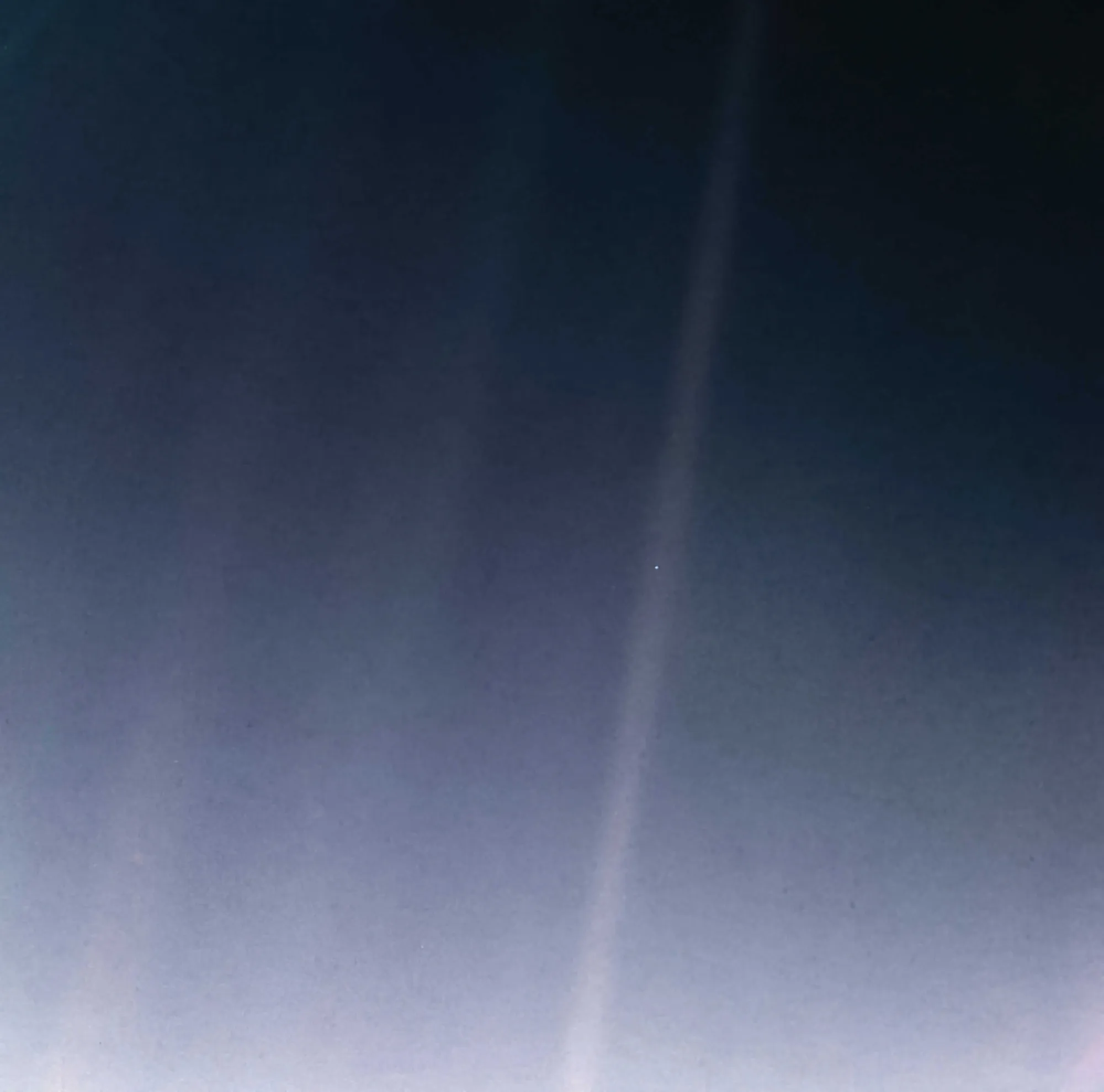
"That’s here. That’s home. That’s us. On it, everyone you love, everyone you know, everyone you ever heard of, every human being who ever was, lived out their lives... our posturings, our imagined self-importance, the delusion that we have some privileged position in the Universe, are challenged by this point of pale light... to me, it underscores our responsibility to deal more kindly with one another, and to preserve and cherish the pale blue dot, the only home we've ever known."
Beacon in the dark
Carl Sagan's single day came to an end on December 20, 1996. His body, weakened by its fight against myelodysplastic syndrome (a form of blood cancer), was unable to survive a bout with pneumonia. He was only sixty-two.
His light was gone, but embers remained—his scientific work; his fight against superstition, ignorance, and our own worst impulses; his show Cosmos; and, of course, his books. Sagan understood the profound power of the book, penning these words:
"Writing is perhaps the greatest of human inventions, binding together people who never knew each other, citizens of distant epochs. Books break the shackles of time. A book is proof that humans are capable of working magic."
Ten years after an astronomy book taught me the concept of impermanence, I walked into my local library and picked up another. It was titled Cosmos, by some astronomer I'd never heard of. I skimmed through it and decided to give it a shot. I had no idea that it was going to change the direction of my own single day, that I was picking up the ember of a burned-out sun to light my own beacon in the dark.