

Solarpunk humanism: How we dream bigger than despair
Solarpunk offers a potent narrative space for imagining secular worlds to come, and how to get there.

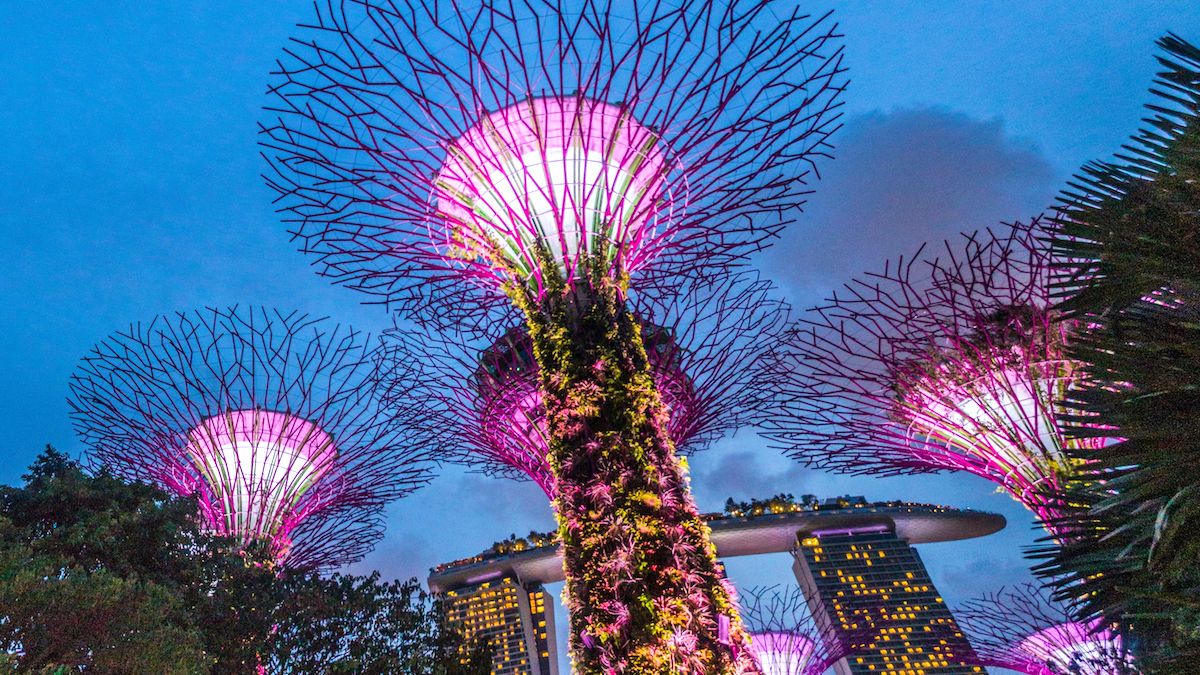
One unspoken tenet of anti-theist discourse is that we are limited by the religious stories at the core of our culture. For that slice of the nonreligious spectrum, it’s not enough not to believe, personally, in a god. The nature of religion poses a narrative problem that anti-theists feel must be confronted at every turn. But the secular community contains multitudes, and while some in our number wrestle with stories from the past, a significant number have been dreaming up new narratives. Solarpunk is one such humanist movement for radical, real-world change.
The term draws on a tradition in science fiction that started with cyberpunk, a gritty fusion of dystopic futures drawn from shifting global hegemonies and anxieties around new digital tech. The future in cyberpunk is full of possibilities for what it means to be human, but in a world that shows little care for sentient beings either way.
From cyberpunk came a whole slew of other “-punk” literary movements, including “steampunk”, which imagined alternative pasts and expansive futures in which Victorian- and Edwardian-era air-powered technologies never gave way to anything more elaborate. This movement was informed in part by the films by Hayao Miyazaki (e.g., Nausicaa of the Valley of the Wind), which were not “punk” so much as offering healing from historical trauma, but which offered a visual aesthetic for fantastical worlds built on bygone tech.
In the late 2000s, “solarpunk” was proposed for the name of a literary genre that would imagine a post-oil eco-conscious society built around newer, yet elegantly simple technology. The imagined future of solarpunk would be a world run on air, water, and sun, in conjunction with human industry and a radical re-imagining of our communities. It would be a world where technology and human systems were on our side, instead of exacerbating harm.
In the early 2010s, the first solarpunk anthology emerged: out of Brazil, in Portuguese. (A striking reminder of the globalist nature of our struggle, and our dreaming.)
Today, solarpunk refers to many things. It’s a genre, an aesthetic, a rallying cry, a movement. In all its formations, though, it offers a potent narrative space for imagining secular worlds to come, and how to get there.
The priorities of solarpunk
One of the key differences between solarpunk and other futurist movements is its scope. Solarpunk neither pretends that the problems we face as a species are easily surmountable, nor gives over to despair at their size and complexity. Rather, it focuses on imagining eco-conscious and communally restorative solutions, along with the inevitable struggle we’ll have to undergo to achieve them.
As Adam Flynn noted in 2014, solarpunk draws from other traditions of “innovative dissent”, and recasts “infrastructure as a form of resistance” to despondency around our status quo. Flynn also sagely noted that solarpunk, in its best formation, seeks to overcome the half-heartedly revolutionary vibe in a lot of steampunk, which has often fallen prey to fetishism of historical periods that were rife with societal oppressions.
Another popular manifesto, out of the Regenerative Design group, highlights that optimism is itself a radical act in hard times such as ours. To them, “solarpunk is a vision of a future that embodies the best of what humanity can achieve: a post-scarcity, post-hierarchy, post-capitalistic world where humanity sees itself as part of nature and clean energy replaces fossil fuels.” (Oh, is that all? Easy peasy!)
Some of its implementations, to date
It’s easy to treat radical optimism as naive, but in the years since those early manifestos, we’ve seen the strength of proactive dreaming bear out in solarpunk networks. In particular, as their reach grows on places like reddit (77,000 members on r/solarpunk as of this article) and tumblr, through new publications like Solarpunk Magazine, and in peer-to-peer decentralized platforms like Scuttlebutt, the lines especially blur between “future-dreaming” and everyday, real-world transformations.
One key element in solarpunk’s more immediate transformations lies in knowledge-sharing, which is why solarpunk communities often draw from “prepper” knowledge for disaster scenarios, but with an optimistic rather than a fatalist spin. (For a fun example of the difference, I recommend Cory Doctorow’s Masque of the Red Death, which plays out the prepper mentality in a crisis scenario, in contrast with Walkaway, which offers other, more constructive forms of community-building amid disaster.)
This blurring of imagined and lived realities is especially true on forums like reddit or tumblr, where users will often post a photo of something that looks futuristic, only for respondents to highlight that the source is a real-world implementation of more dynamic and innovative designs and technologies. One key downside to this phenomenon is, obviously, the intersectional issue of “white people discovering what other cultures already knew, then fetishizing those cultures to the exclusion of all their other problems.” But, eh, welcome to humanity. We’re a work in progress.
It is true, though, that some of our world’s deepest inequalities have yielded amazing transformations in the most unassuming places. If your region has been so utterly exploited by global markets that it can’t even begin to pay into traditional energy markets, you’re a prime candidate for “leapfrogging” into more advanced tech and infrastructural solutions. It’s much harder to swap out heavily entrenched corporate power grids in, say, the current U.S. economy, than it is to start from scratch when designing infrastructure in sub-Saharan Africa.
Ongoing sites of humanist consideration
As we consider solarpunk as a potent space for humanist action, though, we still need to keep in mind that we’re dealing with human beings.
And we’re an odd, messy group, aren’t we?
One ongoing concern in the solarpunk movement is the risk of consumerist elitism rearing its head. After all, yes, a lot of the gadgets and designs are beautiful and just plain nifty, but many technologies tied into the “solar” part of the solarpunk equation are costly. This can easily create a schism in the movement between folks with the means to fully embrace a fancy, expensive, aesthetic-driven lifestyle, and innovators working with what they can access to improve whatever in their networks that they can.
If a person can’t completely retrofit their living environment to embody every possible upgrade for a socially conscious world, so what?
This is why the “punk” side is extremely important to curate well. By focusing on community-building, knowledge- and tool-sharing, and other activities directly engaged in dismantling our current capitalist systems to make way for economies that prioritize human beings and our environments, we can keep our eyes on the humanist prize.
Solarpunk Magazine also recently illustrated that the learning curves in these movements can be bumpy affairs. It made an early mistake that I think any atheist familiar with traditional debate circuits will recognize: It considered platforming a movement antithetical to solarpunk’s eco-conscious goals, through essays that would “pro” and “con” the use of environment-destroying crypto-based NFTs. It course-corrected in response to concerns, but there’s a key lesson in the incident all the same:
Solarpunk, like humanism, is a banner term that contains multitudes. It has a body of aesthetics, a literary and visual-art canon, and a range of people who raise that banner high in their sociopolitical and eco-conscious practice. But what it is, and what it can help foster in the way of real-world change, is really up to those who employ it.
Which is why, if you’re in the secular realm and looking for narratives to help you navigate the current, bleak moment and find the motivation needed to work for something better… consider solarpunk. Consider reading about it, learning from it, and contributing your knowledge to its communities in turn. Our movements are what we make of them. Lean into proactive change where you can.