
Protecting secularism in religious enclaves
Communities of choice can't be allowed to cross the line into becoming mini-theocracies.

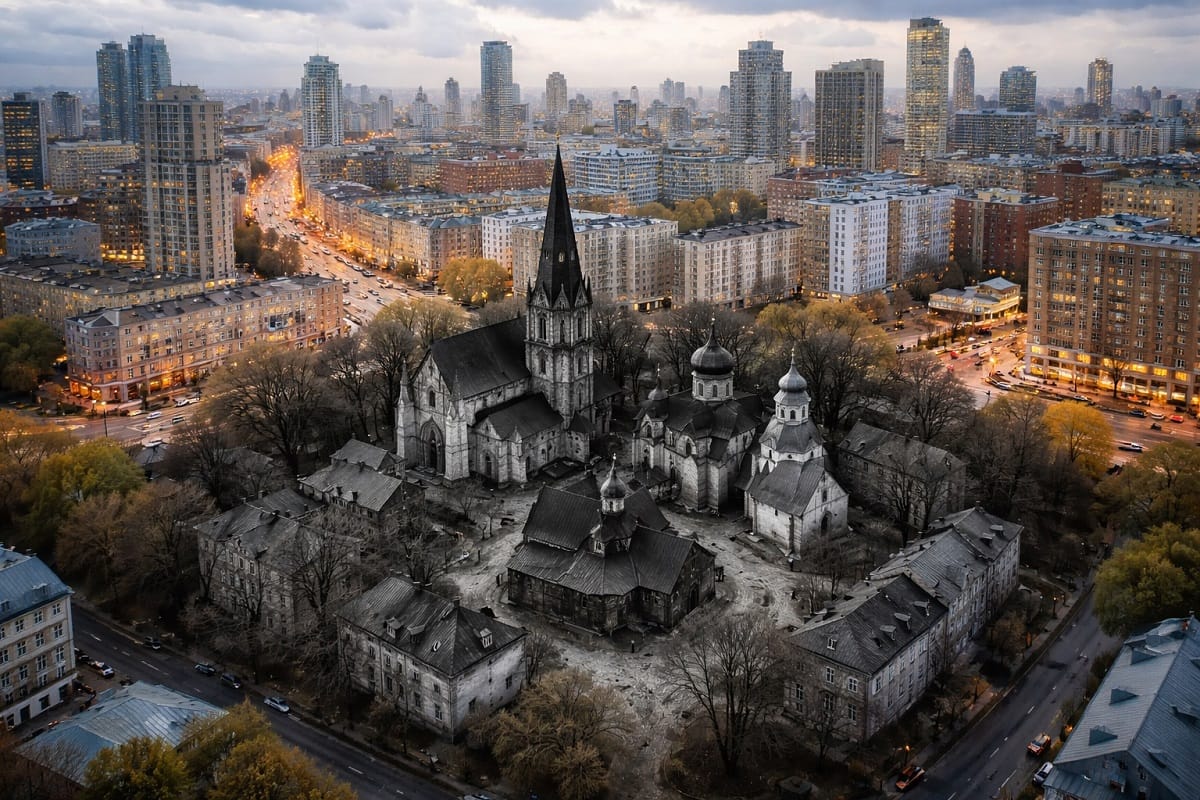
As religious belief retreats all around the world, it's contracting into hardened enclaves. How can secularists ensure that these communities of choice don't cross the line into mini-theocracies?
The big-picture trend couldn't be clearer: humanity is becoming less religious. Despite the wishful thinking of apologists who grasp at straws—every conversion anecdote, every tiny uptick in church attendance, every within-the-margin-of-error poll fluctuation—to proclaim an imminent revival, the stats don't lie.
While denial is still the most common response, a few apologists, more realistic than the rest, are coming to terms with this trend. Rather than insist that it isn't happening, they're counseling their fellow believers on how to deal with a secular, post-religious world.
The Benedict option
One widely-discussed strategy is the so-called Benedict Option, proposed by conservative author Rod Dreher and named after a founding father of Western monasticism.
The idea of the Benedict Option is that Christians should (metaphorically or literally) retreat into the wilderness. They should pull back from a secular culture that they've failed to conquer, and isolate themselves in their own enclaves where they can live and raise their children as they see fit.
They frame this as keeping their morals and values intact. But the none-too-subtle implication is that they want to control everything their children see and hear. They want to ensure they don't have to compete with pesky differing viewpoints. In that sense, it's an admission that fundamentalist views can't survive contact with diversity.
Obviously, the Benedict Option was proposed in a particular Christian context. Not everyone is taking their cues from this idea. But conservative religious communities of all kinds are independently following similar lines of thinking.
Lakewood
One example is, in all places, New Jersey. Last month, the outgoing Murphy administration filed for a state takeover of the Lakewood public school district, in Ocean County on the Atlantic shore.
The state cites years of chronic fiscal management, crippling debt, poor test scores and low graduation rates. If approved, this measure would strip the school board and local voters of authority and put the district under state control.
Why are Lakewood schools in such dire straits? The answer is religion:
The township is a predominantly Orthodox Jewish community. While it has nearly 50,000 school-aged children, only about 6,000 attend public schools. About 84% of students are enrolled in private religious schools.
Lakewood is a nerve center of Orthodox Judaism. It's the site of Beth Medrash Govoha, the largest yeshiva in the world outside of Israel. (Yeshivas are religious schools where the Torah, rabbinic literature and Jewish law are studied, sometimes to the exclusion of all other subjects.)
That's not a problem in and of itself, but this is: Under state and federal law, all school-age children are entitled to an appropriate education. If a child has special needs that a public school can't accommodate, the school district can be required to pay for tuition and busing to send them to a private school that can.
This well-intentioned measure has been abused on a massive scale.
The Orthodox residents of Lakewood, who comprise more than half the district's population, vote as a bloc to ensure a school board that's friendly to their interests. Allegedly, the board rubber-stamps any request to send a Jewish student to private school, accepting disability claims at face value and firing or sidelining district employees who ask questions.
This has resulted in the majority of children in the district attending Jewish religious schools—with New Jersey taxpayers picking up the tab. Only scraps are left for non-Jewish kids and for families who want to attend secular, public schools. The district has gone into massive debt over this, apparently trusting in perpetual state bailouts:
Lakewood spends more than half of its annual budget — over $78 million — on transportation and special education costs, according to court records.
...Lakewood has borrowed about $220 million from the state since 2014 and still owes roughly $173 million. Last year, the district received a $65 million emergency loan from the state to help cover teacher salaries for the remainder of the school year.
Again, private religious schools aren't inherently bad, so long as they meet reasonable standards of accreditation and quality. But we can and should insist that families who send their kids to private school do so at their own expense, not at taxpayer expense. We also can and should insist that, whatever other options exist, secular public schools must always be available. No child should be denied a good education because they're not part of the majority religion.
Even with a state takeover, Lakewood has a long road ahead to get back to equality. Untangling the cases of all the students sent to private school, determining who truly deserves to be there and who doesn't, is going to be a legal nightmare. However, a different story from across the country shows there's reason for optimism.
Hildale and Colorado City
While battles lie ahead for Lakewood, there's bright news from an unlikely place. A new day is dawning in the twin towns of Colorado City, Arizona and Hildale, Utah—the former strongholds of the Fundamentalist Church of Jesus Christ of Latter-Day Saints, or FLDS.
The FLDS was founded by men who split from the mainstream Mormon church in the early 1900s when it banned polygamy. They settled in the desert near the Arizona-Utah border to continue practicing their oppressive, patriarchal faith.
Over the decades, the towns were ruled by a succession of FLDS elders. The last, and arguably the worst, was Warren Jeffs.
Jeffs, the son of previous FLDS president Rulon Jeffs, took power in 2002 when his father died. He ruled as a theocratic despot, managing the towns as if they were his personal fiefdom. He facilitated rape on a large scale, assigning dozens of underage girls and women to himself and trusted allies as "wives" (the women themselves had no say in the matter). He expelled and persecuted people for the slightest transgression of his rigid and ever-growing list of dogmatic rules.
The FLDS church owned most of the land, giving Jeffs the power to dictate where followers lived. The town governments were also under the cult's thumb. Those who stood up for themselves were denied utilities like water and electricity, harassed and threatened by police, or kicked out entirely.
For decades, authorities turned a blind eye. But a stream of survivors who came forward with harrowing stories (such as Carolyn Jessop and Elissa Wall) finally prodded them into taking action. The towns were sued for religious discrimination and placed under court-ordered supervision. Jeffs went on the run, and was captured in 2006. He's serving a life sentence in prison for sexual assault.
With Jeffs gone, the FLDS cult was effectively decapitated. But the people who had formerly been under his thumb were unaccustomed to democracy. They had to learn how to live free for the first time:
The towns functioned for 90 years largely as a theocracy, so they had to learn how to operate "a first-generation representative government," Roger Carter, the court-appointed monitor, pointed out in his progress reports.
The good news is that the towns are progressing rapidly. As I wrote in 2018, an ex-FLDS member, Donia Jessop, was elected mayor of Hildale. Many of the old guard quit rather than cooperate with new leadership, so the towns had to rebuild their governments from scratch. But they're doing so well, they were released from court supervision earlier than anyone expected:
These days, Colorado City, Arizona, and neighboring Hildale, Utah, look much like any other town in this remote and picturesque area near Zion National Park, with weekend soccer games, a few bars, and even a winery.
...With its leader in prison and stripped of its control over the towns, many FLDS members left the sect or moved away. Other places of worship have opened, and practicing FLDS members are now believed to account for only a small percentage of towns' populations.
Freedom of association
It bears repeating that people of the same religion can live together if they choose. That's not the problematic part of any of these stories.
Secularists believe that diversity is a strength, since it fosters tolerance and greater understanding of different cultures. When we live with others who don't share our views, it's less likely that we'll get trapped in bubbles of groupthink or adopt pernicious habits of xenophobia.
On the other hand, freedom of religion and freedom of association are valuable, and there's nothing wrong with communities of choice. People have a right to live in community with others who share their values, especially when they're historically marginalized minorities who benefit from mutual aid and support.
But in every case, those communities must be freely chosen. The problem arises when one sect attains a majority and tries to force their views on everyone, turning religious doctrine into civil law. That's when the state has to step in, to defend the cornerstone principle of church-state separation. As the world becomes less religious and believers increasingly feel like they're an endangered minority, these scenarios are likely going to happen more and more often, which means that defenders of secularism will have to be vigilant.
