

Z: The least religious generation ever
In an analysis that reads like porn for secularists, Daniel Cox details the degrees to which Gen Z is markedly more secular than any previous generational cohort.


And religion in America just continues to decline and decline and decline.
According to a new report from The Survey Center on American Life of the American Enterprise Institute, Gen Z (comprised of Americans born in or after 1995) is the least religious generation in the nation’s history.
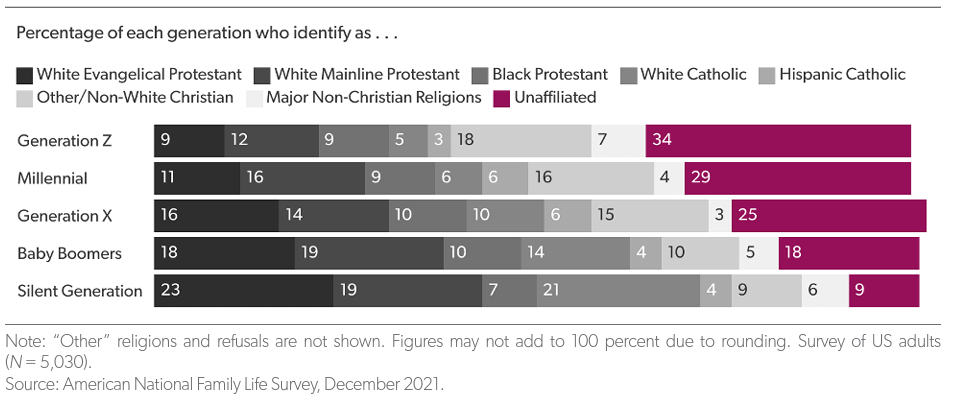
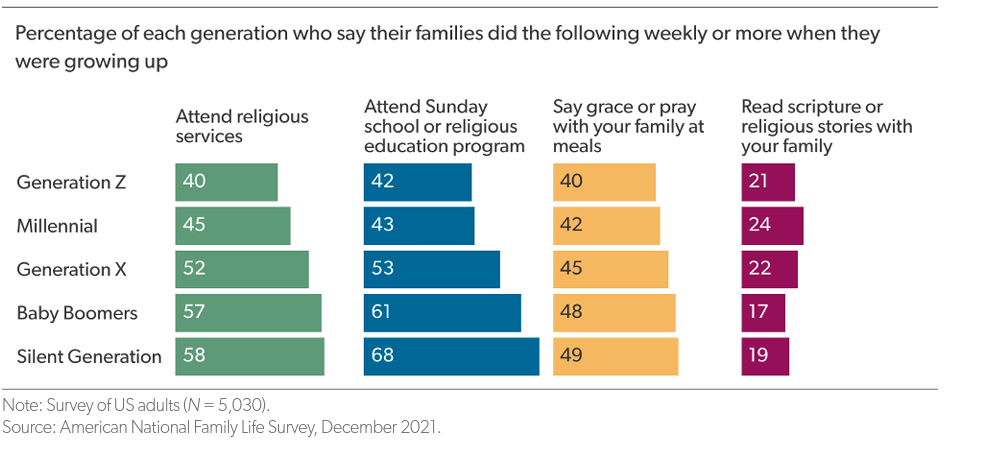
In an analysis that reads like veritable porn for secularists, Daniel Cox — lead author and Senior Fellow in Polling and Public Opinion – details the degrees to which Gen Z is markedly more secular than any previous generational cohort: they are less likely to have attended religious services while growing up, less likely to have attended Sunday school or formal religious programs, and less likely to pray or say grace with their families. Furthermore, Gen Z’ers are also more likely to be atheists or agnostics; 18% of Gen Z’ers identify as explicit nonbelievers, compared to only 9% of baby boomers and 4% of the generation before them.
Let’s start with the simple variable of religious identification. Compared to those Americans who proclaim a religious identity, below are the percentages of “nones”—those who do not affiliate with any religious tradition—by generation:
- Silent Generation: 9% religiously unaffiliated
- Baby Boomers: 18% religiously unaffiliated
- Gen X: 25% religiously unaffiliated
- Millennials: 29% religiously unaffiliated
- Gen Z: 34% religiously unaffiliated
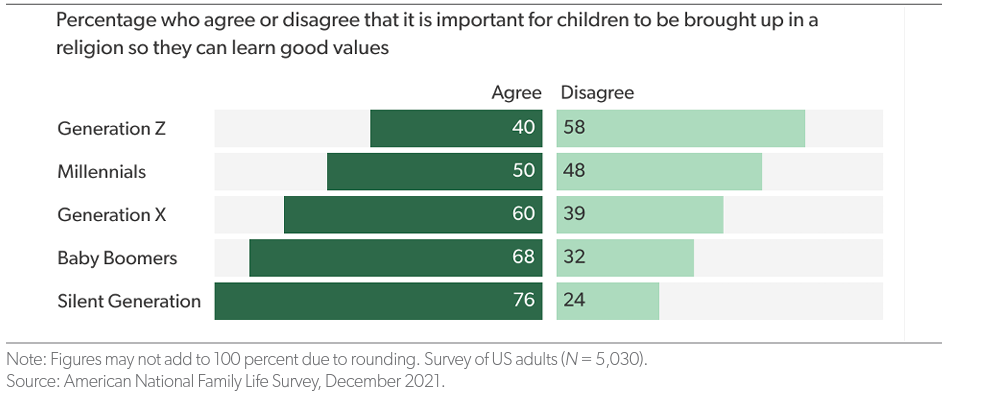
These percentages align nicely with a pronounced drop in how Americans feel about the value of religion. For instance, is it necessary to raise children with religion so that they will have good values? Fewer and fewer subscribe to such a notion:
- 75% of the Silent Gen think that it is necessary
- 68% of Boomers agreed
- 60% of Gen X agreed
- 50% of Millennials agreed
- Only 40%—a statistical minority—of Gen Z agreed
This is some serious generational weakening of religiosity from great-grandparents to grandparents to parents to kids. As Cox explains, “Young adults today have had entirely different religious and social experiences than previous generations did. The parents of millennials and Generation Z did less to encourage regular participation in formal worship services and model religious behaviors in their children than had previous generations. Many childhood religious activities that were once common, such as saying grace, have become more of the exception than the norm.”
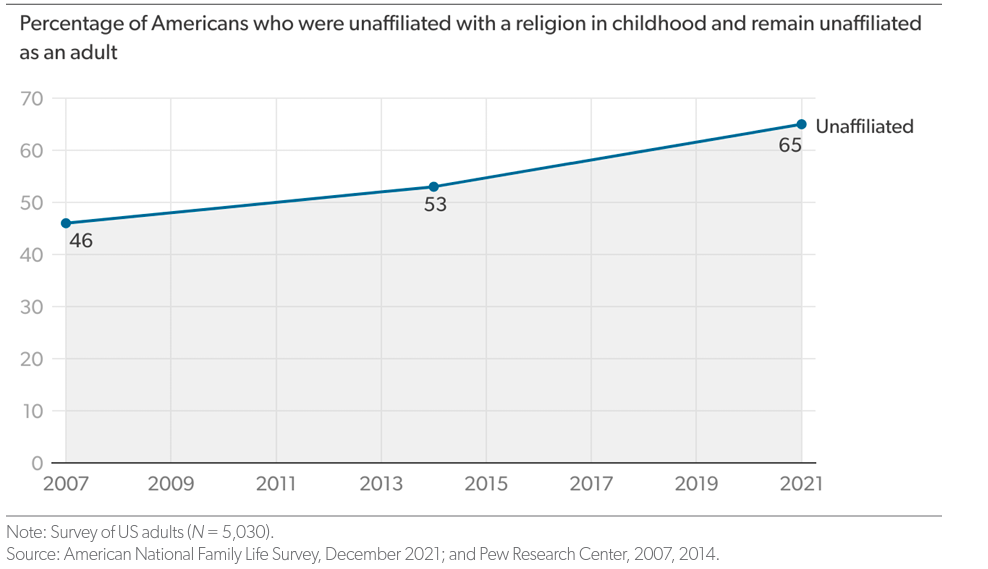
But won’t these young whippersnappers return to religion as they get older? The data suggests that they won’t. As Cox explains, “There is little evidence to suggest that Americans who have disaffiliated will ever return…Disaffiliated Americans express significant skepticism about the societal benefits of religion, even more than those who have never identified with a religious tradition. They also strongly disagree with the majority of religious Americans, who believe in the importance of raising children in a religious faith.” Indeed, the majority of people raised without religion do not go on to find it later in life; nearly two-thirds of Americans who were raised without any religious affiliation remain nonreligious as adults.
There are many reasons that religion is weakening in America: the surge in conservative, right-wing Christianity; the fact that Christianity has been so publicly hijacked by conspiracy-peddling fascists; the criminal Catholic pedophile priest network; more women working in the paid labor force; the internet; and so forth.
But what is key from this latest report is the matter of socialization. Simply put, socialization is the process whereby we passively, informally, and often unconsciously learn the norms and values of our culture. Our experience of socialization is most acute when we are children, and the people who most potently socialize us are those who raise us, keeping us fed and safe – usually our parents. Socialization is fundamental to religion’s maintenance and reproduction. Babies do not start out religious; they have to be taught religion. The process, in short, goes like this: small children are raised by religious people, who teach them the norms, beliefs, and rituals of their religion. Those children internalize that religious socialization and go on to become religious themselves as they grow up. They accept as true the religious beliefs that have been presented to them as such by their loved ones; they come to practice and value the religious rituals they have been socialized to perform; they come to personally identify with the religious group in which they were raised. And when these kids grow up and have kids of their own, the cycle is repeated — or not, which is what is happening today.
In short: As fewer Americans are raised with religion, fewer will go on to be religious, and when they have children, ever fewer of them will be religious.
Until his recent death, Vern Bengtson was the leading authority on religious generational transmission within families. Since 1970, with his Longitudinal Study of Generations, Bengtson and his associates followed 3,500 respondents, representing four generations from over 350 different families in the United States. Since 1970, the percentage of people in his sample who no longer identified as religious increased by more than 300 percent. The main force at play? You guessed it: family socialization. “We find,” Bengtson explained, “nearly 6 out of 10 unaffiliated young adults come from families where their parents were also unaffiliated, indicating that nonreligion is indeed transmitted from one generation to the next.”