
Urban farming 2060: How vertical gardens will feed megacities
Can urban farming feed the world? The short answer is yes, it can and it will!

There's a direct link between the growing human population, the continuing decline of arable land, and rising concerns about food availability. Urban farming, also called vertical farming, is a solution for feeding the megacities of the future while reducing their environmental footprint.
According to U.S. Census Bureau projections, the Earth’s global population is expected to pass 10 billion by 2060, despite the population growing at a slower pace. The share of the population living in cities will be roughly 70%.
One of the most challenging questions we face is how to double food production by 2060 to feed humanity, taking into account that every year the amount of land available shrinks due to sprawl, desertification, and sea level rise.
Other threats to agriculture include extreme weather caused by climate change and the environmental impact of intensive farming practices. Overcoming these challenges calls for technological changes to make food production more efficient and more sustainable.
Vertical gardens will be a key part of the solution. By 2060, vertical gardening could provide food production for densely populated megacities, transforming urban landscapes from consumers of food into producers.
These high-tech indoor farms use hydroponics (growing plants without soil, using nutrient-rich water solutions), aeroponics (misting roots with nutrients in air, further reducing water usage), and AI-driven, climate-controlled environments for cost-effective, consistent production. Vertical gardens turn skyscrapers, rooftops, and abandoned industrial spaces into food production centers. They're designed to be sustainable, integrating renewable energy, water recycling, and eco-friendly materials. They produce fresh, local food year-round, reducing the food miles and pollution associated with traditional agriculture.
Future cities will depend on high-rise buildings and underground cellars for agriculture. It will be all about maximizing efficient usage of space, bringing food closer to consumers. By 2060, AI-optimised systems will manage everything from LED lighting to temperature to nutrient delivery without being affected by droughts, floods, or seasons.
Indoor agriculture consumes 90 to 98% less water than traditional farming, recycling it in closed-loop systems. Localizing production by growing food in cities reduces the need for long-distance transport, lowering carbon emissions. In addition, it allows for fresher, pesticide-free produce, contributing to less toxins and chemicals entering the human body and resulting in a healthier population.
Urban farming is blooming today with a vision that will feed future cities
The largest urban rooftop farm in Europe, at 14,000 square meters (about the size of two football fields), is Nature Urbaine in Paris (NU Paris), located on the roof of the Paris Expo Porte de Versailles. NU Paris opened in 2020. People can rent space to produce their own fruit and vegetables. The farm’s daily harvest is also distributed to nearby restaurants and hotels.
NU Paris focuses on vertical and aeroponic farming, producing up to 1,000 kilograms per day of crops including tomatoes, strawberries, eggplant, and herbs. It uses no-soil methods, recycling water and nutrients to reduce its environmental impact. If you go to Paris, you can visit Nature Urbaine and join one of its guided tours, attend an educational workshop, or have lunch at the rooftop restaurant operated by Le Perchoir.
Singapore has been using vertical farms on city rooftops and within high-rise apartments for the last fourteen years. Singapore became the home to the world’s first commercial vertical farm back in 2012, built by Sky Greens Farms. The aim of the project was to reduce dependence on imported produce by growing food locally with no shipping costs.
In Bangkok, Thailand, the Thammasat Urban Rooftop Farm, the largest urban rooftop in Asia, is a premier example of large-scale urban agriculture. It features a 22,000 square-metre, H-shaped design that mimics traditional rice terraces and stands out due to its advanced, sustainable, and climate-resilient design.
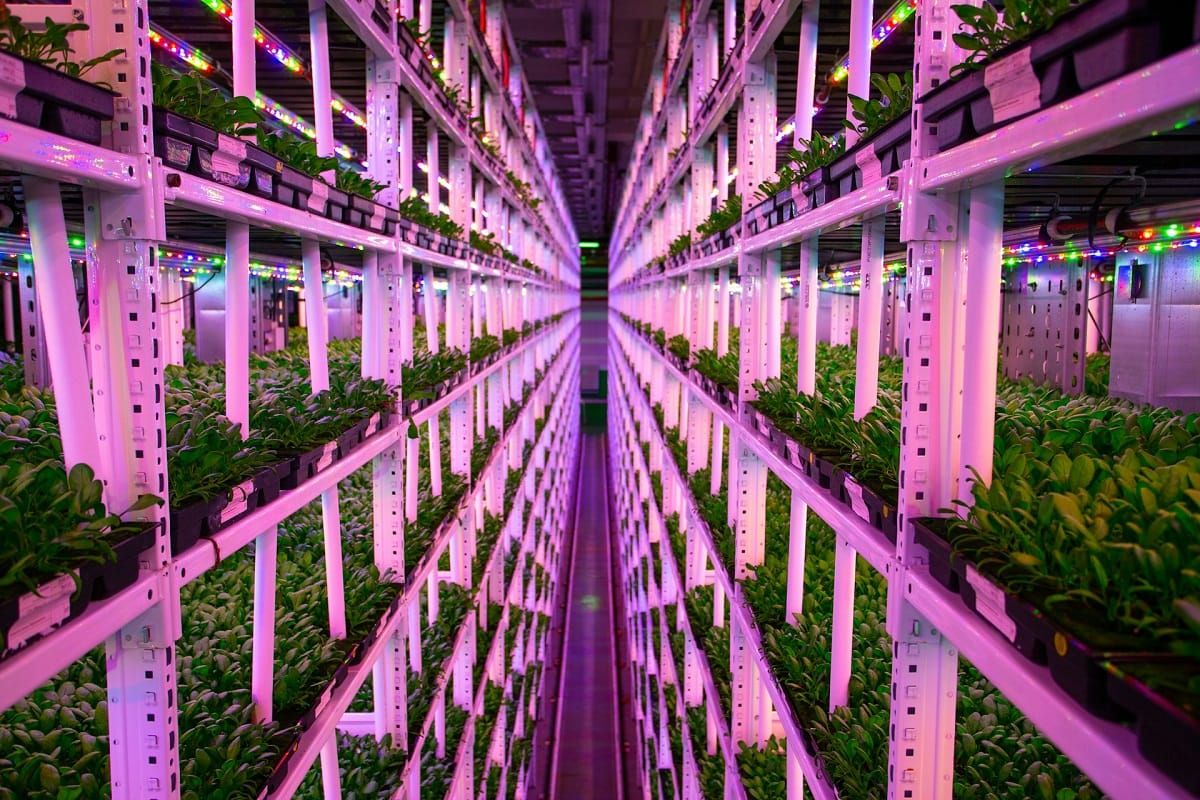
In the United Kingdom, Gloucestershire vertical farm is one of the most technically advanced indoor farms. Its consistent, controlled climate allows the farm to grow basil, dill, parsley, lettuce, and other herbs and salad crops three times as quickly as traditional outdoor agriculture. According to a report from the BBC, a scientifically-calculated color spectrum in the LED lights used stimulates plant growth, hence the pink color usually seen in vertical farming. The air is kept at a constant 27 degrees Celsius (80.6 degrees Fahrenheit) and 75% humidity.
In Japan, urban agriculture is blending traditional agricultural knowledge with modern technology to provide fresh, local produce in urban environments. In Tokyo, unused office spaces are being converted into indoor greenhouses which support local consumption.
In the United States, with urban populations making up 80% of U.S. residents, urban and indoor vertical farming continues to grow to provide food security, sustainability, and respond to community needs. Urban farming is most popular in New York City, using technologies such as large-scale hydroponic systems, vertical stacking, LED lighting, satellite-based insights, and AI monitoring. Other major U.S. cities embracing vertical and urban farming include Chicago, Detroit, San Francisco, Los Angeles, Boston, and Seattle.
In Finland, urban agriculture is evolving from hobby gardening to integrated technological initiatives supported by city governments and research institutions. Urban farming occurs in diverse spaces including public parks, residential courtyards, rooftops, and repurposed industrial spaces.
Urban foraging is a popular activity in Helsinki, where citizens gather fruit and berries from public spaces. The Viikki Urban Farmers is an initiative by university students running their own micro-farming company. In the city of Tampere, there are communal gardens for urban farming where people can rent a plot with prices depending on plot type and cultivation period.
This is just a sample of the cities that are already using urban and vertical farming to feed their inhabitants. There are many more examples around the world.
Urban farming technologies, trends, and challenges to overcome
Despite its environmental, economical, and social benefits, the expansion of vertical farming has been relatively slow. This is due to the high energy consumption, required for lighting and climate control, and the high initial investment costs.
A successful transition requires redesigning urban spaces to produce more food, like Singapore’s 30x30 goal, which aims to cover 30% of its total food needs by 2030, shifting from horizontal to vertical farming architectures.
The plan is to make urban farming globally widespread and sustainable by 2060. To achieve this, the systems used will have to be fully powered by renewable energy. Without a focus on building enough renewable energy, it might be challenging to reach this goal.
Is there an urban farm in your area or a project for building one?
