
To distant worlds
Will humans venture out into the cosmos, or is that destiny reserved for our AI descendants?

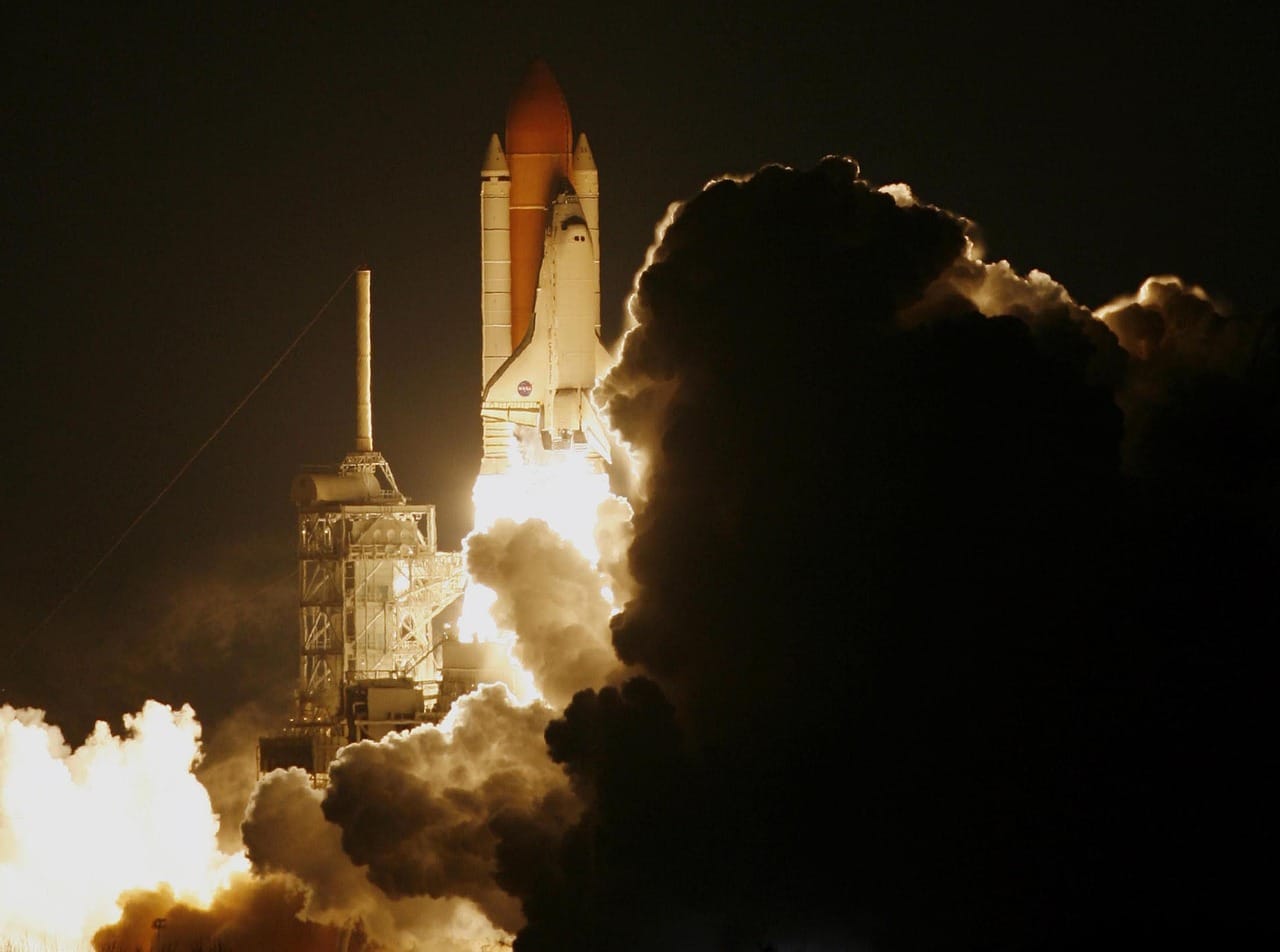
After a lull of decades, human beings are about to blast off into space again. The Artemis 2 mission is set to launch in the coming weeks, carrying four astronauts into lunar orbit.
The idea of space travel has captivated the human imagination for centuries. It was a staple of science fiction well before we had the technology to make it possible. Now we've taken concrete steps toward that goal: human beings have orbited the Earth, lived in space stations and walked on the Moon. The next, more ambitious goal is to send a crewed ship to another planet, such as Mars. Perhaps we'll witness such a mission in our lifetimes.
However, even if humans set foot on Mars, that's at best another small step. Will we ever truly travel into the cosmos as explorers?
The obstacles to space travel are formidable. The most obvious issue is the vast distance. Merely reaching the outskirts of our solar system would take years. To venture beyond the solar system, visiting another star with planets, would require a journey of many light-years. Our technology is nowhere near up to that challenge.
A tourist's guide to interstellar voyages
There have been proposals for overcoming this difficulty, which have been explored often in science fiction. One is the generation ship, a spacebound ark in which many generations would live and die before it reaches its destination. Such a spaceship would have to be like a small self-contained world, with its own ecosystems for recycling food, water and oxygen.
While the practical difficulties of constructing such a ship would be immense, the idea is theoretically possible; it violates no laws of physics. The more critical issue is the human factor. The crew would be signing up to spend the rest of their lives in space, aging and dying without ever seeing Earth again. Could they bear the psychological burden of that knowledge?
Also, even if the crew was willing, how would they persuade their children to carry on the mission? For the generation ship concept to work, successive generations born in space would have to willingly devote their lives to duties on behalf of a home planet they'd never known and a destination they wouldn't live to see. This idea leads in fantastical directions. Would we have to invent a new religion to keep the crew obedient to the mission, led by a priesthood that hands down the teachings of the original crew as if they were prophets?
Over many generations, the crew would eventually be composed of people for whom the original mission was a distant historical memory. They might forget it entirely. Multiple stories have explored this possibility, including one classic episode of Star Trek.
A little less scientifically plausible is the sleeper ship. According to this idea, a spaceship crew would go into some form of stasis, such as hibernation or cryogenic freezing, and be awoken upon their arrival. On one hand, this avoids some of the difficulties of the generation ship, since the original crew would make it to their destination; on the other hand, the technology to keep humans alive indefinitely in suspended animation currently doesn't exist. It would also require a fully automated ship to sustain them on the journey, which is likewise beyond our capabilities.
The last option is the most technologically ambitious: finding a way to cross the distance more quickly. If a ship could be accelerated to some large fraction of lightspeed (using advanced technology like nuclear propulsion or an ion thruster), it would cut down the time it would take to travel interstellar distances. However, as per Einstein's theory of relativity, it would have the side effect of causing time dilation. The ship's crew would leapfrog past people on Earth, potentially by centuries. In effect, it would be a one-way journey into the future.
Space is not for us
All these difficulties raise the question of whether interplanetary travel should be carried out by humans at all. Since we are humans, we have a built-in bias when it comes to this question. It's difficult to think beyond our own limitations and imagine future beings who are nothing like us. However, we may one day create beings who come to surpass us.
Humans are fragile creatures, and space is deeply hostile to life like ours. We have survival needs that are difficult to supply on a spaceship: food, water, oxygen, a constant temperature. Our bodies are adapted to Earth's gravity; without it, our bones and muscles deteriorate. Radiation would be a constant danger, damaging our DNA and causing cancer and other health problems. Also, we're not psychologically adapted to endure boredom, isolation, understimulation and cramped quarters for years on end. Even if their physical needs were met, a space traveler would be at risk of mental breakdown over a long journey.
A single critical failure of any of the ship's systems would spell doom for spacefarers. Over a voyage of decades or centuries, the probability of such a failure approaches one. This would be an even bigger risk on the sleeper-ship model, where the crew and passengers would be in hibernation and wouldn't be able to respond.
Something that's rarely depicted in fiction is space travel with no human crew at all. If artificial intelligence ever advanced sufficiently far to make it possible, we could send an automated ship, or one crewed entirely by robots. This seems futuristic and hard to achieve with current technology, but no more so than most other visions of space travel.
But in reality, assuming it ever becomes possible, it would have great advantages. We've already sent remote-controlled probes that operate successfully for decades, and this would be the next logical step.
Robot crews don't need oxygen, food or other consumable supplies. They could obtain their energy from dependable and long-lasting sources, such as nuclear power. The prospect of traveling for centuries poses no challenge to a machine that doesn't suffer from boredom. We may well find the stars do not belong to humanity, but to some machine descendant of ours.
Of course, the other reason this idea isn't proposed more often is that it leaves open the question of what place—if any—is left for human beings. It's not a coincidence that science fiction which imagines AI or robots supplanting humanity almost always envisions it as a nightmarish, dystopian fate. We're afraid that what we make might surpass us, it seems.
But if we can overcome this human-centered prejudice, the idea may come to seem reasonable, even inevitable. We can take a more hopeful view and choose to believe that the artificial intelligences of the future will be wiser than their creators. They'll aid humanity and explore on our behalf, rather than replacing us.
So, perhaps, the stars will belong to humanity—along with our AI offspring.
