
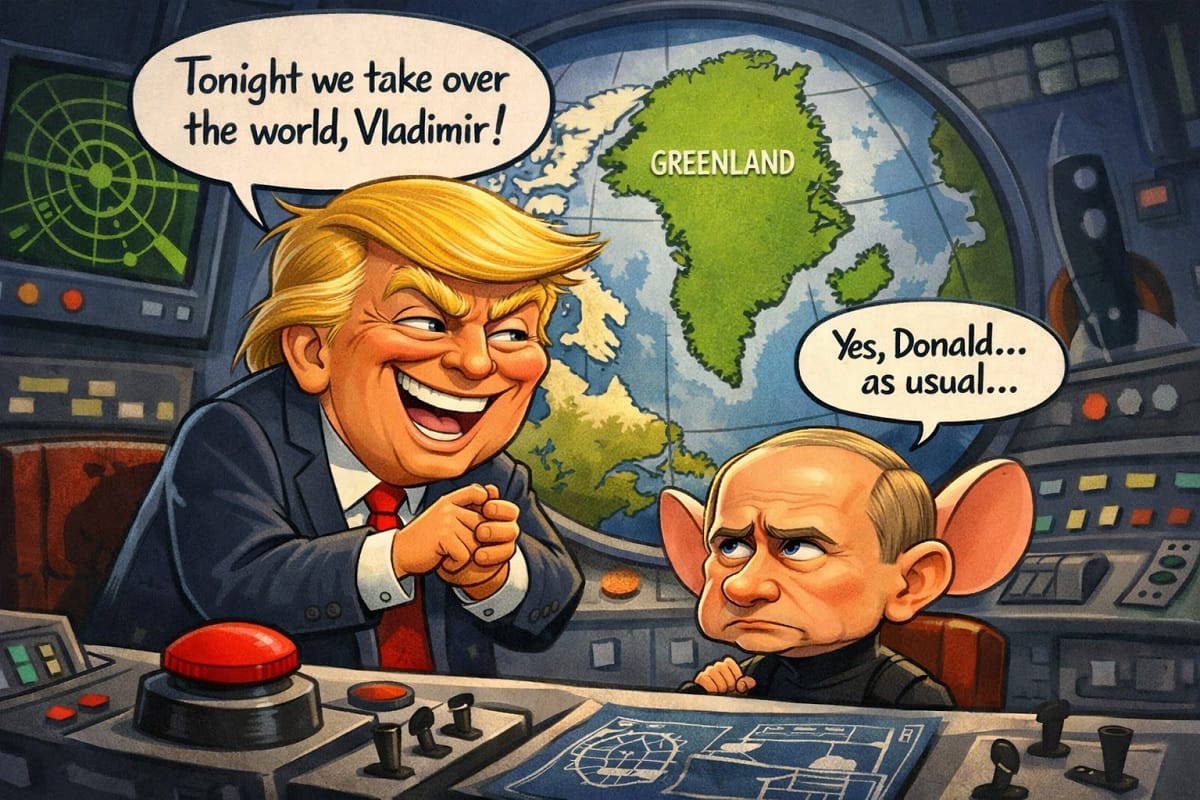
The accidental comedy of modern politics
Pinky and the Brain politics, or how power became a cartoon.

I don’t have a political affiliation. I don’t even like discussing politics. And yet, here we are. Because when American politics turns itself into some of the finest absurdist theatre of the 21st century, ignoring it starts to feel like refusing to comment on a clown juggling chainsaws in a public square.
It’s funny. It’s entertaining. And quite frankly, it’s profoundly sad.
If historians ever need a textbook example of devolution, this is it. It feels like Homo sapiens moonwalked back into a more primitive cognitive state.
I listened to Donald Trump speak at Davos not because I believe he is intelligent, eloquent, insightful, or particularly fond of the English language. Instead, I listened because, accidentally, he is funny. Not ha-ha funny. More like did-that-just-happen funny. The word choices. The syntax. The improvisational relationship with reality. The inaccuracies documented by the BBC. The little insults directed to European heads of state or prime ministers who were present in the same room.The alternative reality that unfolds in his head. The way he speaks as if punctuation were a personal insult.
There is also the lingering suspicion that he believes his audience consists entirely of emotional kindergartners just like himself, tiny humans who respond well to repetition, nicknames, and exaggerated hand gestures. To be fair, this may not be an entirely inaccurate assessment of modern political strategy.
Sometimes, or frankly, rather often lately, I find myself thinking he is in the wrong line of work. Politics seems like a waste of perfectly usable material. Had he chosen stand-up comedy instead, he could have toured internationally. In Europe especially, where he is regarded with a mixture of fascination, disbelief, and the same expression one reserves for a raccoon attempting to use a vending machine.
And speaking of Europe.
Let us turn our attention to the great Kingdom of Denmark and its vast, icy, historically inconvenient territory: Greenland.
Greenland, for those unfamiliar, is not a blank white rectangle waiting for a “For Sale” sign. It has been inhabited for thousands of years by Arctic Indigenous cultures, beginning with the Saqqaq people around 2500 BCE, followed by the Dorset culture. These were societies adapted to one of the harshest environments on Earth, something worth remembering before anyone suggests acquiring the place like a beachfront condo.
In 985 CE, Erik the Red, who was apparently an early pioneer of misleading branding, named the land “Greenland” in what remains history’s most optimistic marketing campaign. Norse settlers established farms and churches along the southern fjords, coexisting (sometimes uneasily) with the Thule people, ancestors of today’s Inuit, who migrated from Canada in the 13th century.
By the 1400s, the Norse colonies vanished, likely undone by climate change, isolation, and the inconvenient reality that ice does not care about ambition. In 1721, Danish-Norwegian missionary Hans Egede arrived, re-establishing European presence and beginning centuries of Danish rule.
Fast-forward a few hundred years. Greenland became fully integrated into the Kingdom of Denmark in 1953. Home Rule followed in 1979. Self-government in 2009. Today, Greenland controls most of its internal affairs, blending Inuit traditions with modern governance, and hosting a population of roughly 56,000 people who did not ask to become a recurring subplot in someone else’s geopolitical fantasy.
Greenland today is strategically important, yes. Climate research. Raw materials. Arctic shipping routes. It is not, however, a novelty-sized chess piece to be acquired on a whim because it looks big on a map.
And yet, here we are.
Because somewhere along the line, history, sovereignty, and international law were quietly pushed aside to make room for a more compelling narrative: Trying to take over the world.
It would be comforting if this were a parody. It would be reassuring if it were satire. Unfortunately, satire now struggles to keep up with reality, wheezing somewhere behind it, begging reality and social media to slow down so it can catch up.
Greenland is not a joke. Climate collapse is not a joke. Global power games are not a joke. And yet, they are increasingly delivered in the tone of a late-night sketch written by someone who gave up halfway through.
So yes, I don’t like discussing politics. But when politics insists on becoming performance art, bad performance art that is performed loudly, with props, right in front of your nose, indirectly threatening your rather peaceful existence, it feels almost rude not to acknowledge it.
After all, this may be the only era in which the fall of seriousness itself is documented daily by punchlines rather than by scholars.
And history, unlike stand-up comedy, will not laugh this off.
At some point, it becomes impossible not to think about Pinky and the Brain, the cartoon in which two genetically modified lab mice spend every evening devising elaborate plans to try to take over the world, plans that fail unfailingly by morning.
“What are we going to do tomorrow night, Vladimir?”
“The same thing we do every night, Donald – try to take over the world!”
