
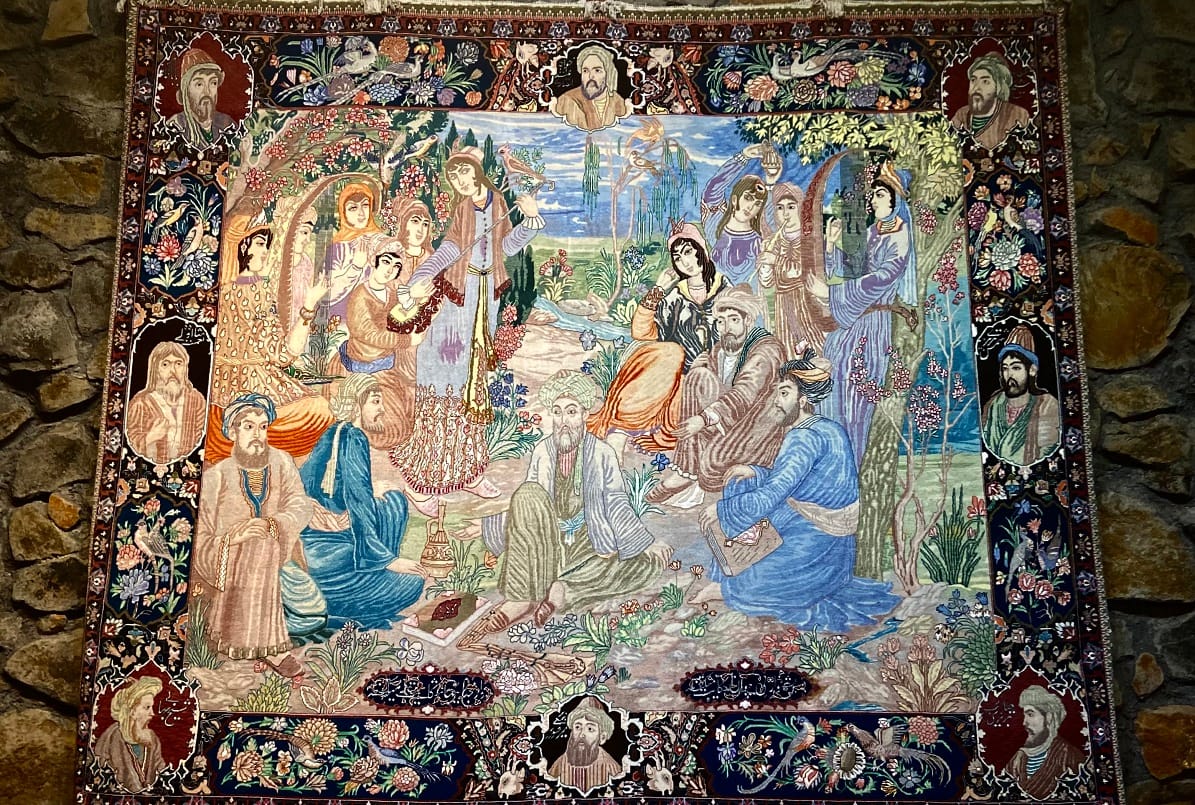
Persian hospitality: Connecting cultures through wine
Can ancient traditions of wine and hospitality bridge the divide between America and Iran?

As the United States and Iran spiral into the abyss of war, the gap of mutual hatred, suspicion and incomprehension that separates our cultures looms larger than ever. If we're going to bridge this divide and imagine a future of peace, we need to find something that unites us. Where better to start the conversation than over a bottle of wine?
Maysara Winery and Momtazi Vineyards (McMinnville, Oregon) ranks as the #23 winery in the world, in part, because it embodies the essence of Persian hospitality that has connected people for centuries. While many in the Western world might associate the sacred use of wine with Christian and Jewish rituals, the actual origin of wine, and biodynamic wine in particular, can be traced to Persia—modern-day Iran.
A Persian folktale illuminates wine’s mythical origins:
When a lady of the court lost the favor of the [mythical] King [Jamshid], she attempted to poison herself by consuming the juice of some spoiled table grapes. Soon, she started to feel intoxicated and drowsy and fell into a deep sleep. When the lady awoke, instead of feeling sick, she realized that the grapes made her feel relaxed and happy. When she informed the King about this, he was so delighted by her new “potion” that he ordered his kingdom to increase the production of spoiled grapes, which later began to be consumed as wine.
In his research, Dr. Patrick McGovern, scientific director of the Biomolecular Archaeology Project for Cuisine, Fermented Beverages, and Health at the University of Pennsylvania Museum in Philadelphia, lends credence to this folktale by documenting the archaeological evidence that wine originated in Persia: “Our earliest finding is that the Neolithic villagers of the northern Zagros Mountains of Iran were making wine and storing wine in some of the earliest pottery jars from the Middle East, ca. 5400 B.C. Chemical analysis of the residue of a Neolithic jar dating from as early as 5400–5000 BC indicates high levels of tartaric acid, again suggesting that the fluid contained therein had been made from grapes.”
Dr. McGovern has documented how fermented beverages, especially wine, have long played a crucial role in the transfer of culture from one people to another around the world. “As medicine, social lubricant, mind-altering substance, and highly valued commodity, wine became the focus of religious cults, pharmacopeias, cuisines, economies, and society,” he states.
According to Mo Momtazi, founder of Maysara Winery and Momtazi Vineyards, Persians like himself refer to wine as a living spirit that springs from the marriage of the sun and the earth. The grapevines that go down into the soil make this plant a prisoner of the earth, dependent on the soil for subsistence. But a grapevine is also a dreamer of the sky, with its vines reaching towards heaven and its flowers opening around the summer solstice.
Persian culture and biodynamic farming
In developing the concept of biodynamic farming, scientist and philosopher Rudolf Steiner (1861–1925) drew upon the works of the ancient Persian philosopher Zoroaster. These teachings viewed life as a struggle between the forces of light, goodness, and creation (aša) and those of darkness and evil (druj). For Steiner, mechanical farming practices such as the use of chemical fertilizers represented druj in that they cause the decline of both plant and animal health. Conversely, aša applies to farming which connects nature and spirit by integrating crops, livestock, and healthy plants into a fertile self-sustaining biosphere.
On his 500-acre farm, Momtazi carries on the traditions of his Persian ancestors and Steiner’s teachings. According to Momtazi, the first spirit is the universal spirit that’s existed since the beginning and brought forth the elements of hot, dry, cold, and wet. Hot and dry combined to make fire, cold and dry created soil, wet and cold produced water, and air is a combination of hot and wet.
The second spirit is the plant spirit, which gets light, heat, and air from the cosmos and minerality from the earth. Next are the animal spirits, which have the same properties as plant spirits but can make certain decisions on their own. Finally comes the human spirit, which is dependent on the first three spirits but also has the capacity to make decisions and create things from the earth such as wine.
As Momtazi reflected in the 2024 James Beard award-winning documentary SOMM: Cup of Salvation, "Wine is the sun’s radiance in liquid form."
Given Persian culture's belief that wine makes itself courtesy of the sun and soil, they don’t have a specific word for "winemaker." Having said that, the wine pourer was deemed a very important figure, as they were the ones who determined how much wine each person was to have. A wine pourer had to go through rigorous training in poetry, literature, and music in order to provide a fully immersive experience that incorporated all the senses, as well as the spirits.
The Persian spirit radiates from Maysara Winery and Momtazi Vineyards throughout the Willamette Valley and beyond. Momtazi sells his biodynamically farmed Pinot Noir grapes to 18 wineries, including Mark Vlossak at St. Innocent Winery (Jefferson, OR), who holds the distinction of making the first Momtazi Vineyard-designated Pinot Noir to sell nationally. Other winemakers producing award-winning wines from Momtazi’s Pinot Noir grapes include Corollary Wines (Amity, OR), Day Wines (Dundee, OR), Dobbes Family Winery (Dundee, OR), Folly of Man (Amity, OR), Nicholas-Jay Estate (Newberg, OR), Spoiled Dog Winery (Langley, WA), and Wildsound Wine (McMinnville, OR).
Momtazi continues the family's winemaking legacy, with his three daughters lending their unique talents to the business. Their eldest daughter, Tahmiene, serves as the head winemaker, with Naseem overseeing marketing and sales and Hanna managing their onsite events.
As I reported earlier for OnlySky, the Momtazi family pays their immigrant experience forward through their efforts to support Lutheran Community Services Northwest (LCSNW)’s Safe Route Program. Also, Momtazi continues his community connections by mentoring other winemakers such as Tracy Kendall, who co-founded Folly of Man with her husband Aaron. In Kendall's estimation, grapes from this vineyard build one of the most balanced, long-lived, and complex Oregon wines. “Momtazi Vineyard is one of Oregon’s most unique vineyards for Pinot Noir. No matter the vintage, there is always a feral quality to the wine, a wildness that is very unique,” she opines.
Those who can't visit Maysara Winery in person can check out SOMM-TV's curated selection of stories from Iran that include the Momtazi family. Pair these stories with a wine made from Momtazi Vineyard grapes and transform a wine tasting into a spiritual experience by taking a more embodied approach to wine. Look beyond the wine ratings, fancy labels, and other marketing maneuvers and PR hype designed to lure you into trying a specific trendy vintage. Instead, take the words of the poet Rumi to heart. Listen to how the Persian approach to wine can help connect us across cultures amid the turmoil in Iran.
Be a connoisseur,
and taste with caution.
Any wine will get you high.
Judge like a king, and choose the purest,
the ones unadulterated with fear,
or some urgency about “what’s needed.”
Drink the wine that moves you
as a camel moves when it’s been untied,
and is just ambling about.
Rumi, Mathnawi IV, 2683–96
