

Lab-grown meat: A cruelty-free carnivore future
Is lab-grown meat the answer to feeding the world with cruelty-free protein while reducing carbon emissions?

One of the perks of being a science and technology journalist is getting to see and try out innovations while they're still in the lab, before they become available to the general public. Food technology is one of my favorites in this regard.
One of my favorite future food moments was about fourteen years ago, when I sampled a vegetarian dish—pictured below—which was based on a recipe created by artificial intelligence and then cooked by a human chef. It was delicious! Since then, I have wondered what the future will bring to our table, and I welcome the opportunity to sample more innovations in food technology.

By 2050, according to the United Nations, the global population is projected to reach 9.7 billion. By the end of the century, that number could rise to 11 billion.
As humanity's population grows and the world becomes wealthier, millions of people in developing countries are moving up into the middle class. Many of these rising millions aspire to a Western diet, heavy on meat and dairy products.
However, as long as we rely on conventional agriculture, this is impossible. Already, the demand for beef, milk and other animal products is driving the widespread destruction of tropical forest so that the land can be used to raise cattle. Scarce water is being diverted to grow animal fodder in desert regions.
Even at present levels, meat production carries a huge environmental cost. There isn't enough land, water or energy on the planet to feed billions of people the way wealthy Americans are used to eating. Even if there were, it would cause ruinous carbon emissions.
To feed humanity in a sustainable way, food production will have to change dramatically. Fortunately, there are high-tech methods under development that aim to achieve precisely this.
Some of the contenders include cultured meat, cellular milk, vertical farming, alternative proteins such as insect protein, genetically modified crops, sustainable seafood, and 3D-printed foods. Startups in all these industries are aiming to advance rapidly to meet consumer demand.
The science of cultivated meat
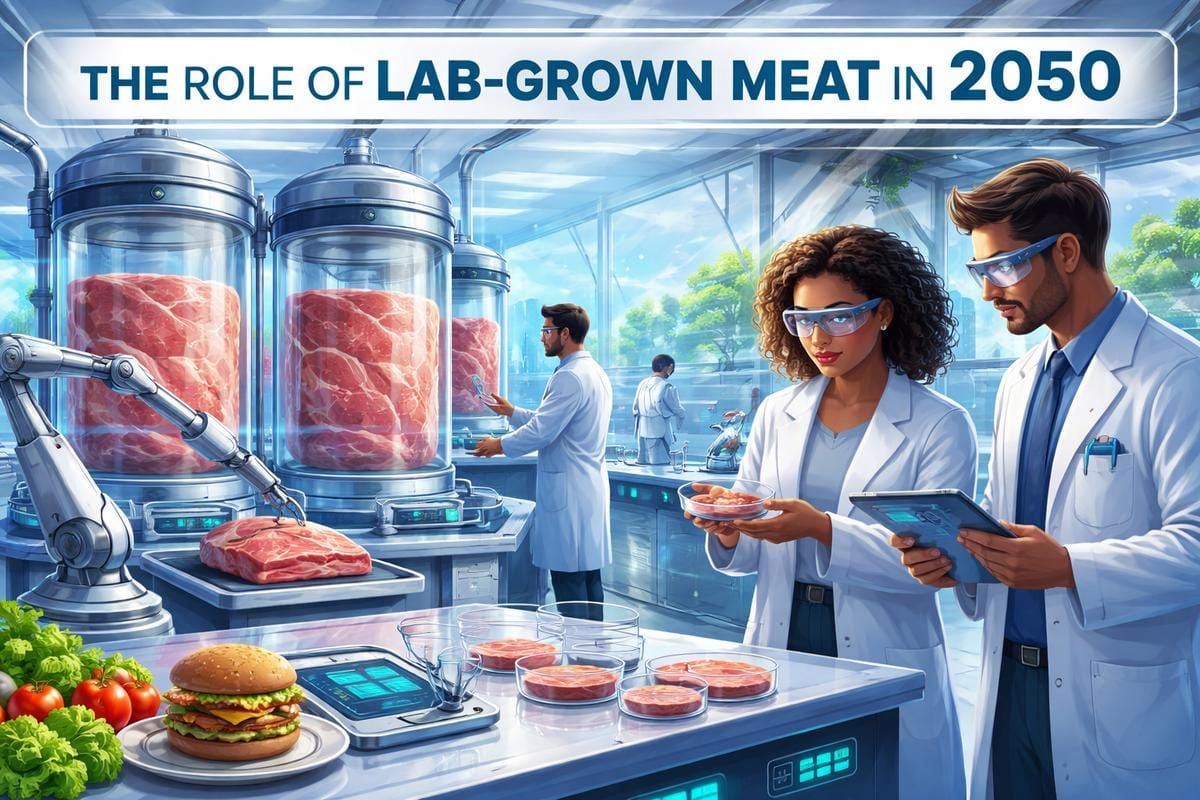
Of all the future food technologies under development, cultured meat and cellular milk are attracting the most attention. These products aim to be physically identical to the natural versions—the same taste, the same texture and the same nutritional profile—but produced in a laboratory, rather than on a farm. The goal is to mitigate the environmental impact of food production, supplying meat and dairy in a sustainable, low-carbon way.
Moreover, lab-grown meat is cruelty-free. For consumers that increasingly care about the ethics of how their food is produced, these products could provide better alternatives to factory farming and animal slaughter.
In order to produce lab-grown meat, food scientists take a small sample of animal stem cells. These cells are grown in bioreactors, which are large tanks that monitor and control temperature, pH, and oxygen supply. According to The Good Food Institute, the cells are nurtured in a broth that contains amino acids, vitamins, glucose, fats, and growth factors—all the nutrients required for them to multiply and form muscle and fat tissue. When the cells are done growing, they can simply be harvested, with no need to kill a living creature.
Cultivated meat moves from science to business
The cultivated meat industry aims to become mainstream by 2050. Food-technology startups around the world have been developing these products for the past two decades. Very soon, they'll be taking their products from the lab to a supermarket near you.
According to Green Queen Media, numerous cultivated meat startups are currently focused on scaling production, reducing costs, and navigating regulatory approvals. They're working on producing lab-grown alternatives to all types of animal products, from beef and pork, to chicken, to salmon and tuna.
Companies which have received regulatory clearance to sell cultivated meat for either humans or pets, and are planning on launching their products this year or next year, include Upside Foods, GOOD MEAT, Aleph Farms, and Clever Carnivore. In the United Kingdom, cultivated meat is expected to make its commercial debut by February 2027, appearing first in fine-dining restaurants and later in supermarkets.
Challenges to overcome before lab-grown meat wins mainstream acceptance
Of all the challenges facing lab-grown meat, the biggest hurdle is public acceptance. Customers wary of "Frankenfoods" will have to be convinced that cultivated meat is safe, environmentally responsible, and offers a comparable gastronomic experience to the real thing. Cost could also be a barrier to adoption, especially in the beginning stages, when lab-grown meat products will likely be most expensive.
Also, the commercial rollout of cultivated meat requires navigating a complex regulatory approval process. So far, startups have only reached this stage in a few countries, including Singapore, the United States, and Israel.
While cultured meat has the potential to be more sustainable, it's not an environmental panacea. Some studies warn that if bioreactors are not powered by renewable energy, the long-term impact on global climate could be as bad as or worse than traditional methods of raising livestock.
With all that said, cultivated meat is expected to be an essential part of sustainable agriculture by 2050. It will shift from an expensive, experimental alternative to a new normal in human diets.
The future of "real" meat vs. lab-grown meat
The best course of action for the planet will always be to eat more plants. From a thermodynamic standpoint, it's inherently less efficient to grow crops, feed them to animals, and then eat those animals, rather than just eating the food crops ourselves. Global adoption of plant-based diets would reduce land use for agriculture by as much as 75%, with comparable decreases in food-related carbon emissions.
However, given that humanity doesn't seem likely to give up on its habit of meat consumption any time in the foreseeable future, lab-grown meat may be the next-best compromise.
According to a report by consultancy AT Kearney, cultivated meat could supply 60% of meat consumption by 2040. As the technology matures and becomes cheaper and better, cultivated meat could eventually be seen as not just an alternative to traditionally produced meat, but an better and higher-quality product overall.
I personally believe that by 2100, animal sentience will be better understood and more widely acknowledged, leading humanity to adopt an animal-free food system. Human diets will look very different from today, with lab-grown cultured meat and plant-based alternatives becoming mainstream, in addition to custom-tailored forms of nutrition currently only available to dedicated biohackers.