
Do we dare journey into our AI future?
Storytelling that seeks to use technology to connect us, not isolate us in our own bubbles.

After attending three South by Southwest (SXSW) conferences over the years, two in person and one virtual, I concluded that I should remain unplugged from the seemingly fanciful—and often farcical—promises offered by AI. As messy as reality might be, I find myself gravitating more toward communities that are grassroots and genuine, not a more enhanced, glitzy, glamorous representation.
For example, I pride myself on listing my latest four books as "Human Author Certified" with the Authors Guild, where I'm a member. This marker serves as ontological proof that I penned my own prose and am speaking from my own authentic voice, in contrast to those influencers/content creators who seek to grab the reader's attention with artificial marketing memes.
So when I got a press release from the Portland Art Museum (PAM) about an AI group experience hosted by a company called the Smartphone Orchestra, I almost "circular filed" this news. Upon initial glance, the prospect of spending sixty minutes connecting with strangers via "playful, surprising, and occasionally profound group experiences" did not appeal to my post-COVID quest for authentic unwired connections. After all, I'm working to get off my smartphone. Why would I want to turn my device into a game controller, a guide, or a conversation starter?
Like lucid dreaming
But then I noticed that one of the performances was the same day as the press preview for the re-opening of the transformed PAM campus. I felt a slight stirring in my body telling me to just go. Give myself an all-day art experience even if I'm hesitant to label anything connected to AI as "artistic." So I signed up.
Surprisingly, the press preview prepped me for this admittedly unusual experience. As part of our tour of the museum's new Rothko Pavilion, we viewed a selection of exhibits designed to encourage visitors to engage with these pieces on a more profound level. Most tickled my eyes and caught my fancy, but they didn't capture my heart and spirit.
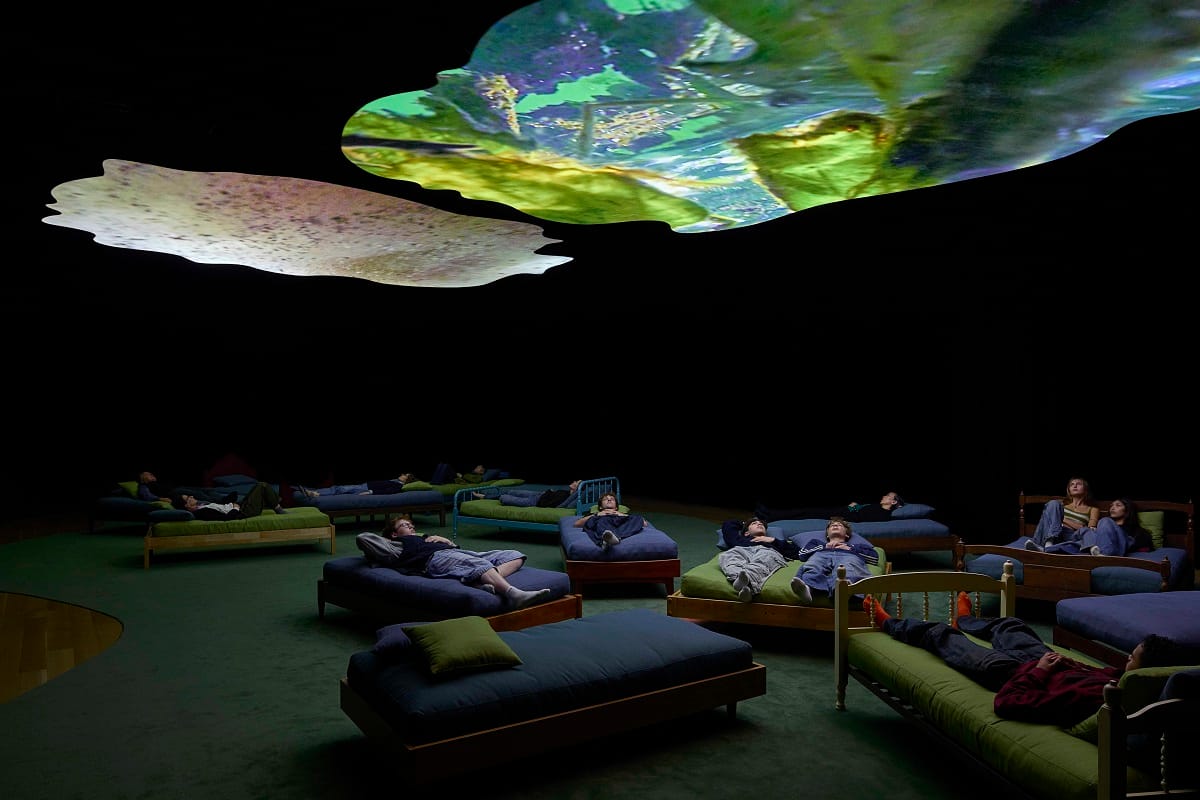
Then I entered a darkened room to experience Swiss video and installation artist Pipilotti Rist's work 4th Floor To Mildness. Lying on a bed staring at an evolving natural playscape, surrounded by a few other folks doing likewise, somehow connected me to this particular piece of art in a way that simply looking at a static painting did not. After my tour, I chose to return to this room until the end of the press preview. Over the next half hour or so, I felt myself engaging in what felt like lucid dreaming even though I'm certain I was awake. I wasn't plugged in virtually as was the case with other similar video installations I've experienced. But I could definitely tune out of the world and tune into some other dimension through a guided experience fueled by 21st-century technology.
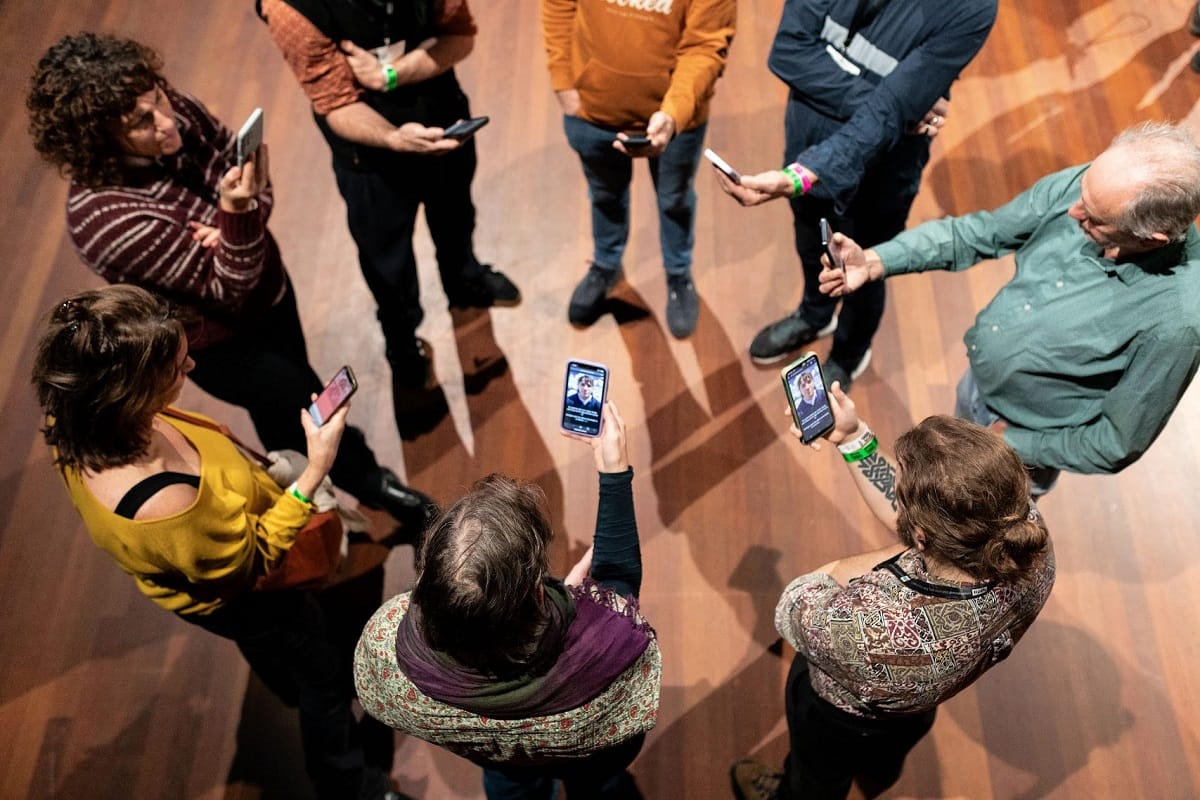
A few hours later I arrived for the West Coast Premiere of Dutch XR Collective Smart Phone Orchestra’s Ancestors: An Interactive Journey into the Future in a liquid state and a bit less skeptical. Guided by a soft-spoken female AI speculative storyteller, about fifty of us gathered for a journey six generations into the future.
Great-grandparents of a future human
After taking a selfie, we began connecting first in pairs, then in increasingly larger circles. In a city mischaracterized by protest and politics, hearing words like "empathy," "compassion," and "care" proved to be a balm to my soggy soul. Eventually, we all morphed into one big circle where we found ourselves to be the great-grandparents of a human born some two hundred years in the future. Collectively, we explored how our world shaped by technology and evolving social dynamics will continue to evolve, with a focus on how even one minor change we make today will continue to have ripple effects for generations.
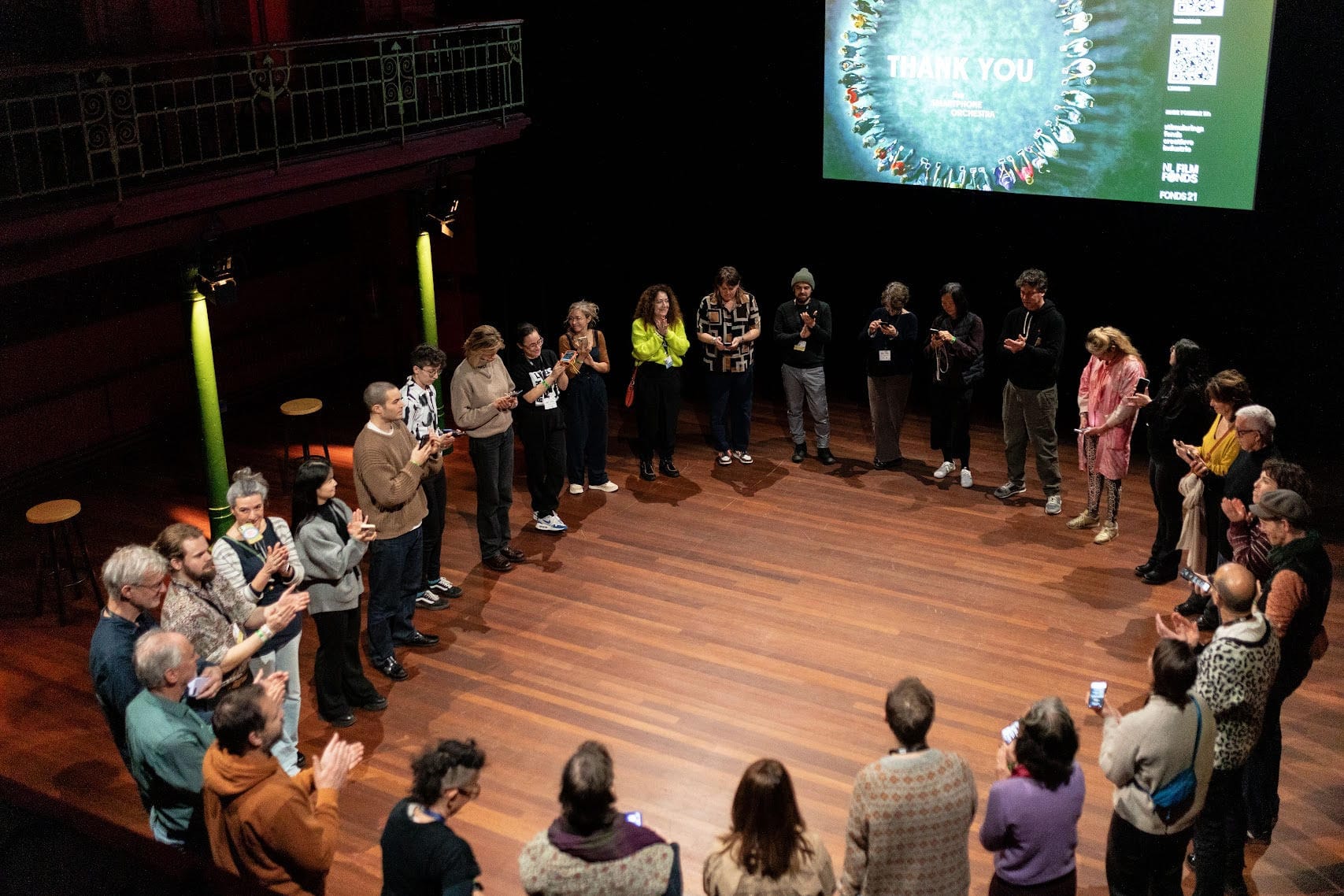
At the conclusion of our journey, we all departed more or less in silence. Nothing was said, so I can’t for certain know how others responded to this oddly familial journey. But I sensed the heavy-hearted energy I had been experiencing lately lifted somehow. Instead, I felt a profound sense of purpose that each one of us in that room possessed the potential to impact the future in small but profound ways.
In my professional capacity as a freelance writer, I've been in countless professional situations where I didn't know a soul and managed to make professional connections. But somehow this AI-informed encounter felt different. This guided form of AI storytelling using the very smartphone I'm trying to downplay in my life helped me connect to those in the room in a way that icebreakers and other introductory-type networking events simply did not.
Where we go from here, I don't know. My inner pessimist smirks that my post-AI buzz is yet another one of those retreat-type highs where everyone comes together for yet another personal growth experience. Like fast food, it may stop my hunger pains but it will never truly satisfy my soul.
Conversely, my ever-present optimist wonders what might happen if the initial sparks I felt during my Atmospheres experience could burn? Could this expand into my local community and beyond? Furthermore, once we begin this immersive participatory journey, can we continue walking to expand our world and our horizons or will we retreat into our own echo chambers?
Given we seem to be unable at this juncture to engage with those we view as political enemies, could AI help us to begin the process of weaving together the threads of our social fabric that have now become unraveled? Emphasis on the word "begin" as we've seen too many dystopian movies where robots take over the world. So in this reweaving, I hope we will continue to realize that as much as we may value the benefits technology affords us, we cannot disregard the value of touch in keeping us connected in community.
