
David Brooks wants to rebuild a humanistic culture
To rediscover our values, we first have to forge a new foundation for them.

In January, David Brooks, a columnist at the New York Times, wrote his farewell column. Brooks is taking a senior fellow position at Yale University. The first half of the column told Brooks’ familiar story of America’s spiritual collapse into a “sadder, meaner and more pessimistic country.” But, in the second half of the column, Brooks explains that he is leaving punditry “to try to build something new.” That “something new” turns out to be something quite old. Brooks is aiming at rebuilding a humanistic culture in America. But he tries to do this without acknowledging the Death of God.
It can’t be done that way.
Four decades of hyperindividualism
Before we can even listen to Brooks, it is necessary to remember aspects of his past he would rather forget. Brooks’ introduces the story of America’s decline with an attempt at humor. Brooks writes that he came to the Times 22 years ago to “promote a moderate conservative political philosophy.” He jokes that he has been so successful that moderate Republicans now dominate American politics.
Brooks is either a hypocrite or lacks all self-insight. There was nothing moderate about his political philosophy. Brooks describes America’s collapse of values as long predating the arrival of Donald Trump. He writes, “Four decades of hyperindividualism expanded individual choice but weakened bonds between people.” Four decades ago was 1986, just after the reelection of Ronald Reagan. Brooks strongly championed Reagan and never repudiated Reagan’s relentless attacks on all forms of human solidarity. Reagan was the poster boy for hyperindividualism. It would be nice to hear Brooks admit that his “moderate” Republicans destroyed the foundations of the Republic.
The story that Brooks tells of America’s spiritual decline absolves him of responsibility in another way as well. He writes that when he began his career as a columnist in 2003, America was still a confident place. Americans at that time had faith in their public institutions. The shocks since then have undermined that faith. Brooks lists these shocks as the Iraq War, the financial crisis of 2008, the disruptions of the Internet, the rise of China and the arrival of Donald Trump.
Brooks fails to mention that only one of the items on his list involved actual lies to the American people by their leaders—the war in Iraq. He also does not acknowledge that he was a prominent supporter of the Iraq invasion, while some of us were protesting against it in the streets. Brooks later called his support of the Iraq war a “misjudgment,” which is putting it mildly. If I made a misjudgment that colossal, I think I would reconsider a career choice of sharing my opinions.
America's humanistic core?
Aside from absolving himself, the story Brooks tells of how America got here is unexceptional. The loss of faith in American public life has led to cultural nihilism, which Brooks defines as “the mindset that says that whatever is lower is more real.” The cynic, “disillusioned by life” embraces a dog-eat-dog brutality and is willing to elect bullies that might protect us.
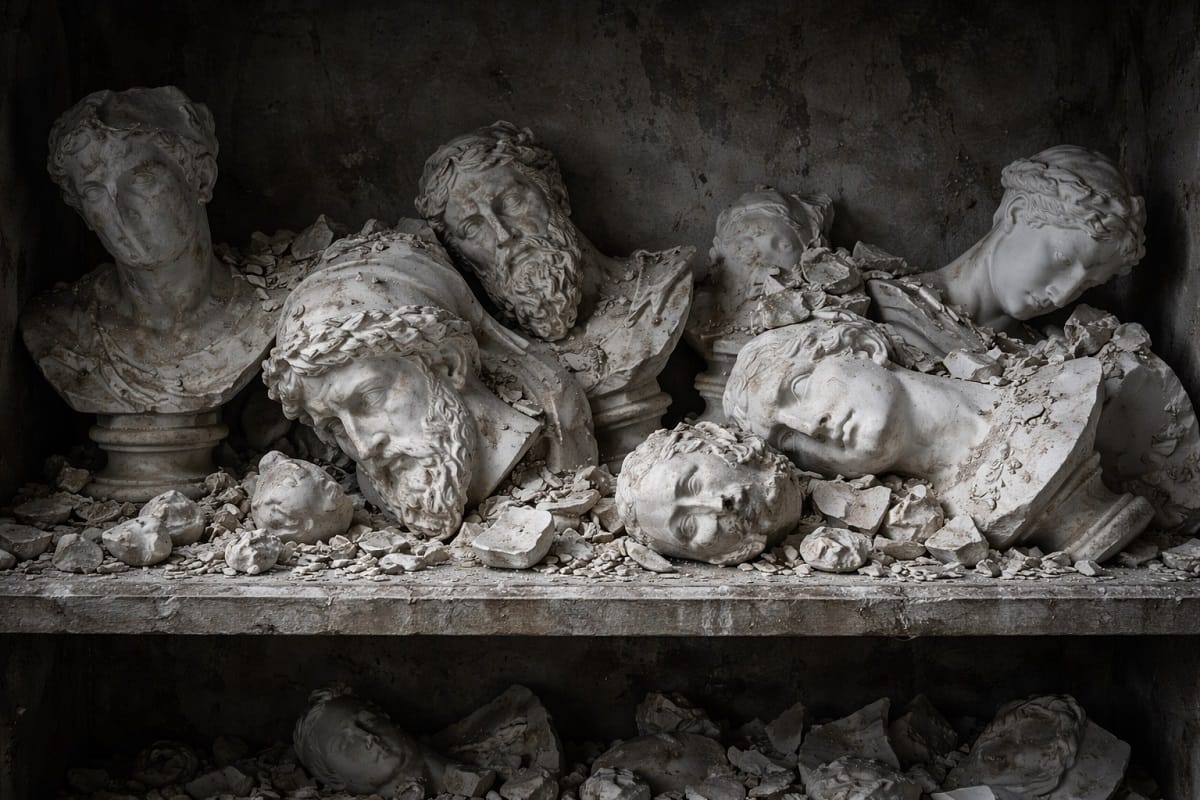
The result of this decline in values is that America abandoned its “humanistic core,” especially in higher education, which moved away from teaching the elements in our civilization that “lift the spirit, nurture empathy and orient the soul… religious devotion, theology, literature, art, history, philosophy.” Based on a critique of Western colonialism, with which Brooks concurs, universities abandoned the study of Western classics. But they did not substitute anything else. Students no longer learned that there was such a thing as truth and that debate and persuasion are supposed to help lead us to it. Politics, and life in general, came to be seen as “ruthless power competition.” Young people in America became “cultural orphans.” Instead of teaching the humanistic tradition, our universities emphasized training in the individual pursuit of money.
The consequence of this educational shift is that college students, especially at elite institutions, are adrift. In a recent survey, 58% of students at Harvard report “no sense of ‘purpose or meaning’ in their life.” Brooks reminds us that most people cannot “flourish in a meaningless, nihilistic universe.”
Brooks even has a response to those who say that none of this is a problem because people make their own meaning in life. He calls that response the “privatization of morality” and considers it to be a burden most people cannot sustain. A culture is a “shared moral order.” Brooks insists that “every healthy society rests on some shared conception of the sacred.” Only when that base of normative orientation toward reality is more or less stable can individuals begin their own exploration. A nihilistic culture inhibits the individual from seeking the meaning of life. Only if America can secure its “emotional, material and spiritual” base can we recover our best selves.
By invoking the concept of the sacred, Brooks is not limiting a healthy culture necessarily to one grounded in traditional religion. He mentions sacred heroes, texts and ideals. You could think here of George Washington and Abraham Lincoln. But this sense of the sacred must be shared for a culture to be healthy.
Brooks considers “true humanism” to be the antidote to nihilism. Brooks describes humanism as “anything that upholds the dignity of each person.” This humanism could be grounded in a religious tradition but would also include secular humanism. The way for America to resuscitate the Western humanist tradition, Brooks says, is through “the Great Conversation” about human flourishing that has taken place in the Humanities for over a thousand years. Universities are responding to our current morass by increasing course offerings that revisit this conversation. These courses include character development, civic training, reasoning when confronting the views of others, and practical advice on human flourishing. Brooks says he is going to “enlist” in this effort at Yale.
The past collapsed for a reason
Despite my criticisms of Brooks, I don’t much disagree with any of this. I teach a course at my law school in philosophy of law that encourages students to reflect on the meaning of their lives based on some of these same classic sources. But Brooks’ retreat to Western Civ classes is a little old hat, not just because of the need to diversify the Western canon by race, gender and geography—Brooks would agree with that—but because he leaves out science entirely.
That omission reveals a larger gap in Brooks’ thinking. Classic humanism in the West was built on a very particular metaphysics and ontology: That foundation was monotheism. A beneficent God created the ordered and knowable universe that Brooks’ Great Conversation aimed at exploring.
But that understanding of reality is no longer the glue that holds us together. Before the reconstruction of humanism that Brooks seeks can take place, humanism will have to be put on a new foundation—perhaps on the foundation of the question asked by the Canadian theologian Bernard Lonergan: Is the universe on our side? That question brings the sciences back to the table. A new foundation does not require the abandonment of all religious literature, of course. But it does call for their reexamination.
Brooks believes we can just retrieve the past. But the past collapsed for a reason.
Brooks is proposing a worthy goal. But his column is a reminder that building a new civilization on a secular foundation is going to be a difficult undertaking. Much more difficult than David Brooks appears to realize. It will take more than a few course offerings in Western Civilization.
