
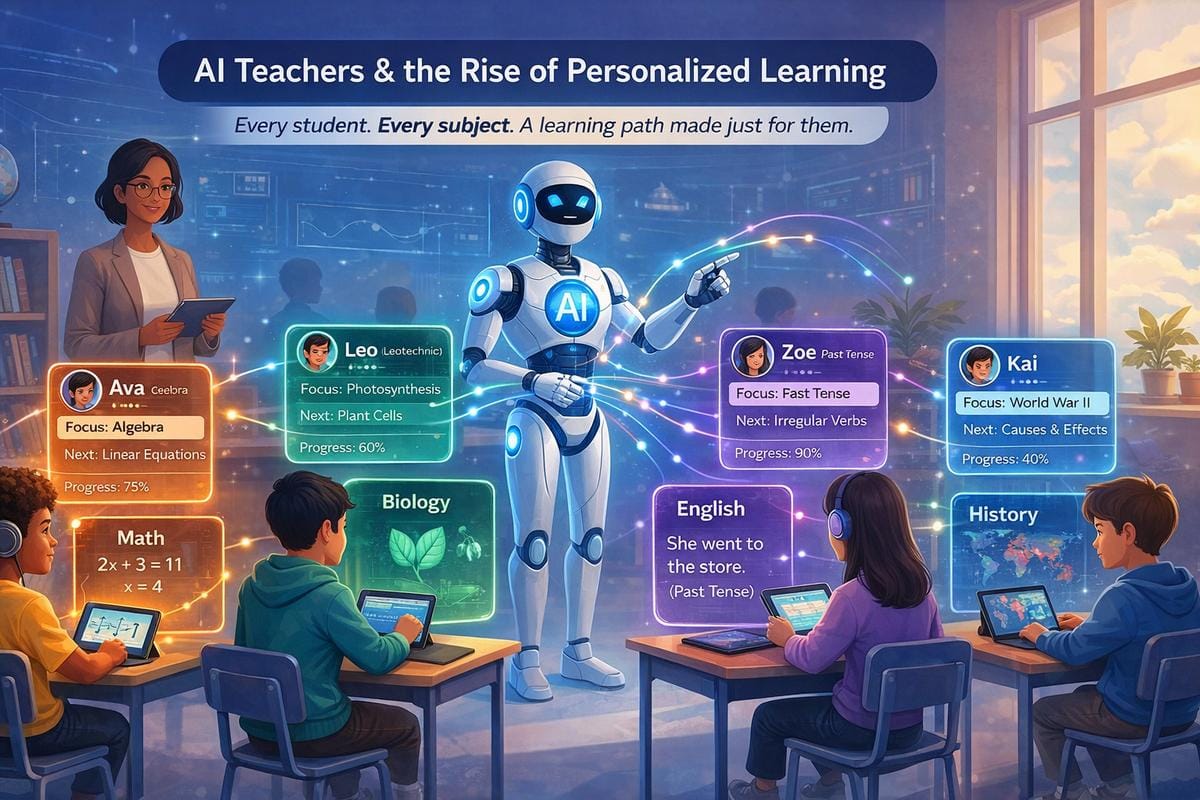
The future of education: AI teachers and personalized learning
Will AI tools help young people train for the jobs of tomorrow, or will students lose the ability to think critically and creatively?

Education is known for being sluggish in keeping up with change. However, even in the famously slow-paced environment of academia, technology is now bringing change faster than ever before.
In the last few years, pen and paper have been almost fully replaced by software, virtual learning environments (VLEs), and tools. These allow students and teachers to create visually enriched presentations, projects, and collaborations. Stacks of heavy notebooks and books have disappeared, replaced by e-books and tablets which allow for sharing schoolwork with teachers and collaborating with other students remotely (a tendency we mostly got used to since 2020), replacing the traditional study group meetings in the library. Social interaction with peers got lost along the way, though; but that's another story.
Most recently, the integration of AI in education is a trend we can’t ignore. Artificial intelligence—which is more than just ChatGPT and other generative large language models—is rapidly moving from experimental classroom tool to full-scale digital teaching assistant, capable of guiding, assessing, and supporting students individually, rather than treating education as an assembly line. The emerging vision of the future of education involves collaboration between AI and human educators. This kind of human teacher+machine collaboration creates highly personalized learning environments which adapt to each student’s pace, abilities, learning style, and goals.
As a former teacher, this sounds to me like a dream come true. Many education researchers believe that personalized learning could redefine schooling.
From one-size-fits-all to personalized learning
For centuries, most educational systems have relied on a one-size-fits-all model consisting of a teacher who delivers the same lesson/lecture to an entire classroom, regardless of differences in the students’ learning speed, ability, learning style, or interests. Many of us suffered from that model as students.
When I was a teacher, I witnessed firsthand how this approach failed some students to the point of them abandoning education for good, simply giving up when it was too much for them to keep up with the rest of the class. Those students, usually labeled as “bad students,” were, in reality, misunderstood; they were stereotyped as lazy or unintelligent simply because they had different learning styles. Sadly, their teachers failed to identify which learning style worked best for them, because doing that for every student in a large class takes time they didn't have. This is where an AI teacher's assistant could help.
AI-driven educational systems promise to change an archaic system into a personalized one that makes more sense. Personalized learning systems analyze data about how a student learns, including mistakes, response times, and conceptual understanding. Then the system adjusts dynamically. Intelligent tutoring systems can recommend exercises, explanations, or learning paths tailored to each student, improving motivation and delivering better results.
Learning styles and personalized learning
To understand why personalized learning is important, we need to know that students have different learning styles. This is part of our personality and how our brain works. The classification of learning styles refers to each student's preferred ways of absorbing, processing, and retaining information.
Learning styles include the following categories, known as the VARK types:
- Visual (prefers images, maps, and graphic organizers)
- Auditory (learns best through listening, lectures, and podcasts)
- Reading/writing (prefers text-based input such as books and reports)
- Kinesthetic (learns through physical activity, hands-on experiments, and movement)
Tailoring teaching to a single style is less effective than using mixed, flexible, and interactive methods. In spite of most of us being able to respond to a mix of styles, it is paramount to identify and respect each student’s primary learning style as the best approach for them. This is the true path to personalized learning.
Some skills might be disappearing
According to IBM Distinguished Engineer and Professor Jeff Crume, teachers and students need to embrace AI tools in order to elevate education. In the future, an AI tutor will help human teachers in the classroom, functioning as a teacher's assistant. At home, a personal AI tutor will explain and reinforce concepts at a student’s level, respecting that student’s primary learning style.
That sounds fantastic. Yet, there are a few human skills traditionally used in teaching and learning that might be on their way to extinction, namely handwriting and in particular cursive handwriting.
Crume says that schools are no longer teaching Gen Alphas how to write (or read) cursive, because everyone is typing on their devices instead. This is something I strongly disagree with, not only because I enjoy writing notes, summaries, and drafts in cursive, but also because I believe that if the younger generations are unable to write and read cursive, they will not be able to connect with information in historical documents. These skills are more than a link to the past; they're a way for humans to remain human.
JIT (just in time) education and AI teachers
Just in time (JIT) education refers to the process of acquiring skills or knowledge when they’re needed. It’s an on-demand approach that allows learners to access important information quickly and easily.
JIT education is where personalized learning and AI teachers come into play. An AI tutor has infinite patience. It can focus on, for instance, teaching mathematics to a student at the student’s pace and adapting the teaching to that individual student’s particular style of learning. An AI tutor doesn’t eliminate the human teacher; rather, it augments the teacher.
An AI tutor can serve as a teacher’s assistant by editing and marking assignments, leaving more time for the teacher to focus on the content of the assignments.
An AI tutor could also help teachers speed up time-consuming lesson planning to let the teacher focus more on the actual teaching, social skills, and human interaction with the students. Because it’s not all about technology and knowledge transfer; teachers also provide mentorship, emotional support, social learning, and identity formation. Those are human traits that AI can’t replicate.
Will AI education be a net gain or a net loss?
AI teachers and personalized learning represent a shift in how education will work going forward. As a matter of fact, AI could move from software into the physical realm—in other words, AI embedded in a robot, a large language model specifically trained as a teacher.
Research shows that AI has certain benefits in education, such as helping students with disabilities. An AI teacher can help students learn at their own pace, focusing on specific areas or interests, keeping them motivated by providing immediate feedback and support. One of the best features is that an AI teacher can offer 24/7 tutoring, so each student can learn at their most productive time. Imagine a future where every student in the world has their own dedicated private tutor!
In a traditional classroom, one teacher might handle 20 to 30 students as a group, but AI can enable something more like “one teacher + 30 personalized learning paths.” This model can improve engagement, retention, and learning outcomes, turning standardized delivery into adaptive experience.
Of course, we can’t ignore that AI isn’t all a rose garden. As with any other technology, there are some risks. To name the most obvious, we've heard many cases of students using AI to do assignments for them, eliminating the necessity of effort and preventing them from developing their own creativity, critical thinking and researching skills. If AI does the thinking for you, the logical consequence is that you don’t develop the skill of thinking yourself.
When AI assistance is omnipresent, educational systems may be forced to rethink testing assessment entirely, since the line between assistance and cheating might become blurred. It’s here where the role of the human teacher must emphasize and reinforce values such as honesty, responsibility, and trust.
All in all, human teachers must be a source of inspiration. They must continue to handle ethics, critical thinking, emotional intelligence, and social dynamics, while AI can handle repetition, grading, adaptive exercises, and data insights that the human teacher can use.
With great power comes great responsibility
Lots of startups are launching AI-powered learning, but how many of their products are truly delivering on the promise of personalized learning? Some systems just adjust the level of difficulty or recommend superficial variations in content. Personalized learning requires deep data on students—behavior, performance, even cognitive patterns. Collecting that data raises ethical concerns as well.
Perhaps the real disruption is not technological, but philosophical: If everyone learns differently, why do we still teach the same way? There is no doubt that now more than ever, the inefficiency of traditional education systems is exposed and in need of fixing. Personalized learning isn't a brand-new concept; it existed before AI entered the first classroom. What AI is truly doing is making it unavoidable.
There is little doubt that AI is a game changer in education, as long as it’s ethically and cautiously incorporated. If educational institutions don’t incorporate these tools in the near future, today’s students will not be prepared for the world of tomorrow, where AI will be as common as a computer or a calculator are today.
